

Volume 36, Issue 257 (5-2026)
J Mazandaran Univ Med Sci 2026, 36(257): 189-199 |
Back to browse issues page



Download citation:
BibTeX | RIS | EndNote | Medlars | ProCite | Reference Manager | RefWorks
Send citation to:


BibTeX | RIS | EndNote | Medlars | ProCite | Reference Manager | RefWorks
Send citation to:
Malayen S, Yousefi Ghand Ali N, Shahhosseini Z. Ethical Considerations in Assisted Reproductive Techniques: A Scoping Review. J Mazandaran Univ Med Sci 2026; 36 (257) :189-199
URL: http://jmums.mazums.ac.ir/article-1-22534-en.html
URL: http://jmums.mazums.ac.ir/article-1-22534-en.html


Abstract: (233 Views)
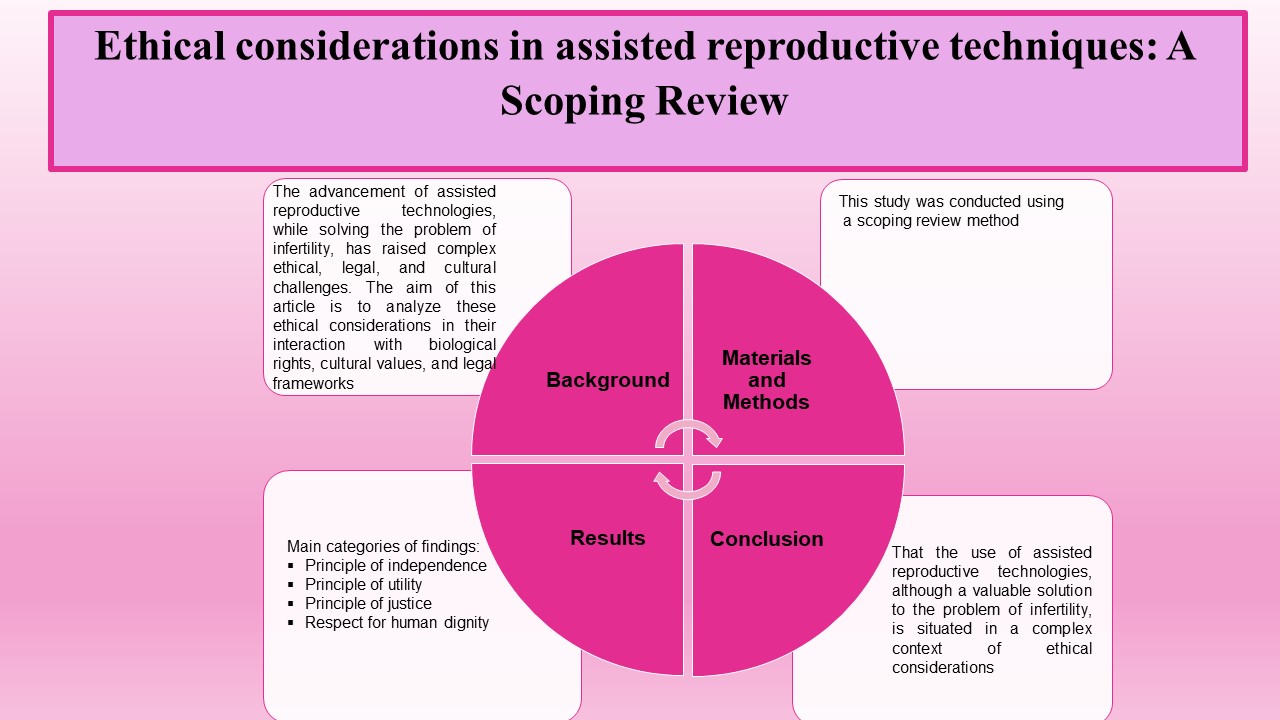
Background and purpose: Fertility has long been recognized as a fundamental aspect of human life because of its role in the continuation of generations and the fulfillment of parenthood. Significant advances in assisted reproductive technologies (ARTs) have enabled many infertile couples to become parents. However, these advances have also raised complex ethical questions and challenges. This article aims to examine and analyze these ethical considerations in relation to reproductive rights, cultural values, and legal frameworks.
Materials and methods: This study was conducted as a scoping review. The review process included formulating the research question, identifying and retrieving relevant studies, selecting eligible studies, charting the data, and reporting the findings. The literature search was conducted in PubMed, Scopus, Web of Science (WOS), Scientific Information Database (SID), and Google Scholar using keywords such as "surrogacy," "medical ethics," "ethical considerations," "assisted reproduction," "gamete donation," "infertility," and "embryo donation," either individually or in combination, and in both Persian and English.
Results: Following the database search, 16 eligible articles were selected, reviewed, and analyzed. The findings were organized into four main categories: (1) autonomy and reproductive decision-making; (2) beneficence and non-maleficence; (3) justice and equitable access to reproductive services; and (4) respect for human dignity and privacy.
Conclusion: According to the findings of the reviewed studies, the use of assisted reproductive technologies, although an important and valuable approach for addressing infertility, occurs within a complex ethical framework. Neglecting these ethical considerations may lead to significant individual and social consequences. Therefore, careful attention to ethical principles is essential for the responsible implementation of ARTs in clinical practice and policy development.
Materials and methods: This study was conducted as a scoping review. The review process included formulating the research question, identifying and retrieving relevant studies, selecting eligible studies, charting the data, and reporting the findings. The literature search was conducted in PubMed, Scopus, Web of Science (WOS), Scientific Information Database (SID), and Google Scholar using keywords such as "surrogacy," "medical ethics," "ethical considerations," "assisted reproduction," "gamete donation," "infertility," and "embryo donation," either individually or in combination, and in both Persian and English.
Results: Following the database search, 16 eligible articles were selected, reviewed, and analyzed. The findings were organized into four main categories: (1) autonomy and reproductive decision-making; (2) beneficence and non-maleficence; (3) justice and equitable access to reproductive services; and (4) respect for human dignity and privacy.
Conclusion: According to the findings of the reviewed studies, the use of assisted reproductive technologies, although an important and valuable approach for addressing infertility, occurs within a complex ethical framework. Neglecting these ethical considerations may lead to significant individual and social consequences. Therefore, careful attention to ethical principles is essential for the responsible implementation of ARTs in clinical practice and policy development.
Type of Study: Review |
Subject:
Medical Ethics
Send email to the article author
| Rights and permissions | |
 |
This work is licensed under a Creative Commons Attribution-NonCommercial 4.0 International License. |

Articles Copyright © The Author(s). Owned by Mazandaran University of Medical Sciences.
Contact Us
Address: Journal Office, Building No. 2, Mazandaran University of Medical Sciences, Moallem Square, Sari.Tel: +98 (011)34484874 Postal code: 48175-866 E-Mail: jmums@mazums.ac.ir Telefax: +98 (011)33262679
