

Volume 36, Issue 257 (5-2026)
J Mazandaran Univ Med Sci 2026, 36(257): 74-83 |
Back to browse issues page



Download citation:
BibTeX | RIS | EndNote | Medlars | ProCite | Reference Manager | RefWorks
Send citation to:


BibTeX | RIS | EndNote | Medlars | ProCite | Reference Manager | RefWorks
Send citation to:
Toghani F, Mirzaian B. The Effectiveness of Cognitive Behavioral Stress Management on Psychological Well-Being and Body Image-Related Fear in Iranian Women with Breast Cancer: A Randomized Controlled Trial. J Mazandaran Univ Med Sci 2026; 36 (257) :74-83
URL: http://jmums.mazums.ac.ir/article-1-22673-en.html
URL: http://jmums.mazums.ac.ir/article-1-22673-en.html


Abstract: (282 Views)
Background and purpose: Breast cancer is the most frequently diagnosed cancer among women worldwide and is associated with numerous physical and psychological challenges. The purpose of this study was to investigate the impact of Cognitive-Behavioral Stress Management (CBSM) on psychological well-being and body image-related fear among women with early-stage breast cancer living in northern Iran.
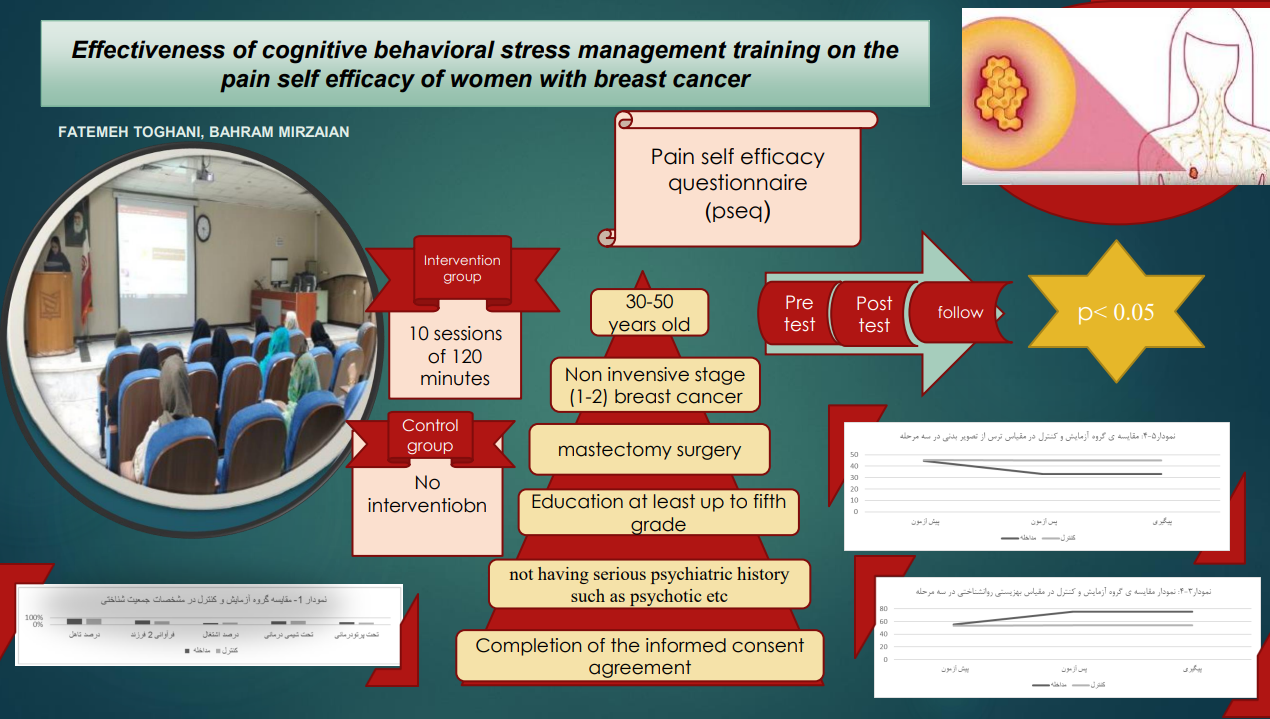
Materials and methods: This parallel-group, single-blind randomized controlled trial included 30 women aged 30-50 years with early-stage (I-II) breast cancer. Participants were recruited through convenience sampling and randomly allocated, using simple randomization in a 1:1 ratio, to either the intervention or control group. The intervention consisted of ten 120-minute CBSM sessions delivered to the intervention group. The study was conducted during the summer of 1402 (2023) in the conference hall of Imam Khomeini Hospital in Sari, Iran. Psychological well-being was assessed using the 18-item Ryff Scale of Psychological Well-Being (RSPWB-18), and body image-related fear was measured using the Body Image Concern Inventory (BICI). Outcomes were evaluated at baseline, immediately after the intervention (post-test), and at a one-month follow-up. Repeated-measures ANOVA and Bonferroni post hoc correction were used to analyze the data.
Results: CBSM significantly improved psychological well-being and reduced body image-related fear (p ≤ 0.05). The mean psychological well-being score increased by 19.9 ± 1.9 points, while the mean body image fear score decreased by 11.8 ± 1.8 points from pre-test to post-test. Effect sizes were large (partial η² = 0.86 for psychological well-being and 0.63 for body image-related fear). No significant differences were observed between the post-test and one-month follow-up assessments, suggesting that the intervention effects were maintained over the short term.
Conclusion: Cognitive-Behavioral Stress Management demonstrated beneficial short-term effects on psychological well-being and body image-related fear among women with early-stage breast cancer in northern Iran. These findings suggest that CBSM may serve as an effective supportive intervention for improving psychological adjustment in this population.
Clinical Trials Registry Number: IRCT20240712062397N1
Materials and methods: This parallel-group, single-blind randomized controlled trial included 30 women aged 30-50 years with early-stage (I-II) breast cancer. Participants were recruited through convenience sampling and randomly allocated, using simple randomization in a 1:1 ratio, to either the intervention or control group. The intervention consisted of ten 120-minute CBSM sessions delivered to the intervention group. The study was conducted during the summer of 1402 (2023) in the conference hall of Imam Khomeini Hospital in Sari, Iran. Psychological well-being was assessed using the 18-item Ryff Scale of Psychological Well-Being (RSPWB-18), and body image-related fear was measured using the Body Image Concern Inventory (BICI). Outcomes were evaluated at baseline, immediately after the intervention (post-test), and at a one-month follow-up. Repeated-measures ANOVA and Bonferroni post hoc correction were used to analyze the data.
Results: CBSM significantly improved psychological well-being and reduced body image-related fear (p ≤ 0.05). The mean psychological well-being score increased by 19.9 ± 1.9 points, while the mean body image fear score decreased by 11.8 ± 1.8 points from pre-test to post-test. Effect sizes were large (partial η² = 0.86 for psychological well-being and 0.63 for body image-related fear). No significant differences were observed between the post-test and one-month follow-up assessments, suggesting that the intervention effects were maintained over the short term.
Conclusion: Cognitive-Behavioral Stress Management demonstrated beneficial short-term effects on psychological well-being and body image-related fear among women with early-stage breast cancer in northern Iran. These findings suggest that CBSM may serve as an effective supportive intervention for improving psychological adjustment in this population.
Clinical Trials Registry Number: IRCT20240712062397N1
Keywords: Breast Cancer, Body Image, Psychological Well-Being, Cognitive Behavioral Therapy, Stress Management
Type of Study: Research(Original) |
Subject:
psychology
Send email to the article author
| Rights and permissions | |
 |
This work is licensed under a Creative Commons Attribution-NonCommercial 4.0 International License. |

Articles Copyright © The Author(s). Owned by Mazandaran University of Medical Sciences.
Contact Us
Address: Journal Office, Building No. 2, Mazandaran University of Medical Sciences, Moallem Square, Sari.Tel: +98 (011)34484874 Postal code: 48175-866 E-Mail: jmums@mazums.ac.ir Telefax: +98 (011)33262679
