

Volume 36, Issue 257 (5-2026)
J Mazandaran Univ Med Sci 2026, 36(257): 200-212 |
Back to browse issues page



Download citation:
BibTeX | RIS | EndNote | Medlars | ProCite | Reference Manager | RefWorks
Send citation to:


BibTeX | RIS | EndNote | Medlars | ProCite | Reference Manager | RefWorks
Send citation to:
Yazdani Charati J, Soltani A, Alinasab Z. Climate Change and Health System Resilience: A Scoping Review of Management and Policy Strategies. J Mazandaran Univ Med Sci 2026; 36 (257) :200-212
URL: http://jmums.mazums.ac.ir/article-1-22711-en.html
URL: http://jmums.mazums.ac.ir/article-1-22711-en.html


Abstract: (252 Views)
Background and purpose: Climate change, as a major global threat, has increasingly placed health systems under pressure, and the need for resilience has become critical. This scoping review aimed to synthesize existing management and policy strategies to enhance health system resilience to climate-related risks.
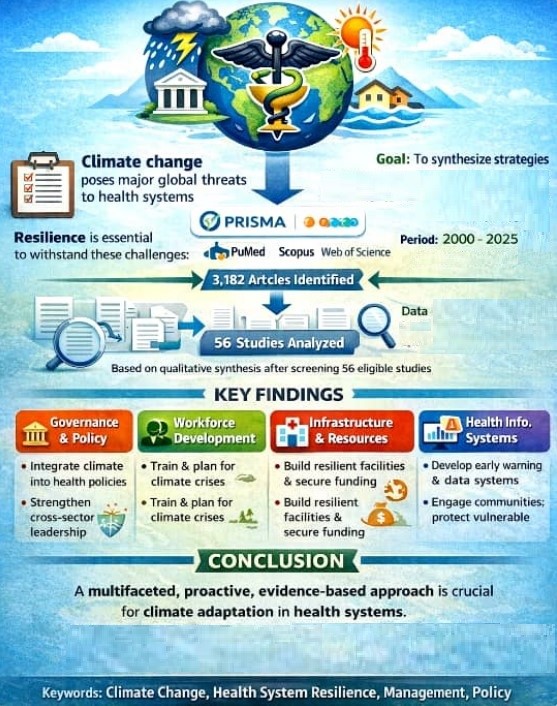
Materials and methods: A scoping review was conducted in accordance with the PRISMA-ScR guidelines. A systematic search was conducted in the PubMed, Scopus, and Web of Science databases for studies published between 2000 and 2025. Inclusion criteria were defined as studies addressing management or policy strategies for health system resilience to climate hazards. After screening, data from 56 eligible studies were extracted and synthesized using qualitative content analysis.
Results: Qualitative analysis of 56 studies identified five key strategic areas: 1. Strengthening governance and policymaking: Integrating climate considerations into national health policies, strengthening leadership, and enhancing intersectoral coordination. 2. Human resource development: Training and empowering health workers to respond to climate-related crises, alongside workforce planning. 3. Improving infrastructure and resources: Designing resilient facilities, ensuring sustainable supply chains, and allocating dedicated funding. 4. Strengthening health information systems: Developing early warning systems and integrating climate-health data. 5. Promoting social participation and equity: Engaging local communities and paying special attention to vulnerable groups. The findings suggest that effective implementation depends on an integrated and coordinated approach across all five domains.
Conclusion: Health system resilience to climate change is a multidimensional issue that requires a shift from reactive responses to proactive, strategic, and evidence-informed planning. Effective strategies should simultaneously address governance, human resources, infrastructure, information systems, and social participation. This review synthesizes an evidence-based framework for policymakers and health system managers and emphasizes the need for future research to assess the real-world effectiveness and implementation of these strategies across different contexts.
Materials and methods: A scoping review was conducted in accordance with the PRISMA-ScR guidelines. A systematic search was conducted in the PubMed, Scopus, and Web of Science databases for studies published between 2000 and 2025. Inclusion criteria were defined as studies addressing management or policy strategies for health system resilience to climate hazards. After screening, data from 56 eligible studies were extracted and synthesized using qualitative content analysis.
Results: Qualitative analysis of 56 studies identified five key strategic areas: 1. Strengthening governance and policymaking: Integrating climate considerations into national health policies, strengthening leadership, and enhancing intersectoral coordination. 2. Human resource development: Training and empowering health workers to respond to climate-related crises, alongside workforce planning. 3. Improving infrastructure and resources: Designing resilient facilities, ensuring sustainable supply chains, and allocating dedicated funding. 4. Strengthening health information systems: Developing early warning systems and integrating climate-health data. 5. Promoting social participation and equity: Engaging local communities and paying special attention to vulnerable groups. The findings suggest that effective implementation depends on an integrated and coordinated approach across all five domains.
Conclusion: Health system resilience to climate change is a multidimensional issue that requires a shift from reactive responses to proactive, strategic, and evidence-informed planning. Effective strategies should simultaneously address governance, human resources, infrastructure, information systems, and social participation. This review synthesizes an evidence-based framework for policymakers and health system managers and emphasizes the need for future research to assess the real-world effectiveness and implementation of these strategies across different contexts.
Type of Study: Review |
Subject:
Health Services Management
Send email to the article author
| Rights and permissions | |
 |
This work is licensed under a Creative Commons Attribution-NonCommercial 4.0 International License. |

Articles Copyright © The Author(s). Owned by Mazandaran University of Medical Sciences.
Contact Us
Address: Journal Office, Building No. 2, Mazandaran University of Medical Sciences, Moallem Square, Sari.Tel: +98 (011)34484874 Postal code: 48175-866 E-Mail: jmums@mazums.ac.ir Telefax: +98 (011)33262679
