

Volume 36, Issue 257 (5-2026)
J Mazandaran Univ Med Sci 2026, 36(257): 84-97 |
Back to browse issues page


Download citation:
BibTeX | RIS | EndNote | Medlars | ProCite | Reference Manager | RefWorks
Send citation to:


BibTeX | RIS | EndNote | Medlars | ProCite | Reference Manager | RefWorks
Send citation to:
khoshgoeain T, Mirzaian B, bahar A. Effects of Group-Based Cognitive-Behavioral Therapy on Psychological Distress, Self-Care Behaviours, and Dysfunctional Beliefs in Patients with Type 2 Diabetes. J Mazandaran Univ Med Sci 2026; 36 (257) :84-97
URL: http://jmums.mazums.ac.ir/article-1-22771-en.html
URL: http://jmums.mazums.ac.ir/article-1-22771-en.html


Abstract: (252 Views)
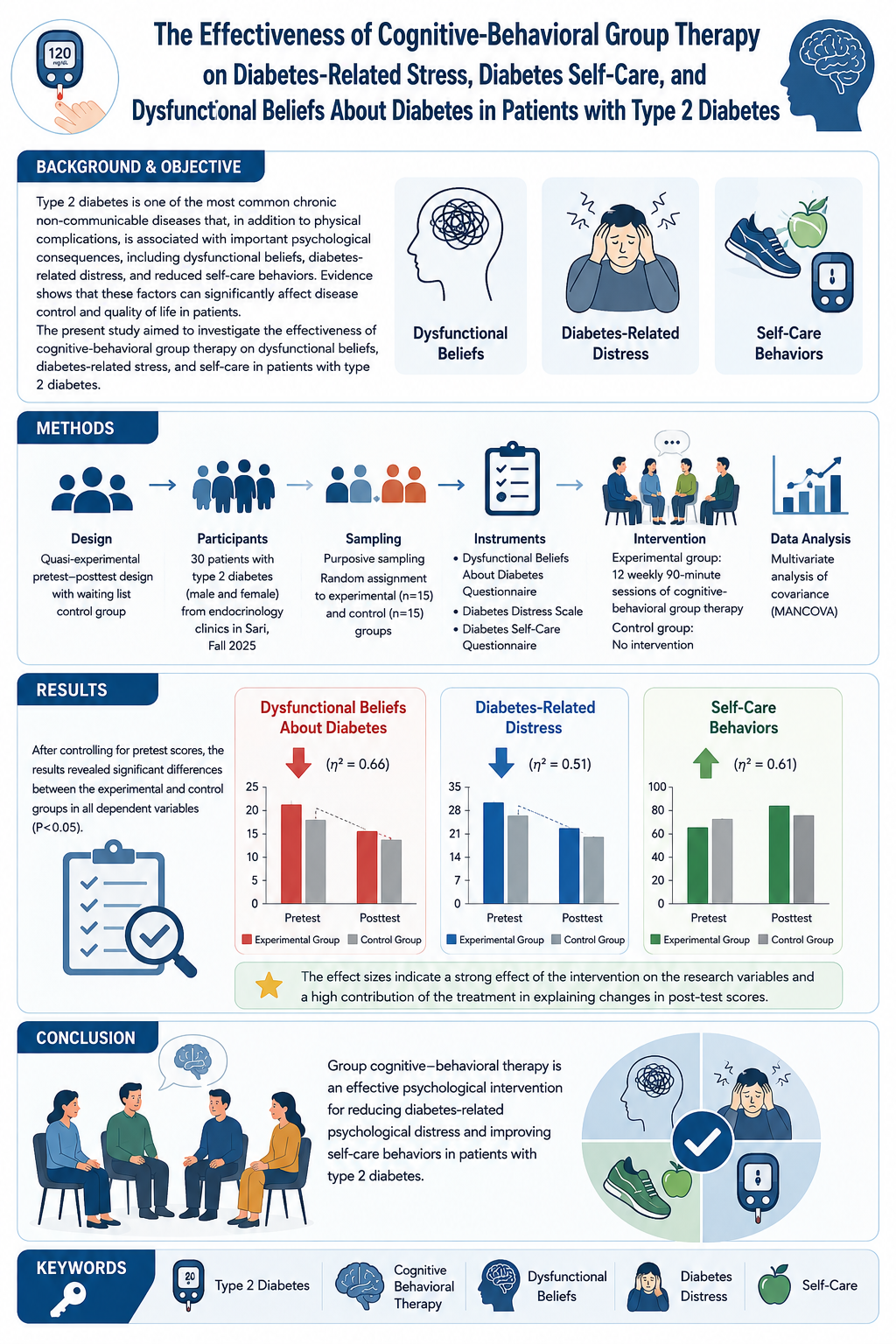
Background and purpose: Type 2 diabetes is one of the most prevalent chronic non-communicable diseases and is associated not only with physical complications but also with significant psychological consequences, including dysfunctional beliefs, diabetes-related distress, and reduced engagement in self-care behaviours. Evidence suggests that these factors are associated with poorer glycaemic control and reduced quality of life. This study aimed to examine the effectiveness of a group-based cognitive-behavioural therapy (CBT) intervention on dysfunctional beliefs, diabetes-related distress, and self-care behaviours in individuals with type 2 diabetes.
Materials and methods: This quasi-experimental study employed a pretest–posttest control group design with a wait-list control condition. The study population comprised patients with type 2 diabetes attending specialised endocrinology clinics in Sari, Iran, during autumn 2025. A total of 30 participants were selected using purposive sampling based on eligibility criteria and were then randomly allocated to either the experimental or control group (15 participants per group). The research instruments included the Dysfunctional Beliefs About Diabetes Questionnaire, the Diabetes Distress Scale, and the Diabetes Self-Care Questionnaire. The intervention group received twelve weekly 90-minute group CBT sessions, while the control group received no intervention during the study period. Data were analysed using multivariate analysis of covariance (MANCOVA).
Results: After adjusting for baseline scores, there were statistically significant differences between the groups across all outcome variables (P< 0.05). The intervention group demonstrated a significant reduction in dysfunctional beliefs about diabetes (η² = 0.66) and diabetes-related distress (η² = 0.51), as well as a significant improvement in self-care behaviours (η² = 0.61). Effect sizes indicated a large intervention effect across all outcomes.
Conclusion: Group-based cognitive-behavioural therapy is an effective intervention for reducing maladaptive diabetes-related cognitions and psychological distress, while improving self-care behaviours in individuals with type 2 diabetes. These findings support the integration of structured psychological interventions within routine diabetes care.
(Clinical Trials Registry Number: IRCT 20260224068938N1)
Materials and methods: This quasi-experimental study employed a pretest–posttest control group design with a wait-list control condition. The study population comprised patients with type 2 diabetes attending specialised endocrinology clinics in Sari, Iran, during autumn 2025. A total of 30 participants were selected using purposive sampling based on eligibility criteria and were then randomly allocated to either the experimental or control group (15 participants per group). The research instruments included the Dysfunctional Beliefs About Diabetes Questionnaire, the Diabetes Distress Scale, and the Diabetes Self-Care Questionnaire. The intervention group received twelve weekly 90-minute group CBT sessions, while the control group received no intervention during the study period. Data were analysed using multivariate analysis of covariance (MANCOVA).
Results: After adjusting for baseline scores, there were statistically significant differences between the groups across all outcome variables (P< 0.05). The intervention group demonstrated a significant reduction in dysfunctional beliefs about diabetes (η² = 0.66) and diabetes-related distress (η² = 0.51), as well as a significant improvement in self-care behaviours (η² = 0.61). Effect sizes indicated a large intervention effect across all outcomes.
Conclusion: Group-based cognitive-behavioural therapy is an effective intervention for reducing maladaptive diabetes-related cognitions and psychological distress, while improving self-care behaviours in individuals with type 2 diabetes. These findings support the integration of structured psychological interventions within routine diabetes care.
(Clinical Trials Registry Number: IRCT 20260224068938N1)
Keywords: Type 2 diabetes, cognitive-behavioral therapy, dysfunctional beliefs, diabetes distress, self-care
Type of Study: Research(Original) |
Subject:
psychology
Send email to the article author
| Rights and permissions | |
 |
This work is licensed under a Creative Commons Attribution-NonCommercial 4.0 International License. |

Articles Copyright © The Author(s). Owned by Mazandaran University of Medical Sciences.
Contact Us
Address: Journal Office, Building No. 2, Mazandaran University of Medical Sciences, Moallem Square, Sari.Tel: +98 (011)34484874 Postal code: 48175-866 E-Mail: jmums@mazums.ac.ir Telefax: +98 (011)33262679
