

Volume 36, Issue 260 (9-2026)
J Mazandaran Univ Med Sci 2026, 36(260): 229-233 |
Back to browse issues page



Download citation:
BibTeX | RIS | EndNote | Medlars | ProCite | Reference Manager | RefWorks
Send citation to:


BibTeX | RIS | EndNote | Medlars | ProCite | Reference Manager | RefWorks
Send citation to:
Shirzad R. Unilateral Graves' Disease: A Rare Cause of Hyperthyroidism. J Mazandaran Univ Med Sci 2026; 36 (260) :229-233
URL: http://jmums.mazums.ac.ir/article-1-22977-en.html
URL: http://jmums.mazums.ac.ir/article-1-22977-en.html


Abstract: (29 Views)
Background and purpose: Graves’ disease is the most common cause of hyperthyroidism and typically presents with diffuse, bilateral involvement of the thyroid gland. However, unilateral involvement is extremely rare, and its atypical presentation can make diagnosis challenging, requiring careful clinical and imaging evaluation. This rare presentation highlights the importance of diagnostic accuracy and clinical vigilance.
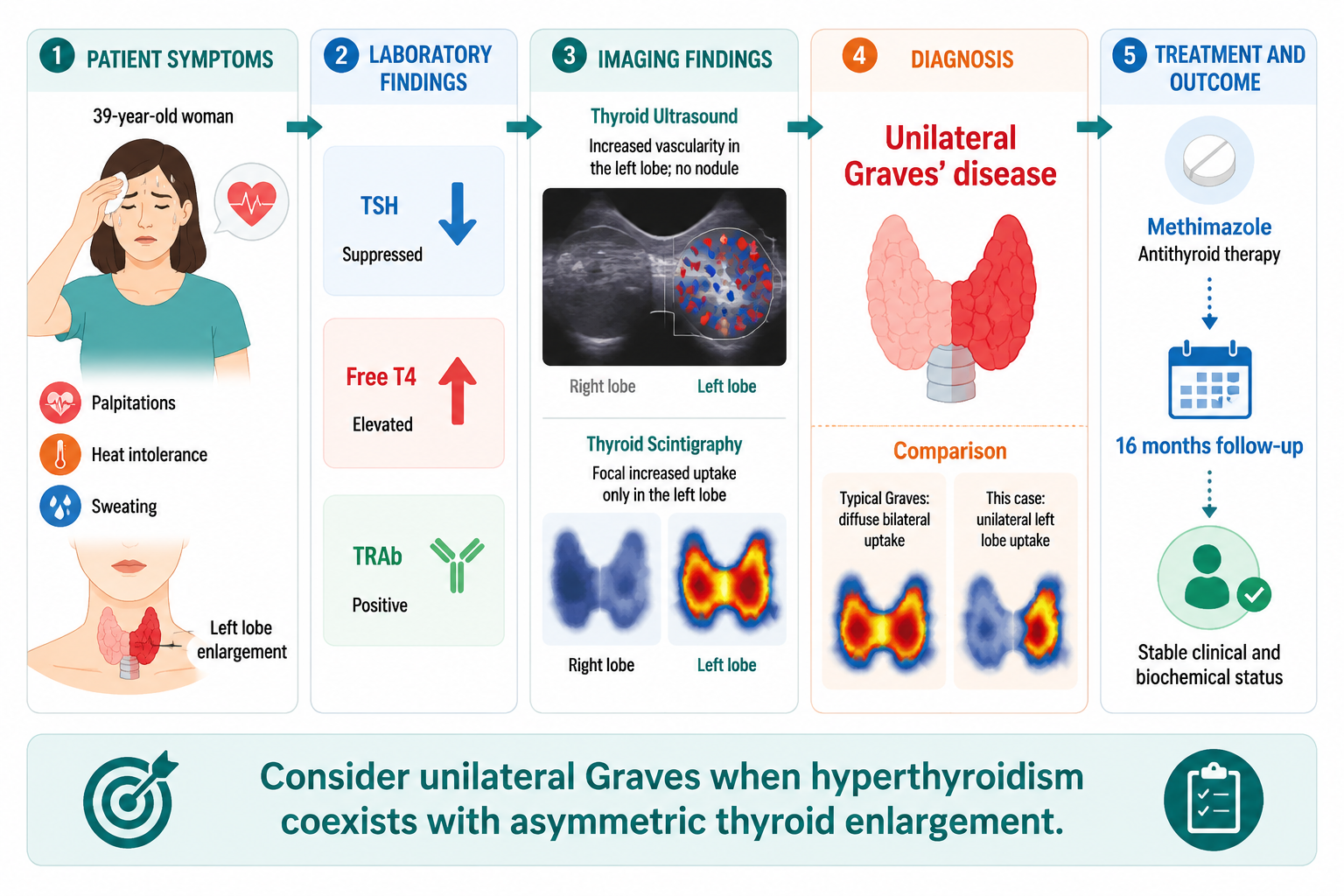
Materials and methods: A 39-year-old woman presented to the endocrine clinic with typical symptoms of thyrotoxicosis, including sweating, palpitations, and heat intolerance. Physical examination revealed enlargement of the left thyroid lobe. Initial laboratory investigations showed suppressed thyroid-stimulating hormone (TSH) and elevated free thyroxine (T4), confirming hyperthyroidism. Thyroid ultrasonography demonstrated increased vascularity in the left lobe with no detectable nodules or other structural abnormalities. To further assess thyroid function, a 99mTc-pertechnetate thyroid scan was performed, revealing focal increased uptake in the left lobe, consistent with unilateral Graves’ disease. The patient was subsequently started on methimazole therapy. During follow-up, her symptoms gradually improved, and after sixteen months, her clinical condition and laboratory findings remained stable.
Conclusion: Although Graves’ disease classically presents with diffuse bilateral thyroid uptake, unilateral Graves’ disease should be considered in patients with hyperthyroidism and thyroid asymmetry. Accurate diagnosis requires a combination of clinical findings, laboratory evaluation, and thyroid ultrasonography to exclude nodular or structural abnormalities, with confirmation by TSH receptor antibody testing when available. The underlying pathophysiology of this rare presentation remains unclear, but proposed mechanisms include differential expression of iodine transporter genes and an early stage of bilateral Graves’ disease. Early recognition remains essential for appropriate management.
Materials and methods: A 39-year-old woman presented to the endocrine clinic with typical symptoms of thyrotoxicosis, including sweating, palpitations, and heat intolerance. Physical examination revealed enlargement of the left thyroid lobe. Initial laboratory investigations showed suppressed thyroid-stimulating hormone (TSH) and elevated free thyroxine (T4), confirming hyperthyroidism. Thyroid ultrasonography demonstrated increased vascularity in the left lobe with no detectable nodules or other structural abnormalities. To further assess thyroid function, a 99mTc-pertechnetate thyroid scan was performed, revealing focal increased uptake in the left lobe, consistent with unilateral Graves’ disease. The patient was subsequently started on methimazole therapy. During follow-up, her symptoms gradually improved, and after sixteen months, her clinical condition and laboratory findings remained stable.
Conclusion: Although Graves’ disease classically presents with diffuse bilateral thyroid uptake, unilateral Graves’ disease should be considered in patients with hyperthyroidism and thyroid asymmetry. Accurate diagnosis requires a combination of clinical findings, laboratory evaluation, and thyroid ultrasonography to exclude nodular or structural abnormalities, with confirmation by TSH receptor antibody testing when available. The underlying pathophysiology of this rare presentation remains unclear, but proposed mechanisms include differential expression of iodine transporter genes and an early stage of bilateral Graves’ disease. Early recognition remains essential for appropriate management.
Type of Study: Case Report |
Subject:
Endocrine diseases
Send email to the article author
| Rights and permissions | |
 |
This work is licensed under a Creative Commons Attribution-NonCommercial 4.0 International License. |

Articles Copyright © The Author(s). Owned by Mazandaran University of Medical Sciences.
Contact Us
Address: Journal Office, Building No. 2, Mazandaran University of Medical Sciences, Moallem Square, Sari.Tel: +98 (011)34484874 Postal code: 48175-866 E-Mail: jmums@mazums.ac.ir Telefax: +98 (011)33262679
