

Volume 36, Issue 260 (9-2026)
J Mazandaran Univ Med Sci 2026, 36(260): 82-93 |
Back to browse issues page



Download citation:
BibTeX | RIS | EndNote | Medlars | ProCite | Reference Manager | RefWorks
Send citation to:


BibTeX | RIS | EndNote | Medlars | ProCite | Reference Manager | RefWorks
Send citation to:
Shokati Sayyad M, Alishahi M, Kheiri M, Esmaeili Kenari M, Motamed Nia V, Talebpour Amiri F et al . Repurposing Potential of Aripiprazole against Paraquat-Induced Hepatotoxicity in Male Mice. J Mazandaran Univ Med Sci 2026; 36 (260) :82-93
URL: http://jmums.mazums.ac.ir/article-1-23032-en.html
URL: http://jmums.mazums.ac.ir/article-1-23032-en.html
Mohammad Shokati Sayyad 
 , Maryam Alishahi , Mohsen Kheiri , Mobina Esmaeili Kenari , Vida Motamed Nia , Fereshteh Talebpour Amiri , Mohammad Karami
, Maryam Alishahi , Mohsen Kheiri , Mobina Esmaeili Kenari , Vida Motamed Nia , Fereshteh Talebpour Amiri , Mohammad Karami
Abstract: (19 Views)
Background and purpose: Hepatotoxicity is a major adverse effect of exposure to chemical compounds, with oxidative stress and inflammation playing key roles in its pathogenesis. Paraquat, a highly toxic herbicide, can induce liver injury through these mechanisms, and no specific and effective treatment is currently available. Given the antioxidant and anti-inflammatory properties of aripiprazole, this study aimed to investigate its potential protective effects against paraquat-induced hepatotoxicity in mice.
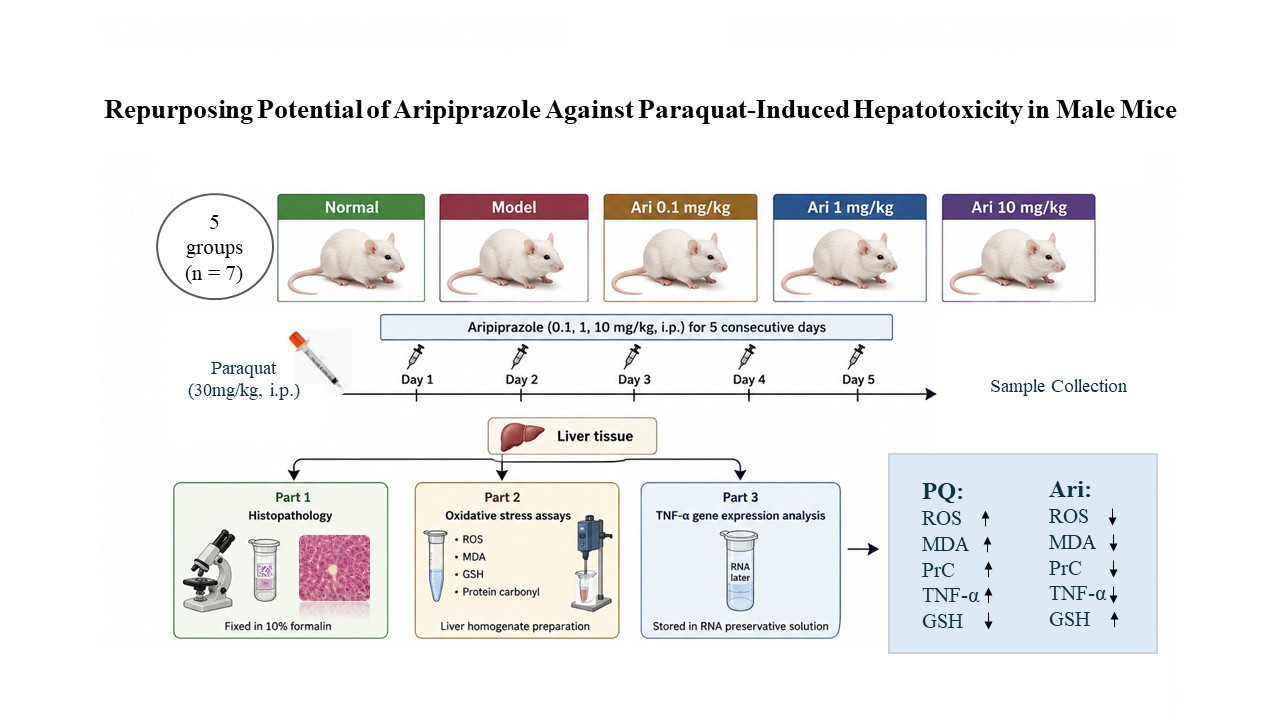
Materials and methods: Thirty-five male BALB/c mice were randomly assigned to five groups (n= 7): a normal group, a hepatotoxicity model group treated with paraquat (30 mg/kg), and three treatment groups that received paraquat followed by aripiprazole at doses of 0.1, 1, or 10 mg/kg. Aripiprazole was administered intraperitoneally for five consecutive days. On day 6, liver tissues were collected to assess reactive oxygen species (ROS), glutathione (GSH), malondialdehyde (MDA), and protein carbonyl (PrC) levels, measure TNF-α gene expression by real-time PCR, and assess histopathological changes using hematoxylin and eosin (H&E) staining.
Results: Paraquat administration significantly increased ROS and PrC levels, as well as TNF-α gene expression, while significantly decreasing liver GSH levels compared with the normal group. Treatment with aripiprazole at doses of 1 and 10 mg/kg significantly reduced ROS and PrC levels and TNF-α gene expression and significantly increased GSH levels compared with the model group (P< 0.05). Moreover, a significant reduction in MDA levels was observed only in mice treated with aripiprazole at 1 mg/kg. Histopathological examination also revealed an improvement in paraquat-induced liver damage in the aripiprazole-treated groups.
Conclusion: The findings of this study suggest that aripiprazole may exert a protective effect against paraquat-induced liver injury through the attenuation of oxidative stress and inflammatory responses. However, further studies are required to elucidate the precise mechanisms underlying these effects.
Materials and methods: Thirty-five male BALB/c mice were randomly assigned to five groups (n= 7): a normal group, a hepatotoxicity model group treated with paraquat (30 mg/kg), and three treatment groups that received paraquat followed by aripiprazole at doses of 0.1, 1, or 10 mg/kg. Aripiprazole was administered intraperitoneally for five consecutive days. On day 6, liver tissues were collected to assess reactive oxygen species (ROS), glutathione (GSH), malondialdehyde (MDA), and protein carbonyl (PrC) levels, measure TNF-α gene expression by real-time PCR, and assess histopathological changes using hematoxylin and eosin (H&E) staining.
Results: Paraquat administration significantly increased ROS and PrC levels, as well as TNF-α gene expression, while significantly decreasing liver GSH levels compared with the normal group. Treatment with aripiprazole at doses of 1 and 10 mg/kg significantly reduced ROS and PrC levels and TNF-α gene expression and significantly increased GSH levels compared with the model group (P< 0.05). Moreover, a significant reduction in MDA levels was observed only in mice treated with aripiprazole at 1 mg/kg. Histopathological examination also revealed an improvement in paraquat-induced liver damage in the aripiprazole-treated groups.
Conclusion: The findings of this study suggest that aripiprazole may exert a protective effect against paraquat-induced liver injury through the attenuation of oxidative stress and inflammatory responses. However, further studies are required to elucidate the precise mechanisms underlying these effects.
Type of Study: Research(Original) |
Subject:
pharmacology
Send email to the article author
| Rights and permissions | |
 |
This work is licensed under a Creative Commons Attribution-NonCommercial 4.0 International License. |

Articles Copyright © The Author(s). Owned by Mazandaran University of Medical Sciences.
Contact Us
Address: Journal Office, Building No. 2, Mazandaran University of Medical Sciences, Moallem Square, Sari.Tel: +98 (011)34484874 Postal code: 48175-866 E-Mail: jmums@mazums.ac.ir Telefax: +98 (011)33262679
