

Volume 36, Issue 261 (10-2026)
J Mazandaran Univ Med Sci 2026, 36(261): 55-63 |
Back to browse issues page



Download citation:
BibTeX | RIS | EndNote | Medlars | ProCite | Reference Manager | RefWorks
Send citation to:


BibTeX | RIS | EndNote | Medlars | ProCite | Reference Manager | RefWorks
Send citation to:
Abedi samakoosh M, razavipour M, shahpoori M, Abdi Talarposhti M, darzi darounkolaee P. Frequency of Acute Kidney Injury and Associated Risk Factors after Major Orthopaedic Surgery in Selected Hospitals Affiliated with Mazandaran University of Medical Sciences. J Mazandaran Univ Med Sci 2026; 36 (261) :55-63
URL: http://jmums.mazums.ac.ir/article-1-21728-en.html
URL: http://jmums.mazums.ac.ir/article-1-21728-en.html
Mohammad Abedi samakoosh 
 , Mehran Razavipour , Mohammad Shahpoori , Masoomeh Abdi Talarposhti , Pouya Darzi darounkolaee
, Mehran Razavipour , Mohammad Shahpoori , Masoomeh Abdi Talarposhti , Pouya Darzi darounkolaee
Abstract: (25 Views)
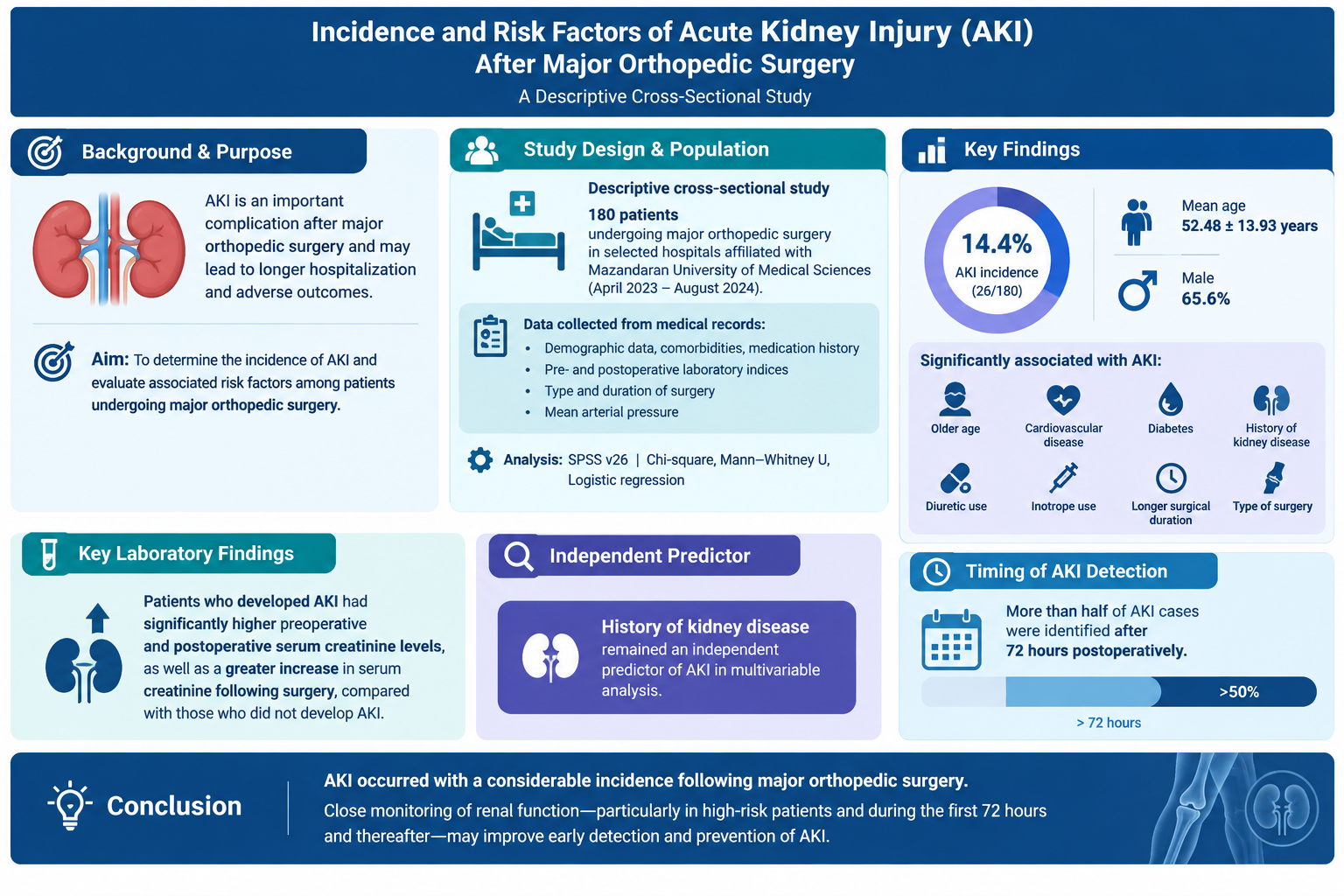
Background and purpose: Acute kidney injury (AKI) is an important complication of major orthopaedic surgery and may lead to prolonged hospitalisation and adverse outcomes. This study aimed to determine the incidence of AKI and evaluate its associated risk factors among patients undergoing major orthopaedic surgery.
Materials and methods: This descriptive cross-sectional study included 180 patients who underwent major orthopaedic surgery in selected hospitals affiliated with Mazandaran University of Medical Sciences from April 2023 to August 2024. Demographic data, comorbidities, medication history, pre- and postoperative laboratory parameters, type and duration of surgery, and mean arterial pressure were extracted from medical records. Data were analysed using SPSS version 26. The Chi-square test, Mann-Whitney U test, and logistic regression analysis were used.
Results: The mean age of patients was 52.48 ± 13.93 years, and 65.6% were male. Overall, 26 patients (14.4%) developed AKI after surgery. Older age, cardiovascular disease, diabetes, a history of kidney disease, diuretic use, inotrope use, longer surgical duration, and type of surgery were significantly associated with AKI. Patients who developed AKI had significantly higher preoperative and postoperative serum creatinine levels, as well as a greater increase in serum creatinine following surgery, compared with those who did not develop AKI. In multivariable analysis, a history of kidney disease remained an independent predictor of AKI. More than half of the AKI cases were identified more than 72 hours postoperatively.
Conclusion: AKI occurred in a considerable proportion of patients following major orthopaedic surgery. Close monitoring of renal function, particularly in high-risk patients during the first 72 hours after surgery and thereafter, may facilitate the early detection of AKI and support its prevention
Materials and methods: This descriptive cross-sectional study included 180 patients who underwent major orthopaedic surgery in selected hospitals affiliated with Mazandaran University of Medical Sciences from April 2023 to August 2024. Demographic data, comorbidities, medication history, pre- and postoperative laboratory parameters, type and duration of surgery, and mean arterial pressure were extracted from medical records. Data were analysed using SPSS version 26. The Chi-square test, Mann-Whitney U test, and logistic regression analysis were used.
Results: The mean age of patients was 52.48 ± 13.93 years, and 65.6% were male. Overall, 26 patients (14.4%) developed AKI after surgery. Older age, cardiovascular disease, diabetes, a history of kidney disease, diuretic use, inotrope use, longer surgical duration, and type of surgery were significantly associated with AKI. Patients who developed AKI had significantly higher preoperative and postoperative serum creatinine levels, as well as a greater increase in serum creatinine following surgery, compared with those who did not develop AKI. In multivariable analysis, a history of kidney disease remained an independent predictor of AKI. More than half of the AKI cases were identified more than 72 hours postoperatively.
Conclusion: AKI occurred in a considerable proportion of patients following major orthopaedic surgery. Close monitoring of renal function, particularly in high-risk patients during the first 72 hours after surgery and thereafter, may facilitate the early detection of AKI and support its prevention
Type of Study: Research(Original) |
Subject:
Nephrology
Send email to the article author
| Rights and permissions | |
 |
This work is licensed under a Creative Commons Attribution-NonCommercial 4.0 International License. |

Articles Copyright © The Author(s). Owned by Mazandaran University of Medical Sciences.
Contact Us
Address: Journal Office, Building No. 2, Mazandaran University of Medical Sciences, Moallem Square, Sari.Tel: +98 (011)34484874 Postal code: 48175-866 E-Mail: jmums@mazums.ac.ir Telefax: +98 (011)33262679
