

Volume 35, Issue 254 (3-2026)
J Mazandaran Univ Med Sci 2026, 35(254): 89-95 |
Back to browse issues page



Download citation:
BibTeX | RIS | EndNote | Medlars | ProCite | Reference Manager | RefWorks
Send citation to:


BibTeX | RIS | EndNote | Medlars | ProCite | Reference Manager | RefWorks
Send citation to:
Shahriari M, Jafari M A, Hosseininasab A, Parvaresh S, Ahmadipour M, Sinaei R, et al . Prevalence of COVID-19 in Children with Kawasaki Disease: A Cross-Sectional Study. J Mazandaran Univ Med Sci 2026; 35 (254) :89-95
URL: http://jmums.mazums.ac.ir/article-1-21795-en.html
URL: http://jmums.mazums.ac.ir/article-1-21795-en.html
Mahdi Shahriari 
 , Mohammad Ali Jafari , Ali Hosseininasab , Saeedeh Parvaresh , Maryam Ahmadipour , Reza Sinaei , Azam Dehghani , Fatemeh Karami Robati , Maedeh Jafari
, Mohammad Ali Jafari , Ali Hosseininasab , Saeedeh Parvaresh , Maryam Ahmadipour , Reza Sinaei , Azam Dehghani , Fatemeh Karami Robati , Maedeh Jafari
Abstract: (634 Views)
Background and purpose: Kawasaki disease is the most common form of vasculitis in children, affecting medium- and small-sized vessels and often involving the coronary arteries. This study aimed to investigate the frequency of COVID-19 in children with Kawasaki disease.
Materials and methods: This descriptive cross-sectional study was conducted at Afzalipour Hospital in Kerman, Iran, between 2020 and 2021. All patients diagnosed with Kawasaki disease were included using a non-probability convenience sampling method. Patients were divided into two groups: COVID-19–positive and COVID-19–negative. The variables of interest were then compared between the two groups. Data were recorded in a standardised data collection form and subsequently analyzed. Descriptive and inferential statistical methods were applied using SPSS.
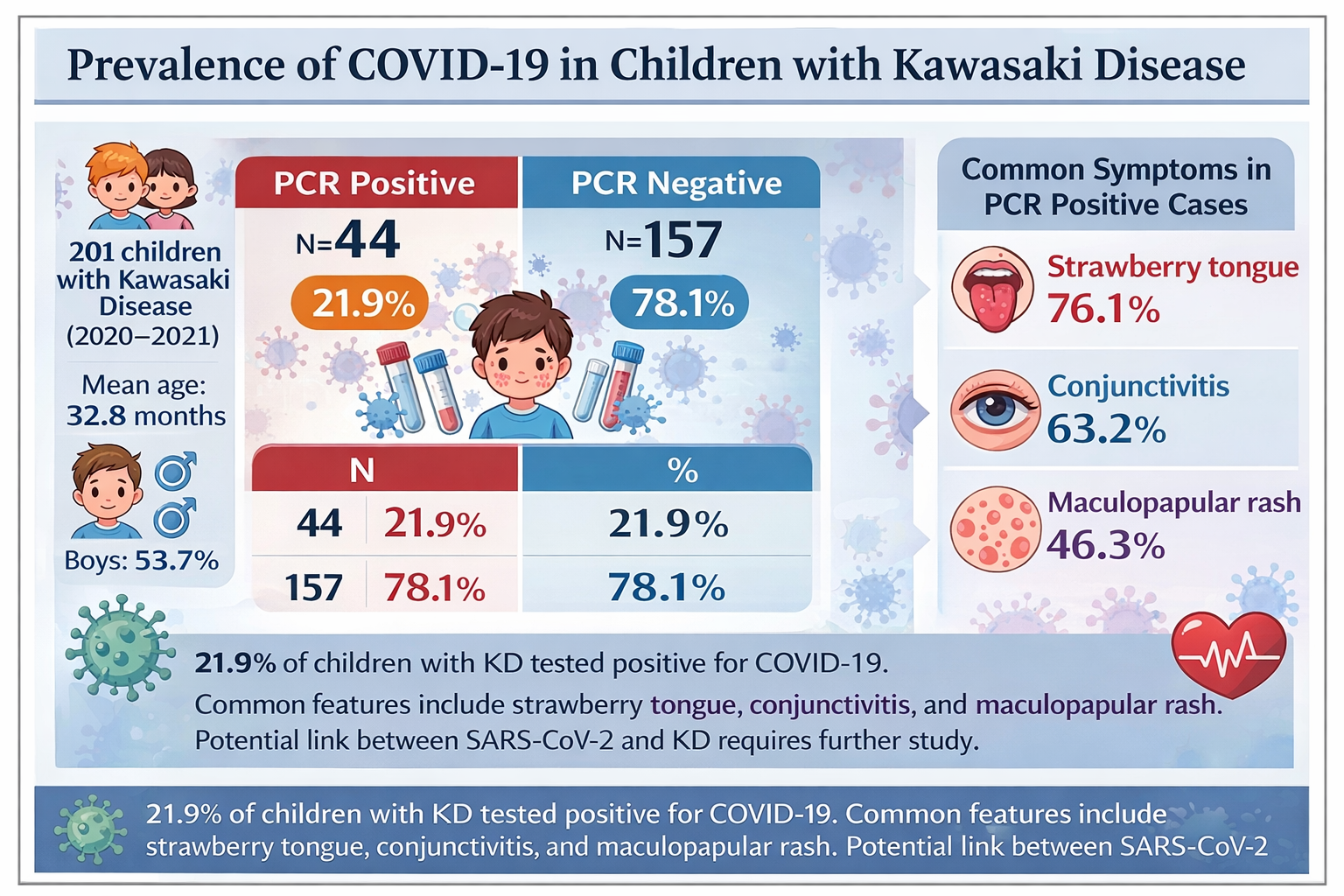
Results: A total of 201 children diagnosed with Kawasaki disease were included in the study. The mean age of the children was 32.82 ± 3.05 months. The mean C-reactive protein (CRP) level was 31.06 ± 3.10 mg/L, and the mean erythrocyte sedimentation rate (ESR) was 50.55 ± 3.37 mm/h. Boys constituted the majority of cases (53.7%); although the disease was more prevalent in boys, the difference was not statistically significant (P= 0.82). Overall, 21.9% of children with Kawasaki disease were polymerase chain reaction (PCR)-positive for COVID-19. More than 76% of the children (76.1%) had a strawberry tongue, 63.2% had conjunctivitis, and 46.3% presented with a maculopapular rash. The mean age of children with PCR-positive Kawasaki disease (35.10 ± 2.54 months) was significantly higher than that of children with PCR-negative Kawasaki disease (25.59 ± 3.03 months) (P = 0.01).
Conclusion: The findings of this study showed that 21.9% of children with Kawasaki disease during the COVID-19 pandemic had a positive PCR test and presented with clinical manifestations such as strawberry tongue, conjunctivitis, and maculopapular rash. However, the potential association between SARS-CoV-2 infection and Kawasaki disease warrants further investigation in paediatric populations.
Materials and methods: This descriptive cross-sectional study was conducted at Afzalipour Hospital in Kerman, Iran, between 2020 and 2021. All patients diagnosed with Kawasaki disease were included using a non-probability convenience sampling method. Patients were divided into two groups: COVID-19–positive and COVID-19–negative. The variables of interest were then compared between the two groups. Data were recorded in a standardised data collection form and subsequently analyzed. Descriptive and inferential statistical methods were applied using SPSS.
Results: A total of 201 children diagnosed with Kawasaki disease were included in the study. The mean age of the children was 32.82 ± 3.05 months. The mean C-reactive protein (CRP) level was 31.06 ± 3.10 mg/L, and the mean erythrocyte sedimentation rate (ESR) was 50.55 ± 3.37 mm/h. Boys constituted the majority of cases (53.7%); although the disease was more prevalent in boys, the difference was not statistically significant (P= 0.82). Overall, 21.9% of children with Kawasaki disease were polymerase chain reaction (PCR)-positive for COVID-19. More than 76% of the children (76.1%) had a strawberry tongue, 63.2% had conjunctivitis, and 46.3% presented with a maculopapular rash. The mean age of children with PCR-positive Kawasaki disease (35.10 ± 2.54 months) was significantly higher than that of children with PCR-negative Kawasaki disease (25.59 ± 3.03 months) (P = 0.01).
Conclusion: The findings of this study showed that 21.9% of children with Kawasaki disease during the COVID-19 pandemic had a positive PCR test and presented with clinical manifestations such as strawberry tongue, conjunctivitis, and maculopapular rash. However, the potential association between SARS-CoV-2 infection and Kawasaki disease warrants further investigation in paediatric populations.
Type of Study: Brief Report |
Subject:
children
Send email to the article author
| Rights and permissions | |
 |
This work is licensed under a Creative Commons Attribution-NonCommercial 4.0 International License. |

Articles Copyright © The Author(s). Owned by Mazandaran University of Medical Sciences.
Contact Us
Address: Journal Office, Building No. 2, Mazandaran University of Medical Sciences, Moallem Square, Sari.Tel: +98 (011)34484874 Postal code: 48175-866 E-Mail: jmums@mazums.ac.ir Telefax: +98 (011)33262679
