

Volume 36, Issue 259 (8-2026)
J Mazandaran Univ Med Sci 2026, 36(259): 172-178 |
Back to browse issues page



Download citation:
BibTeX | RIS | EndNote | Medlars | ProCite | Reference Manager | RefWorks
Send citation to:


BibTeX | RIS | EndNote | Medlars | ProCite | Reference Manager | RefWorks
Send citation to:
Sedighi O, Tabaripour R, Sharifpour A, Fakhar M, Marvi M, Effati M H. Microscopic and Molecular Detection of Lophomonas in Sputum Samples from Dialysis Patients Attending Dialysis Centers in Sari, Northern Iran. J Mazandaran Univ Med Sci 2026; 36 (259) :172-178
URL: http://jmums.mazums.ac.ir/article-1-22237-en.html
URL: http://jmums.mazums.ac.ir/article-1-22237-en.html
Omid Sedighi 
 , Rabeeh Tabaripour , Ali Sharifpour , Mahdi Fakhar , Mohaddeseh Marvi , Mohammad Hassan Effati
, Rabeeh Tabaripour , Ali Sharifpour , Mahdi Fakhar , Mohaddeseh Marvi , Mohammad Hassan Effati
Abstract: (519 Views)
Background and purpose: The respiratory protozoan Lophomonas can cause opportunistic infections in immunocompromised individuals, such as patients with chronic kidney disease (CKD). Given the challenges associated with its microscopic diagnosis, this study aimed to detect Lophomonas infection microscopically and molecularly in sputum samples from dialysis candidates with respiratory symptoms in Sari, Iran
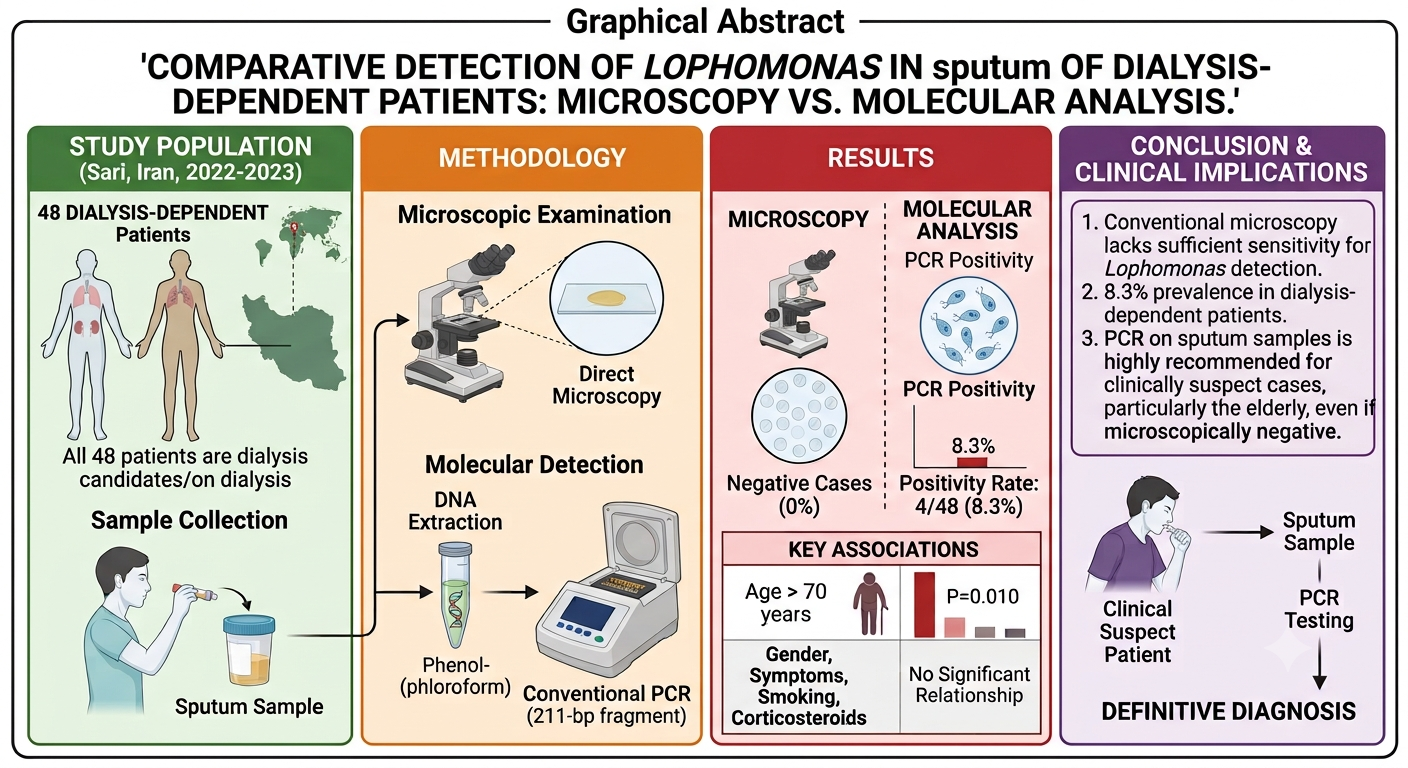
Patients and methods: In this descriptive-analytical study, conducted between 2022 and 2023, 48 CKD patients with chronic respiratory symptoms were enrolled through convenience sampling. Sputum samples were homogenized with 0.5% N-acetylcysteine before microscopic examination. Genomic DNA was extracted using the standard phenol-chloroform method. Subsequently, conventional polymerase chain reaction (PCR) was performed to amplify a specific 211-bp fragment of the SSU rRNA gene for molecular identification. Data were analysed using SPSS software (version 24), and statistical significance was assessed using the chi-square test.
Results: Microscopic examination did not detect any positive cases. However, molecular analysis revealed Lophomonas DNA in 4 of 48 sputum samples, corresponding to a prevalence of 8.3%. A statistically significant association was identified between age >70 years and PCR positivity (P=0.010). No significant associations were observed between PCR positivity and other variables, including gender, residency, occupation, smoking history, corticosteroid use, or specific clinical symptoms. However, cough (6.3%) was the most common clinical symptom among PCR-positive patients.
Conclusion: Conventional microscopy has limited sensitivity for detecting Lophomonas. Given the 8.3% prevalence of molecular detection among dialysis candidates, particularly older patients, PCR testing of sputum samples may be useful in clinically suspected cases with negative microscopic findings.
Patients and methods: In this descriptive-analytical study, conducted between 2022 and 2023, 48 CKD patients with chronic respiratory symptoms were enrolled through convenience sampling. Sputum samples were homogenized with 0.5% N-acetylcysteine before microscopic examination. Genomic DNA was extracted using the standard phenol-chloroform method. Subsequently, conventional polymerase chain reaction (PCR) was performed to amplify a specific 211-bp fragment of the SSU rRNA gene for molecular identification. Data were analysed using SPSS software (version 24), and statistical significance was assessed using the chi-square test.
Results: Microscopic examination did not detect any positive cases. However, molecular analysis revealed Lophomonas DNA in 4 of 48 sputum samples, corresponding to a prevalence of 8.3%. A statistically significant association was identified between age >70 years and PCR positivity (P=0.010). No significant associations were observed between PCR positivity and other variables, including gender, residency, occupation, smoking history, corticosteroid use, or specific clinical symptoms. However, cough (6.3%) was the most common clinical symptom among PCR-positive patients.
Conclusion: Conventional microscopy has limited sensitivity for detecting Lophomonas. Given the 8.3% prevalence of molecular detection among dialysis candidates, particularly older patients, PCR testing of sputum samples may be useful in clinically suspected cases with negative microscopic findings.
Type of Study: Brief Report |
Subject:
parasitology
Send email to the article author
| Rights and permissions | |
 |
This work is licensed under a Creative Commons Attribution-NonCommercial 4.0 International License. |

Articles Copyright © The Author(s). Owned by Mazandaran University of Medical Sciences.
Contact Us
Address: Journal Office, Building No. 2, Mazandaran University of Medical Sciences, Moallem Square, Sari.Tel: +98 (011)34484874 Postal code: 48175-866 E-Mail: jmums@mazums.ac.ir Telefax: +98 (011)33262679
