

Volume 36, Issue 256 (4-2026)
J Mazandaran Univ Med Sci 2026, 36(256): 76-85 |
Back to browse issues page



Download citation:
BibTeX | RIS | EndNote | Medlars | ProCite | Reference Manager | RefWorks
Send citation to:


BibTeX | RIS | EndNote | Medlars | ProCite | Reference Manager | RefWorks
Send citation to:
Riazi Kermani K, Mofidi O, Rajaei S. Referral Indications for Fetal Echocardiography at Dr. Shariati Hospital, Bandar Abbas: A Cross-Sectional Study. J Mazandaran Univ Med Sci 2026; 36 (256) :76-85
URL: http://jmums.mazums.ac.ir/article-1-22258-en.html
URL: http://jmums.mazums.ac.ir/article-1-22258-en.html


Abstract: (122 Views)
Background and purpose: Congenital heart defects (CHD) are among the most common congenital structural anomalies and a leading cause of neonatal mortality. Despite advances in imaging, early diagnosis of these conditions remains challenging; therefore, identifying patterns of referral indications and their association with echocardiographic findings is essential to improve the timing and accuracy of screening. The aim of this study was to investigate referral indications for fetal echocardiography and associated echocardiographic findings.
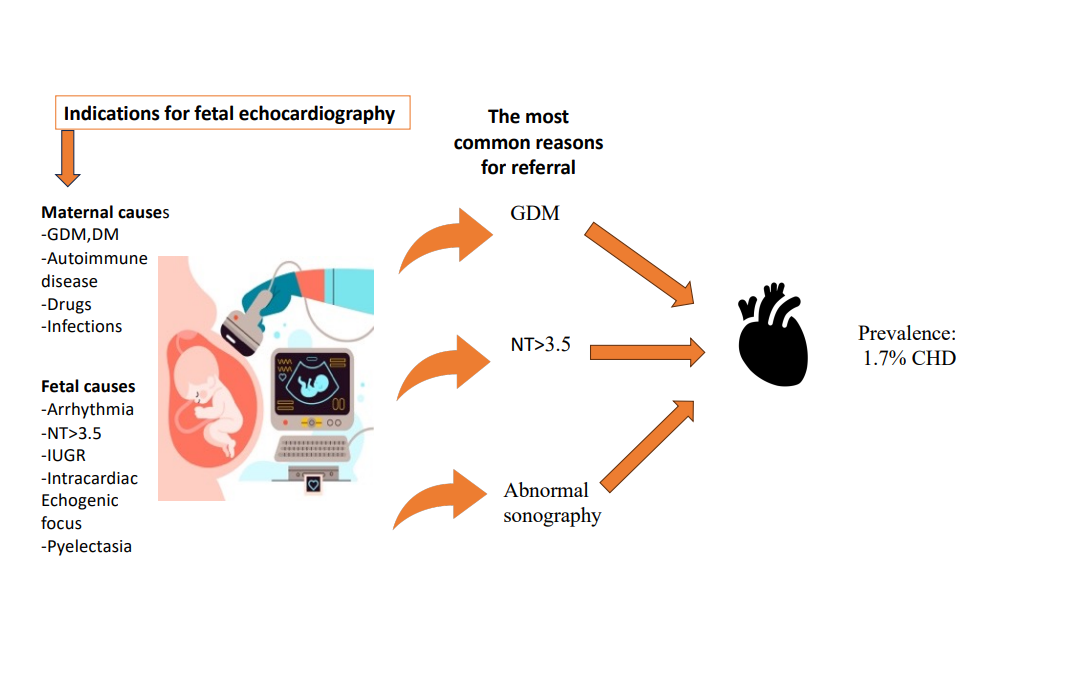
Materials and methods: This retrospective cross-sectional study was conducted on all cases of fetal echocardiography performed at Dr. Shariati Hospital, Bandar Abbas, between 2021 and 2023. Pregnant women were referred by specialists due to maternal or fetal indications. Indications were categorised as maternal (age ≥35 years, diabetes, autoimmune disease, family history of CHD, use of teratogenic drugs, and maternal infectious diseases) or fetal (increased nuchal translucency, abnormal ultrasound findings, arrhythmia, amniotic fluid disorders, choroid plexus cyst, pyelectasis, single umbilical artery, and abnormal screening results).
Results: A total of 1215 pregnant women were studied, with a mean maternal age of 30.96 years and a mean gestational age at the time of echocardiography of 20.02 weeks. The most common reason for maternal referral was gestational diabetes (15%), and the most common fetal indication was increased nuchal translucency (12.8%). In 22.8% of cases, more than one fetal echocardiography examination was performed. CHD was diagnosed in 44 fetuses (3.4%), of whom 21 (1.7%) were referred for termination of pregnancy due to complex cardiac malformations. The most common referral indications among CHD-positive cases were increased nuchal translucency, gestational diabetes, and abnormal cardiac findings on ultrasound (excluding echogenic focus).
Conclusion: Fetal echocardiography, particularly when performed before 20 weeks of gestation, is an effective method for detecting CHD and can support timely clinical and management decisions, including appropriate therapeutic interventions.
Materials and methods: This retrospective cross-sectional study was conducted on all cases of fetal echocardiography performed at Dr. Shariati Hospital, Bandar Abbas, between 2021 and 2023. Pregnant women were referred by specialists due to maternal or fetal indications. Indications were categorised as maternal (age ≥35 years, diabetes, autoimmune disease, family history of CHD, use of teratogenic drugs, and maternal infectious diseases) or fetal (increased nuchal translucency, abnormal ultrasound findings, arrhythmia, amniotic fluid disorders, choroid plexus cyst, pyelectasis, single umbilical artery, and abnormal screening results).
Results: A total of 1215 pregnant women were studied, with a mean maternal age of 30.96 years and a mean gestational age at the time of echocardiography of 20.02 weeks. The most common reason for maternal referral was gestational diabetes (15%), and the most common fetal indication was increased nuchal translucency (12.8%). In 22.8% of cases, more than one fetal echocardiography examination was performed. CHD was diagnosed in 44 fetuses (3.4%), of whom 21 (1.7%) were referred for termination of pregnancy due to complex cardiac malformations. The most common referral indications among CHD-positive cases were increased nuchal translucency, gestational diabetes, and abnormal cardiac findings on ultrasound (excluding echogenic focus).
Conclusion: Fetal echocardiography, particularly when performed before 20 weeks of gestation, is an effective method for detecting CHD and can support timely clinical and management decisions, including appropriate therapeutic interventions.
Keywords: Congenital heart disease, fetal echocardiography, prenatal screening, nuchal translucency, gestational diabetes
Type of Study: Research(Original) |
Subject:
pediatric cardiology
Send email to the article author
| Rights and permissions | |
 |
This work is licensed under a Creative Commons Attribution-NonCommercial 4.0 International License. |

Articles Copyright © The Author(s). Owned by Mazandaran University of Medical Sciences.
Contact Us
Address: Journal Office, Building No. 2, Mazandaran University of Medical Sciences, Moallem Square, Sari.Tel: +98 (011)34484874 Postal code: 48175-866 E-Mail: jmums@mazums.ac.ir Telefax: +98 (011)33262679
