

Volume 36, Issue 259 (8-2026)
J Mazandaran Univ Med Sci 2026, 36(259): 266-280 |
Back to browse issues page



Download citation:
BibTeX | RIS | EndNote | Medlars | ProCite | Reference Manager | RefWorks
Send citation to:


BibTeX | RIS | EndNote | Medlars | ProCite | Reference Manager | RefWorks
Send citation to:
Dolatkhah N, Hajifarji M. The Role of the Gut Microbiome in Cancer Metabolism and Therapeutic Response: A Systematic Review. J Mazandaran Univ Med Sci 2026; 36 (259) :266-280
URL: http://jmums.mazums.ac.ir/article-1-22287-en.html
URL: http://jmums.mazums.ac.ir/article-1-22287-en.html


Abstract: (576 Views)
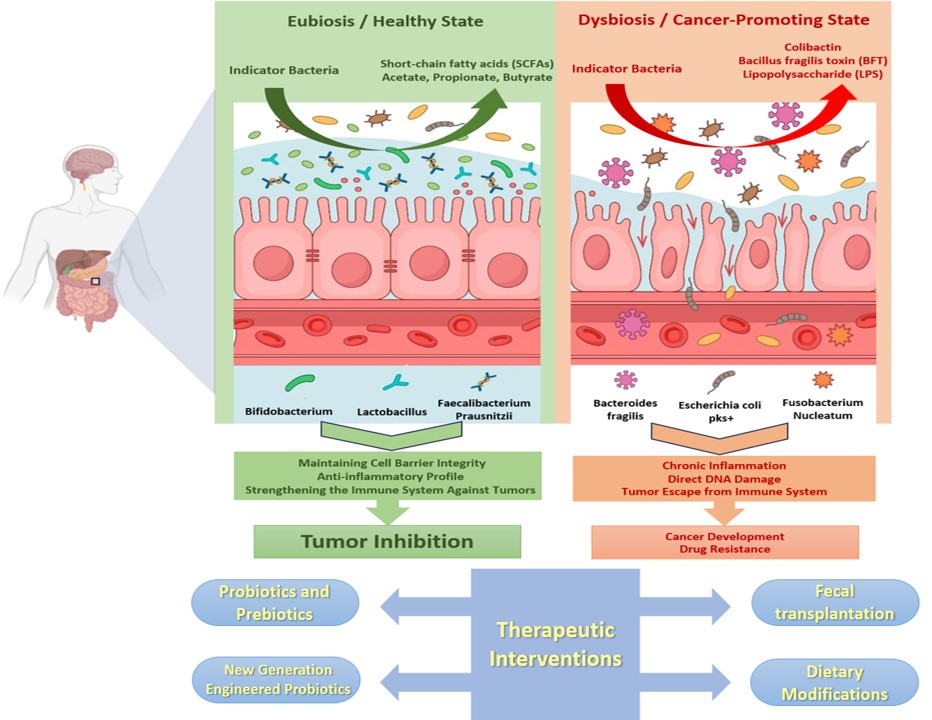
In recent years, increasing attention has been directed toward the gut microbiota and its complex interactions with human health and disease. This systematic review critically evaluated current evidence on the role of the gut microbiome in cancer metabolism and therapeutic response, with the aim of providing practical insights for cancer prevention and treatment. A comprehensive search was conducted across Scopus, PubMed, Google Scholar, and Web of Science, covering articles published from January 2010 to March 2026. Multiple keyword combinations were employed, including "gut microbiota," "dysbiosis," "cancer," "oncology," "tumor," "carcinogenesis," "metabolism," "pharmacomicrobiome," "chemotherapy," "immunotherapy," "radiotherapy," "probiotics," "prebiotics," "synbiotics," "fecal microbiota transplantation," "short-chain fatty acids," and "inflammation." Original articles, reviews, clinical trials, and laboratory studies addressing gut microbiome-cancer interactions were included. From an initial 1,800 records, 500 duplicates were removed, and 1,300 articles were screened. Following full-text assessment, 120 articles were included in the review, comprising 40% reviews, 30% clinical trials, and 30% laboratory studies. Quality was assessed using the AMSTAR checklist (mean score, 8.11), with mean scores of 9.10 for study design and 7.10 for statistical analysis. In a healthy gut, commensal bacteria prevent pathogen invasion and produce anti-cancer metabolites, such as short-chain fatty acids (SCFAs). Conversely, disruption of this microbial community (dysbiosis) increases susceptibility to cancer. Carcinogenic bacteria, including Fusobacterium nucleatum and enterotoxigenic Bacteroides fragilis, contribute to cancer progression, particularly in colorectal, pancreatic, and hepatic malignancies. Conversely, beneficial genera such as Lactobacillus and Bifidobacterium exert tumour-suppressive effects. The gut microbiome also significantly modulates responses to chemotherapy, immunotherapy, and radiotherapy. Microbiome-targeting strategies, including probiotics, prebiotics, synbiotics, and faecal microbiota transplantation (FMT), show considerable promise for enhancing therapeutic outcomes and reducing treatment-related adverse effects in patients with cancer. Overall, the available evidence suggests that the gut microbiome plays a pivotal role in cancer development and treatment response, highlighting its potential as a therapeutic target and a promising avenue for personalised cancer management.
Keywords: gut microbiome, cancer, metabolism, Lactobacillus, Bifidobacterium, Fusobacterium, Bacteroides
Type of Study: Review |
Subject:
Hematology and Oncology
Send email to the article author
| Rights and permissions | |
 |
This work is licensed under a Creative Commons Attribution-NonCommercial 4.0 International License. |

Articles Copyright © The Author(s). Owned by Mazandaran University of Medical Sciences.
Contact Us
Address: Journal Office, Building No. 2, Mazandaran University of Medical Sciences, Moallem Square, Sari.Tel: +98 (011)34484874 Postal code: 48175-866 E-Mail: jmums@mazums.ac.ir Telefax: +98 (011)33262679
