

Volume 35, Issue 251 (12-2025)
J Mazandaran Univ Med Sci 2025, 35(251): 3-14 |
Back to browse issues page



Download citation:
BibTeX | RIS | EndNote | Medlars | ProCite | Reference Manager | RefWorks
Send citation to:


BibTeX | RIS | EndNote | Medlars | ProCite | Reference Manager | RefWorks
Send citation to:
Farhang-Nasab M, Zare P, Salari A, Roghani M. Effects of Safranal on Lipopolysaccharide-Induced Acute Kidney Injury in C57BL/6 Mice. J Mazandaran Univ Med Sci 2025; 35 (251) :3-14
URL: http://jmums.mazums.ac.ir/article-1-22307-en.html
URL: http://jmums.mazums.ac.ir/article-1-22307-en.html


Abstract: (1329 Views)
Background and purpose: Oxidative stress is a major contributor to kidney injury and plays a critical role in the pathogenesis of acute kidney injury (AKI) by promoting ischemia-reperfusion damage Experimental models of AKI often employ the induction of oxidative stress using lipopolysaccharide (LPS). Safranal, a principal bioactive component of saffron, exhibits potent antioxidant and anti-inflammatory activities. The present study aimed to evaluate the protective effects of safranal against LPS-induced AKI in mice.
Materials and methods: In this experimental study, 32 male C57BL/6 mice (19–24 g) were randomly assigned to four groups: control, LPS, and LPS-treated groups receiving safranal at doses of 0.05 or 0.2 ml/kg. AKI was induced by intraperitoneal administration of LPS (10 mg/kg). Safranal was administered orally twice, with the final dose given one hour prior to LPS injection. After 24 hours, animals were anesthetized, and blood and kidney samples were collected. Serum levels of albumin, creatinine, and blood urea nitrogen (BUN) were assessed. Renal oxidative stress markers, including malondialdehyde (MDA), superoxide dismutase (SOD), catalase, and nitrite, were quantified using commercial assay kits.
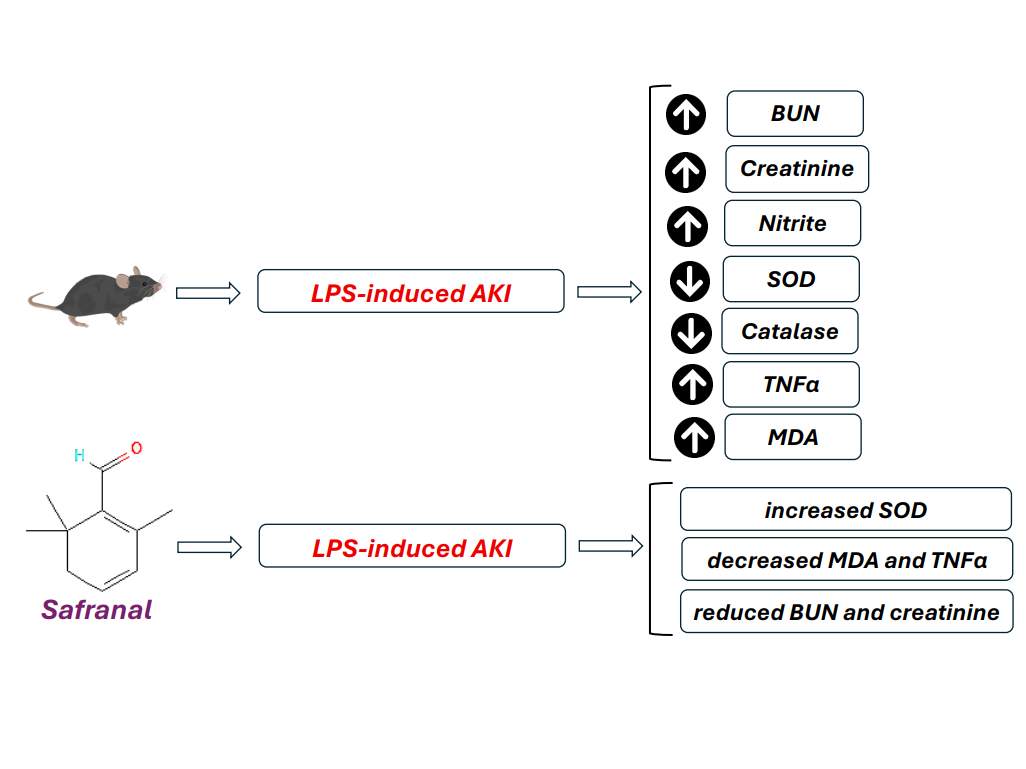
Results: LPS administration significantly elevated MDA and nitrite levels while reducing SOD and catalase activities compared with the control group. Serum BUN and creatinine were also significantly increased in the LPS group, whereas albumin levels remained unchanged. Treatment with safranal at 0.2 ml/kg significantly enhanced SOD activity and decreased MDA levels compared with the LPS group. At this dose, safranal also reduced BUN and creatinine levels, indicating improved renal function, although it had no significant effect on nitrite, catalase, or albumin. In contrast, safranal at 0.05 ml/kg did not produce significant changes in oxidative stress markers or renal function.
Conclusion: The results of this study demonstrate that safranal, owing to its antioxidant properties, ameliorates kidney function in LPS-induced AKI.
Materials and methods: In this experimental study, 32 male C57BL/6 mice (19–24 g) were randomly assigned to four groups: control, LPS, and LPS-treated groups receiving safranal at doses of 0.05 or 0.2 ml/kg. AKI was induced by intraperitoneal administration of LPS (10 mg/kg). Safranal was administered orally twice, with the final dose given one hour prior to LPS injection. After 24 hours, animals were anesthetized, and blood and kidney samples were collected. Serum levels of albumin, creatinine, and blood urea nitrogen (BUN) were assessed. Renal oxidative stress markers, including malondialdehyde (MDA), superoxide dismutase (SOD), catalase, and nitrite, were quantified using commercial assay kits.
Results: LPS administration significantly elevated MDA and nitrite levels while reducing SOD and catalase activities compared with the control group. Serum BUN and creatinine were also significantly increased in the LPS group, whereas albumin levels remained unchanged. Treatment with safranal at 0.2 ml/kg significantly enhanced SOD activity and decreased MDA levels compared with the LPS group. At this dose, safranal also reduced BUN and creatinine levels, indicating improved renal function, although it had no significant effect on nitrite, catalase, or albumin. In contrast, safranal at 0.05 ml/kg did not produce significant changes in oxidative stress markers or renal function.
Conclusion: The results of this study demonstrate that safranal, owing to its antioxidant properties, ameliorates kidney function in LPS-induced AKI.
Type of Study: Research(Original) |
Subject:
physiology
Send email to the article author
| Rights and permissions | |
 |
This work is licensed under a Creative Commons Attribution-NonCommercial 4.0 International License. |

Articles Copyright © The Author(s). Owned by Mazandaran University of Medical Sciences.
Contact Us
Address: Journal Office, Building No. 2, Mazandaran University of Medical Sciences, Moallem Square, Sari.Tel: +98 (011)34484874 Postal code: 48175-866 E-Mail: jmums@mazums.ac.ir Telefax: +98 (011)33262679
