

Volume 35, Issue 251 (12-2025)
J Mazandaran Univ Med Sci 2025, 35(251): 42-52 |
Back to browse issues page


Download citation:
BibTeX | RIS | EndNote | Medlars | ProCite | Reference Manager | RefWorks
Send citation to:


BibTeX | RIS | EndNote | Medlars | ProCite | Reference Manager | RefWorks
Send citation to:
Saghaei F, Karimi-Dehkordi M. Protective potential of umbelliprenin against acrylamide-induced reproductive toxicity in male mice. J Mazandaran Univ Med Sci 2025; 35 (251) :42-52
URL: http://jmums.mazums.ac.ir/article-1-22355-en.html
URL: http://jmums.mazums.ac.ir/article-1-22355-en.html


Abstract: (1550 Views)
Background and purpose: Acrylamide is a chemical compound formed during industrial processes and cooking that can disrupt reproductive system function. Given the increased human exposure to this compound, this study aimed to investigate the protective effect of umbelliprenin in reducing acrylamide-induced reproductive toxicity in male mice.
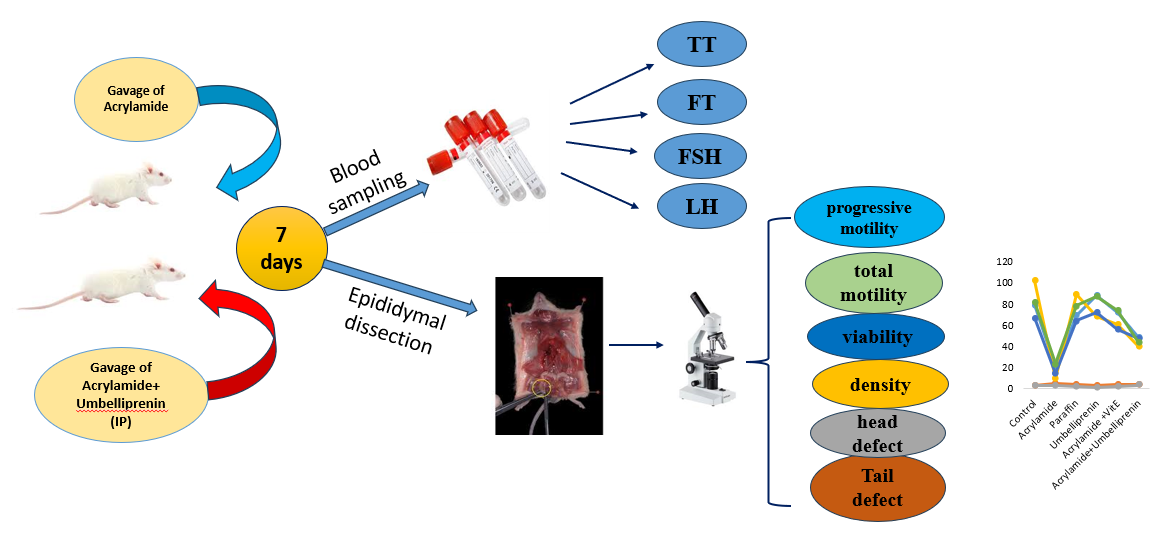
Materials and methods: Forty-two adult male BALB/c mice were divided into six groups: control, acrylamide (60 mg/kg, administered orally by gavage), umbelliprenin (12.5 mg/kg, administered intraperitoneally), paraffin (the vehicle for umbelliprenin), acrylamide + vitamin E (100 mg/kg, administered intramuscularly), and acrylamide + umbelliprenin. Treatments were administered daily for seven days. At the end of the experimental period, blood samples were collected to measure total testosterone (TT), free testosterone (FT), luteinizing hormone (LH), and follicle-stimulating hormone (FSH) levels. The epididymis was examined to assess sperm motility, viability, concentration, and morphological abnormalities. Data were analyzed using one-way ANOVA followed by Tukey’s post hoc test (p < 0.05).
Results: Acrylamide significantly reduced the levels of TT, FT, FSH, and LH, as well as sperm parameters including total motility, progressive motility, concentration, and viability. The increase in sperm structural abnormalities was not statistically significant. Umbelliprenin treatment resulted in a significant increase in TT and FT levels, although these values did not return to normal levels. Sperm viability, total motility, and progressive motility showed significant improvement compared to the acrylamide group but remained lower than those of the control group. Notably, treatment with vitamin E restored TT and FT levels to values close to normal and also improved sperm parameters, particularly motility, concentration, and viability. The paraffin and umbelliprenin groups showed no significant changes compared with the control group. None of the treatments modulated the effects of acrylamide on FSH and LH levels.
Conclusion: Vitamin E exerts a stronger protective effect than umbelliprenin against acrylamide-induced reproductive toxicity. Although umbelliprenin also shows protective activity, it is less effective in fully restoring hormonal balance and sperm function.
Materials and methods: Forty-two adult male BALB/c mice were divided into six groups: control, acrylamide (60 mg/kg, administered orally by gavage), umbelliprenin (12.5 mg/kg, administered intraperitoneally), paraffin (the vehicle for umbelliprenin), acrylamide + vitamin E (100 mg/kg, administered intramuscularly), and acrylamide + umbelliprenin. Treatments were administered daily for seven days. At the end of the experimental period, blood samples were collected to measure total testosterone (TT), free testosterone (FT), luteinizing hormone (LH), and follicle-stimulating hormone (FSH) levels. The epididymis was examined to assess sperm motility, viability, concentration, and morphological abnormalities. Data were analyzed using one-way ANOVA followed by Tukey’s post hoc test (p < 0.05).
Results: Acrylamide significantly reduced the levels of TT, FT, FSH, and LH, as well as sperm parameters including total motility, progressive motility, concentration, and viability. The increase in sperm structural abnormalities was not statistically significant. Umbelliprenin treatment resulted in a significant increase in TT and FT levels, although these values did not return to normal levels. Sperm viability, total motility, and progressive motility showed significant improvement compared to the acrylamide group but remained lower than those of the control group. Notably, treatment with vitamin E restored TT and FT levels to values close to normal and also improved sperm parameters, particularly motility, concentration, and viability. The paraffin and umbelliprenin groups showed no significant changes compared with the control group. None of the treatments modulated the effects of acrylamide on FSH and LH levels.
Conclusion: Vitamin E exerts a stronger protective effect than umbelliprenin against acrylamide-induced reproductive toxicity. Although umbelliprenin also shows protective activity, it is less effective in fully restoring hormonal balance and sperm function.
Type of Study: Research(Original) |
Subject:
Medicinal Plant
Send email to the article author
| Rights and permissions | |
 |
This work is licensed under a Creative Commons Attribution-NonCommercial 4.0 International License. |

Articles Copyright © The Author(s). Owned by Mazandaran University of Medical Sciences.
Contact Us
Address: Journal Office, Building No. 2, Mazandaran University of Medical Sciences, Moallem Square, Sari.Tel: +98 (011)34484874 Postal code: 48175-866 E-Mail: jmums@mazums.ac.ir Telefax: +98 (011)33262679
