

Volume 36, Issue 258 (7-2026)
J Mazandaran Univ Med Sci 2026, 36(258): 52-65 |
Back to browse issues page



Download citation:
BibTeX | RIS | EndNote | Medlars | ProCite | Reference Manager | RefWorks
Send citation to:


BibTeX | RIS | EndNote | Medlars | ProCite | Reference Manager | RefWorks
Send citation to:
Ashrafi A V, Mardanshahi A, Abedi S M, Godazandeh F, Molavipordanjani S. Novel Gadolinium Complexes as Potential MRI Contrast Agents. J Mazandaran Univ Med Sci 2026; 36 (258) :52-65
URL: http://jmums.mazums.ac.ir/article-1-22384-en.html
URL: http://jmums.mazums.ac.ir/article-1-22384-en.html
Ali Vahedi Ashrafi 
 , Alireza Mardanshahi , Seyed Mohammad Abedi , Farnaz Godazandeh , Sajjad Molavipordanjani
, Alireza Mardanshahi , Seyed Mohammad Abedi , Farnaz Godazandeh , Sajjad Molavipordanjani
Abstract: (629 Views)
Background and purpose: Magnetic resonance imaging (MRI) is one of the most widely used noninvasive diagnostic imaging modalities in clinical practice. However, its relatively low intrinsic contrast often necessitates the use of contrast agents to improve image quality and diagnostic accuracy. Gadolinium-based contrast agents (GBCAs) are commonly used for this purpose; however, the development of new agents with improved efficacy and safety remains an important research goal. This study aimed to synthesize, characterize, and evaluate novel gadolinium complexes derived from amino tricarboxylic acid ligands as potential MRI contrast agents.
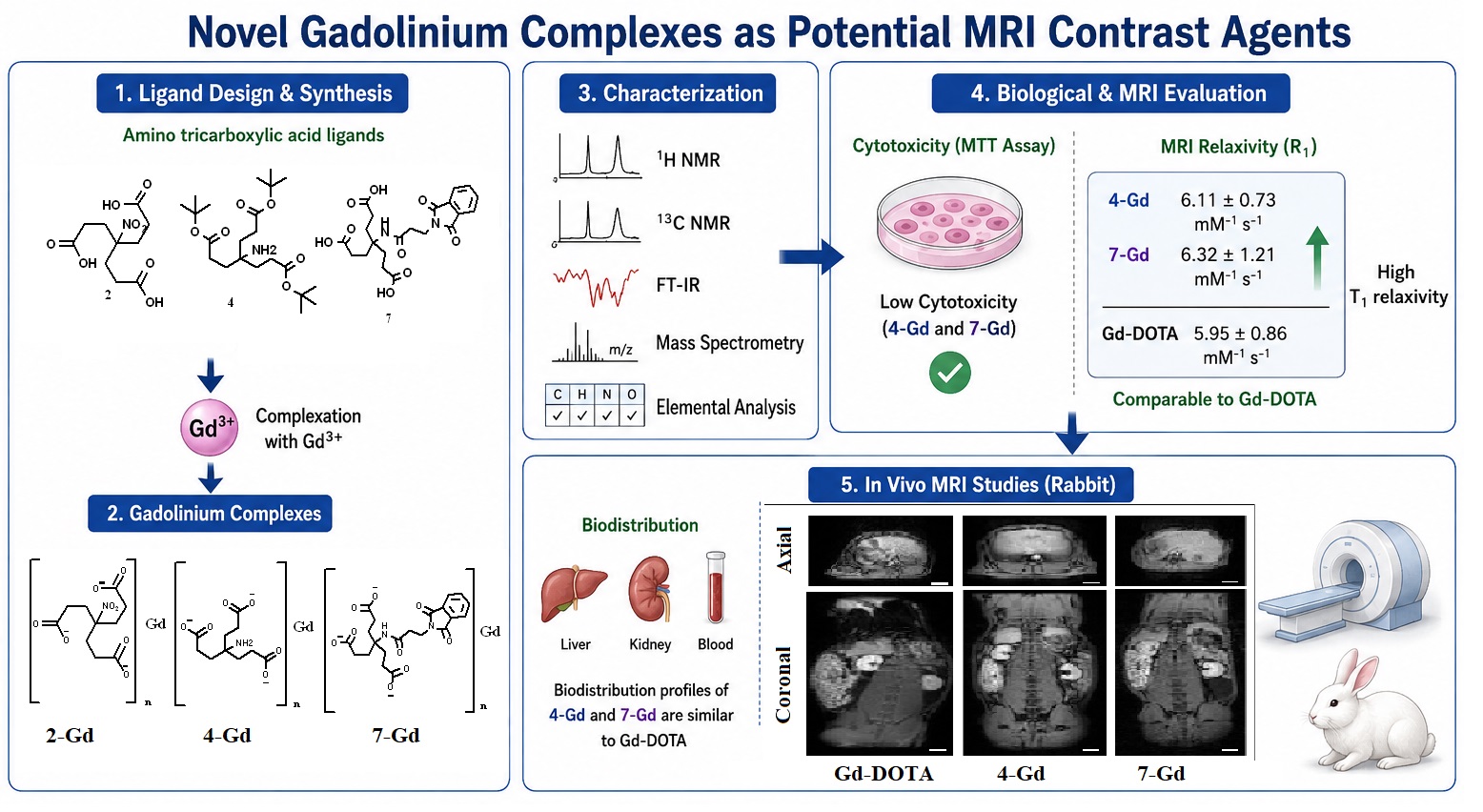
Materials and methods: In this experimental study, three amino tricarboxylic acid ligands (2, 4, and 7) were synthesized and subsequently complexed with Gd³⁺ ions to generate the corresponding gadolinium complexes, designated as 2-Gd, 4-Gd, and 7-Gd. Structural characterization was performed using nuclear magnetic resonance (NMR) spectroscopy, infrared (IR) spectroscopy, mass spectrometry, and elemental analysis. The physicochemical and biological properties of the complexes were evaluated using in vitro cytotoxicity assays, T₁ and T₂ relaxation measurements, biodistribution studies, and in vivo MRI experiments.
Results: Among the synthesized complexes, 4-Gd and 7-Gd exhibited favorable relaxometric properties, with longitudinal relaxivity (R₁) values of 6.11 ± 0.73 and 6.32 ± 1.21 mM⁻¹s⁻¹, respectively. These values were comparable to those of the clinically used contrast agent Gd-DOTA (5.95 ± 0.86 mM⁻¹s⁻¹). Furthermore, both complexes demonstrated low cytotoxicity and biodistribution patterns similar to those of Gd-DOTA, indicating good biocompatibility.
Conclusion: The findings suggest that 4-Gd and 7-Gd possess promising physicochemical and biological characteristics, supporting their potential application as effective MRI contrast agents and warranting further preclinical investigation
Materials and methods: In this experimental study, three amino tricarboxylic acid ligands (2, 4, and 7) were synthesized and subsequently complexed with Gd³⁺ ions to generate the corresponding gadolinium complexes, designated as 2-Gd, 4-Gd, and 7-Gd. Structural characterization was performed using nuclear magnetic resonance (NMR) spectroscopy, infrared (IR) spectroscopy, mass spectrometry, and elemental analysis. The physicochemical and biological properties of the complexes were evaluated using in vitro cytotoxicity assays, T₁ and T₂ relaxation measurements, biodistribution studies, and in vivo MRI experiments.
Results: Among the synthesized complexes, 4-Gd and 7-Gd exhibited favorable relaxometric properties, with longitudinal relaxivity (R₁) values of 6.11 ± 0.73 and 6.32 ± 1.21 mM⁻¹s⁻¹, respectively. These values were comparable to those of the clinically used contrast agent Gd-DOTA (5.95 ± 0.86 mM⁻¹s⁻¹). Furthermore, both complexes demonstrated low cytotoxicity and biodistribution patterns similar to those of Gd-DOTA, indicating good biocompatibility.
Conclusion: The findings suggest that 4-Gd and 7-Gd possess promising physicochemical and biological characteristics, supporting their potential application as effective MRI contrast agents and warranting further preclinical investigation
Type of Study: Research(Original) |
Subject:
chemistry
Send email to the article author
| Rights and permissions | |
 |
This work is licensed under a Creative Commons Attribution-NonCommercial 4.0 International License. |

Articles Copyright © The Author(s). Owned by Mazandaran University of Medical Sciences.
Contact Us
Address: Journal Office, Building No. 2, Mazandaran University of Medical Sciences, Moallem Square, Sari.Tel: +98 (011)34484874 Postal code: 48175-866 E-Mail: jmums@mazums.ac.ir Telefax: +98 (011)33262679
