

Volume 36, Issue 258 (7-2026)
J Mazandaran Univ Med Sci 2026, 36(258): 222-235 |
Back to browse issues page



Download citation:
BibTeX | RIS | EndNote | Medlars | ProCite | Reference Manager | RefWorks
Send citation to:


BibTeX | RIS | EndNote | Medlars | ProCite | Reference Manager | RefWorks
Send citation to:
Habibzadeh S, Yousefi R, Rafati S, Seyed N. A Review of Next-Generation Plasmid Systems for the Design and Optimization of DNA Vaccines. J Mazandaran Univ Med Sci 2026; 36 (258) :222-235
URL: http://jmums.mazums.ac.ir/article-1-22390-en.html
URL: http://jmums.mazums.ac.ir/article-1-22390-en.html


Abstract: (598 Views)
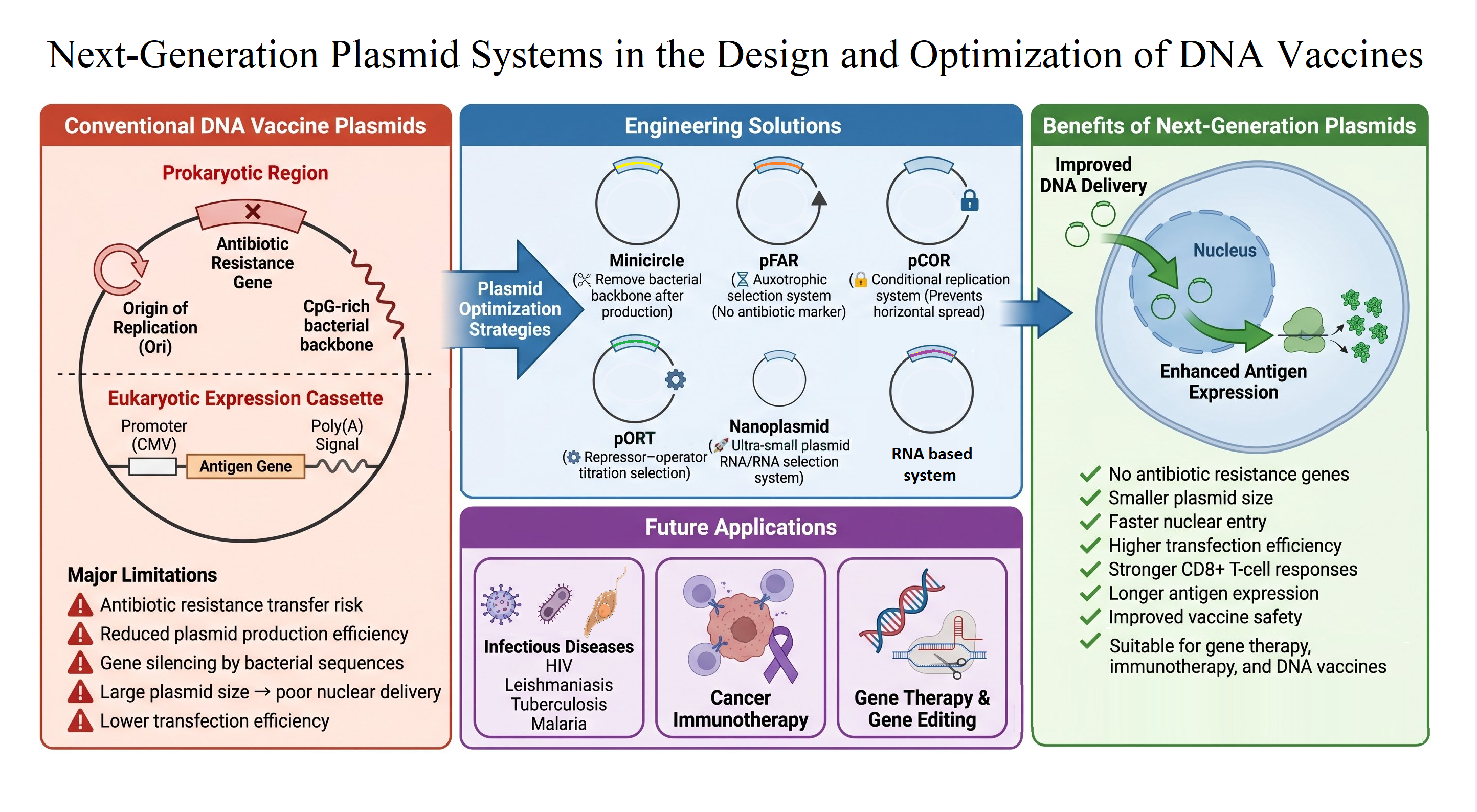
Vaccines are widely regarded as one of the greatest achievements of modern medicine. By substantially reducing the burden of infectious diseases, they have dramatically improved global public health and life expectancy. Vaccination has successfully controlled or eliminated many life-threatening diseases, including smallpox, plague, poliomyelitis, and tetanus. However, effective vaccines remain unavailable for several diseases in which protection depends predominantly on cell-mediated immunity rather than humoral immune responses. Third-generation vaccines, also known as DNA vaccines, represent a major advance in vaccine technology because they are capable of inducing robust cellular immune responses and offer several advantages over conventional vaccine platforms. Nevertheless, no DNA vaccine has yet been approved for the prevention of human infectious diseases. One of the major limitations is the presence of prokaryotic sequences within conventional plasmid DNA vectors. These bacterial elements are required during plasmid construction and propagation but serve no functional purpose once the vector is delivered into human cells. Moreover, they raise safety concerns, including the potential spread of antibiotic resistance genes. Fortunately, advances in molecular biotechnology have led to the development of next-generation DNA vectors designed to overcome these limitations. This review summarizes these emerging vector platforms and the mechanisms by which they function. Replacing conventional plasmid vectors with these next-generation systems may facilitate the development of effective DNA vaccines against diseases that require strong cell-mediated immunity, such as leishmaniasis. Furthermore, these advanced plasmid platforms have the potential to enhance not only DNA vaccine efficacy but also other applications of molecular medicine, including gene therapy, genome editing, and immunotherapy.
Type of Study: Review |
Subject:
Immunology
Send email to the article author
| Rights and permissions | |
 |
This work is licensed under a Creative Commons Attribution-NonCommercial 4.0 International License. |

Articles Copyright © The Author(s). Owned by Mazandaran University of Medical Sciences.
Contact Us
Address: Journal Office, Building No. 2, Mazandaran University of Medical Sciences, Moallem Square, Sari.Tel: +98 (011)34484874 Postal code: 48175-866 E-Mail: jmums@mazums.ac.ir Telefax: +98 (011)33262679
