

Volume 36, Issue 255 (3-2026)
J Mazandaran Univ Med Sci 2026, 36(255): 57-64 |
Back to browse issues page



Download citation:
BibTeX | RIS | EndNote | Medlars | ProCite | Reference Manager | RefWorks
Send citation to:


BibTeX | RIS | EndNote | Medlars | ProCite | Reference Manager | RefWorks
Send citation to:
Saadatfard S, Ghahrani N, Ranjbar M, Sadeghimahalli F. Evaluation of Educational Service Quality from the Perspective of Basic Medical Sciences Students at Mazandaran University of Medical Sciences. J Mazandaran Univ Med Sci 2026; 36 (255) :57-64
URL: http://jmums.mazums.ac.ir/article-1-22392-en.html
URL: http://jmums.mazums.ac.ir/article-1-22392-en.html


Abstract: (930 Views)
Background and purpose: Considering the lack of comprehensive studies on the quality of educational services in medical sciences universities in the country, especially at the level of basic medical sciences education, this study was conducted to assess the quality of educational services from the perspective of basic medical sciences students at Sari Medical School.
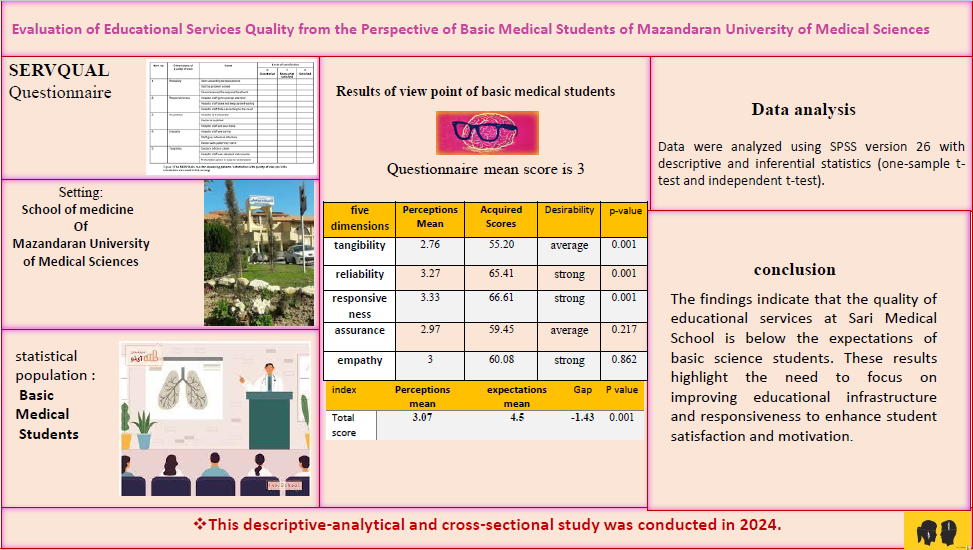
Materials and methods: This study adopted a descriptive-analytical design. The statistical population consisted of students of basic medical sciences at Mazandaran University of Medical Sciences in 2024. From this population, a total of 256 students were selected using stratified random sampling. The research instrument was a modified SERVQUAL questionnaire for educational services, consisting of 20 items across five dimensions: tangibility, reliability, responsiveness, assurance, and empathy. Collected data were analyzed with SPSS version 26 using descriptive and inferential statistics.
Results: The findings showed that in all dimensions of the SERVQUAL scale, negative gaps were observed between students’ expectations and perceptions. The average perception in the overall service quality index was 3.07, while expectations were 4.50, indicating a quality gap of -1.43. The largest gap was reported in the tangibles dimension (-1.74) and the smallest in the responsiveness dimension (-1.20). The tangibles and reliability dimensions were linked to dissatisfaction due to the lack of modern equipment and incomplete or inaccurate implementation of programs. In contrast, the assurance dimension, which reflects the academic competence and professional behavior of professors, showed a relatively better performance. Examining gender differences showed that the average perceptions of men (3.094) were slightly higher than those of women (3.034), but no significant differences were observed across the five dimensions.
Conclusion: The findings indicate that the quality of educational services at Sari Medical School falls below the expectations of basic medical sciences students. These results highlight the need to focus on improving educational infrastructure and enhancing responsiveness to increase student satisfaction and motivation.
Materials and methods: This study adopted a descriptive-analytical design. The statistical population consisted of students of basic medical sciences at Mazandaran University of Medical Sciences in 2024. From this population, a total of 256 students were selected using stratified random sampling. The research instrument was a modified SERVQUAL questionnaire for educational services, consisting of 20 items across five dimensions: tangibility, reliability, responsiveness, assurance, and empathy. Collected data were analyzed with SPSS version 26 using descriptive and inferential statistics.
Results: The findings showed that in all dimensions of the SERVQUAL scale, negative gaps were observed between students’ expectations and perceptions. The average perception in the overall service quality index was 3.07, while expectations were 4.50, indicating a quality gap of -1.43. The largest gap was reported in the tangibles dimension (-1.74) and the smallest in the responsiveness dimension (-1.20). The tangibles and reliability dimensions were linked to dissatisfaction due to the lack of modern equipment and incomplete or inaccurate implementation of programs. In contrast, the assurance dimension, which reflects the academic competence and professional behavior of professors, showed a relatively better performance. Examining gender differences showed that the average perceptions of men (3.094) were slightly higher than those of women (3.034), but no significant differences were observed across the five dimensions.
Conclusion: The findings indicate that the quality of educational services at Sari Medical School falls below the expectations of basic medical sciences students. These results highlight the need to focus on improving educational infrastructure and enhancing responsiveness to increase student satisfaction and motivation.
Type of Study: Brief Report |
Subject:
medical education
Send email to the article author
| Rights and permissions | |
 |
This work is licensed under a Creative Commons Attribution-NonCommercial 4.0 International License. |

Articles Copyright © The Author(s). Owned by Mazandaran University of Medical Sciences.
Contact Us
Address: Journal Office, Building No. 2, Mazandaran University of Medical Sciences, Moallem Square, Sari.Tel: +98 (011)34484874 Postal code: 48175-866 E-Mail: jmums@mazums.ac.ir Telefax: +98 (011)33262679
