

Volume 36, Issue 255 (3-2026)
J Mazandaran Univ Med Sci 2026, 36(255): 77-94 |
Back to browse issues page



Download citation:
BibTeX | RIS | EndNote | Medlars | ProCite | Reference Manager | RefWorks
Send citation to:


BibTeX | RIS | EndNote | Medlars | ProCite | Reference Manager | RefWorks
Send citation to:
Eslami O, Farsinejad A, Khanahmad A. Probiotics in the Management of Hepatic Diseases: Underlying Mechanisms and Clinical Applications. J Mazandaran Univ Med Sci 2026; 36 (255) :77-94
URL: http://jmums.mazums.ac.ir/article-1-22393-en.html
URL: http://jmums.mazums.ac.ir/article-1-22393-en.html


Abstract: (1082 Views)
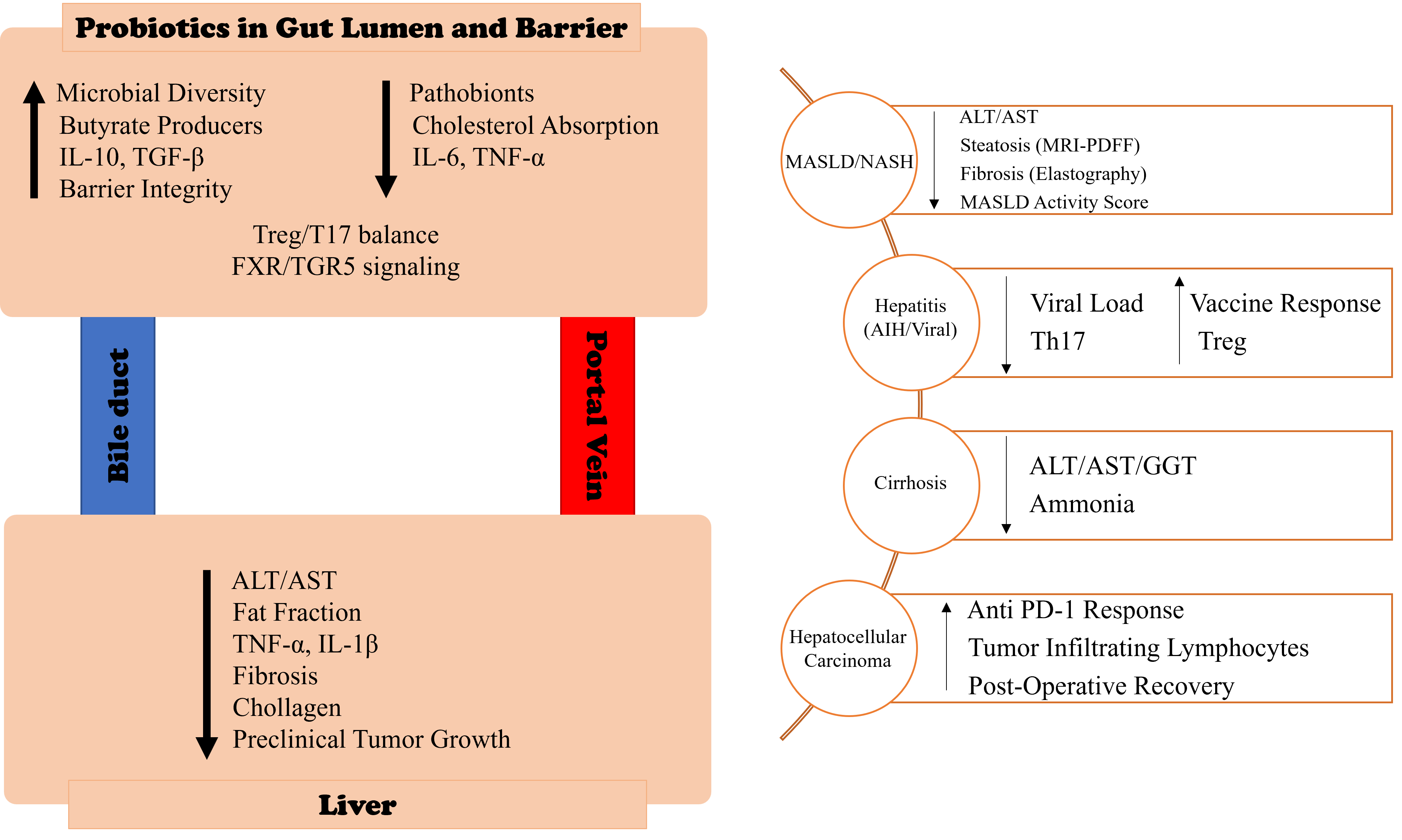
Liver diseases are among the most important public health issues globally, associated with significant mortality and disability. Increasing evidence indicates that an imbalance in the gut microbiome, known as dysbiosis, contributes to the development and progression of various liver conditions. This relationship is mediated through the gut-liver axis, where increased intestinal permeability caused by dysbiosis facilitates the transport of microbial products such as lipopolysaccharides to the liver via the portal vein and promotes liver damage by activating inflammatory pathways. In this context, probiotics, live beneficial microorganisms, promote host health by restoring intestinal microbial balance, strengthening the intestinal epithelial barrier, inhibiting inflammatory pathways, and modulating immunity. They are proposed as a novel, low-complication approach in the management of various liver diseases. The present study aims to use a narrative approach to review the hepatoprotective mechanisms of probiotics and summarize the available clinical evidence on their efficacy and safety in the management of liver diseases, including metabolic syndrome-associated fatty liver disease (MASLD), nonalcoholic steatohepatitis (NASH), viral and autoimmune hepatitis, cirrhosis, and primary liver malignancies. Findings from numerous studies indicate that probiotic administration can improve liver function parameters, reduce inflammatory markers, diminish fibrosis, and even increase response to standard treatments in some of these diseases through the aforementioned mechanisms. However, the significant heterogeneity in study results, the diversity of strains used, different doses, and safety concerns, especially in patients with immunodeficiency or advanced liver disease, make it increasingly clear that larger, well-designed clinical studies are needed to determine optimal strains, effective doses, and standardized durations of use before widespread clinical administration.
Type of Study: Review |
Subject:
Gastroenterology and Hepatology
Send email to the article author
| Rights and permissions | |
 |
This work is licensed under a Creative Commons Attribution-NonCommercial 4.0 International License. |

Articles Copyright © The Author(s). Owned by Mazandaran University of Medical Sciences.
Contact Us
Address: Journal Office, Building No. 2, Mazandaran University of Medical Sciences, Moallem Square, Sari.Tel: +98 (011)34484874 Postal code: 48175-866 E-Mail: jmums@mazums.ac.ir Telefax: +98 (011)33262679
