

Volume 35, Issue 254 (3-2026)
J Mazandaran Univ Med Sci 2026, 35(254): 47-56 |
Back to browse issues page



Download citation:
BibTeX | RIS | EndNote | Medlars | ProCite | Reference Manager | RefWorks
Send citation to:


BibTeX | RIS | EndNote | Medlars | ProCite | Reference Manager | RefWorks
Send citation to:
Meftah N, Alijanzadeh M, Moudi S, Manouchehri A, Hossieni S Z, Omrani H, et al . Suicidal Behaviors and Their Associated Factors in Patients with Type 2 Diabetes. J Mazandaran Univ Med Sci 2026; 35 (254) :47-56
URL: http://jmums.mazums.ac.ir/article-1-22403-en.html
URL: http://jmums.mazums.ac.ir/article-1-22403-en.html
Neda Meftah 
 , Mobin Alijanzadeh , Sussan Moudi , Aliasghar Manouchehri , Seyedeh Zohreh Hossieni , Haniyeh Omrani , Afsaneh Fendereski , Shiw Kumar
, Mobin Alijanzadeh , Sussan Moudi , Aliasghar Manouchehri , Seyedeh Zohreh Hossieni , Haniyeh Omrani , Afsaneh Fendereski , Shiw Kumar
Abstract: (116 Views)
Background and purpose: Type 2 diabetes is one of the most common metabolic disorders worldwide. Due to its chronic nature, patients are prone to mood disorders over time, which can lead to suicidal ideation and suicide attempts. This study aimed to assess the prevalence of suicidal behaviors and related factors in patients with diabetes referred to teaching hospitals in Babol.
Materials and methods: This cross-sectional study was conducted among patients with diabetes who presented to medical centers in Babol. Sampling was performed using a convenience sampling method. Data were collected using standardised questionnaires, including the Patient Health Questionnaire-4 (PHQ-4), Diabetes Distress Scale (DDS), Perceived Stress Scale, and the Suicide Behaviors Questionnaire-Revised (SBQ-R). Demographic information and clinical characteristics of the patients were also collected. Data analysis was performed using SPSS statistical software. A P-value of less than 0.05 was considered statistically significant.
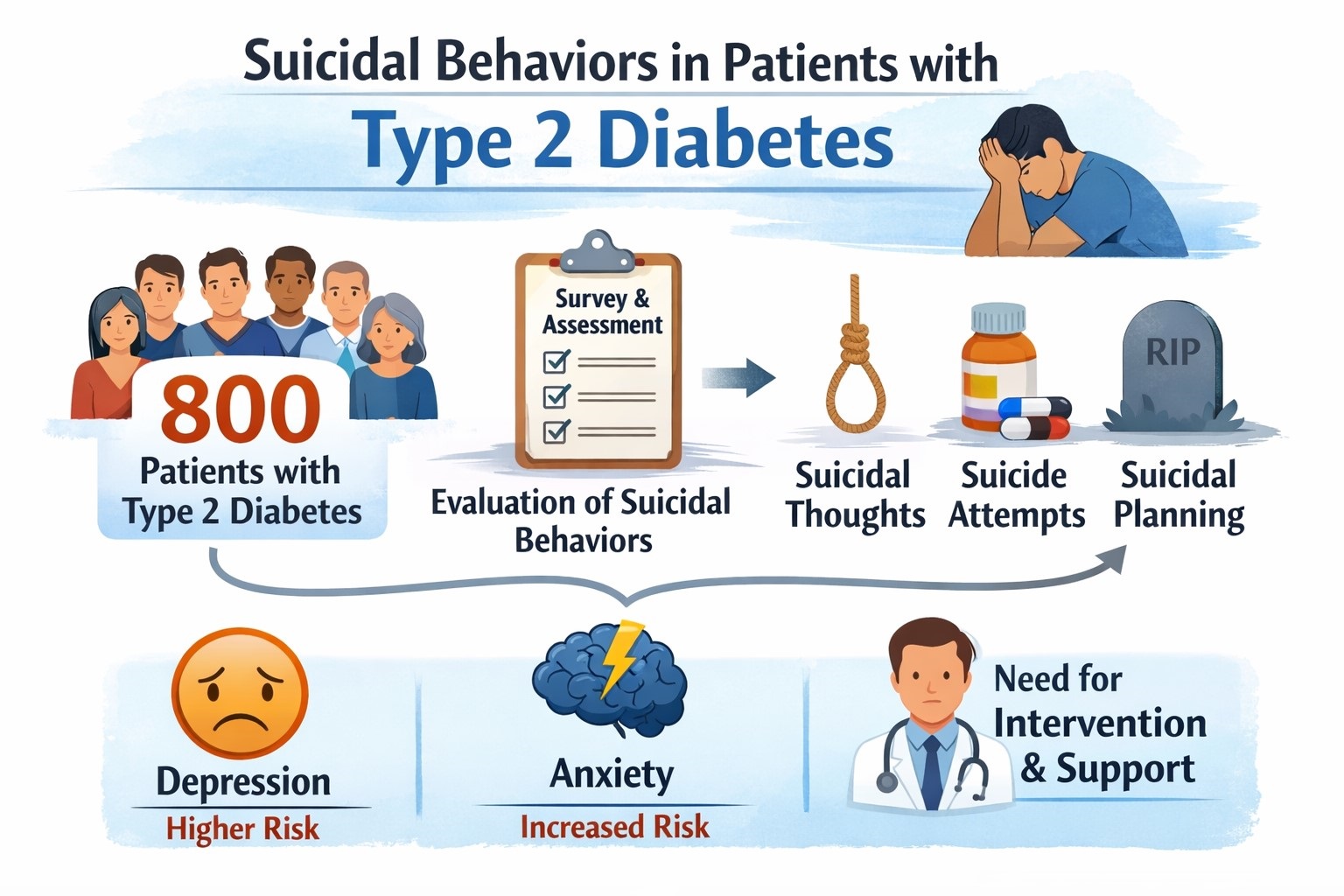
Results: In this study, 800 patients with Type 2 diabetes were examined; 47% were female. The mean score of suicidal behavior was 29.2 ± 11.75, indicating an elevated level of suicidal behavior. Male sex (P = 0.017), being employed (P = 0.005), marital status (married) (P = 0.007), and smoking (P = 0.007) were significantly associated with higher suicidal behavior scores. The mean Diabetes Distress Scale (DDS) score was 2.7 ± 0.07, which was within the normal range. The mean Perceived Stress Scale score was 14.2 ± 8.10, indicating slightly elevated perceived stress, and the mean Patient Health Questionnaire-4 (PHQ-4) score was 5.1 ± 4.02, which was within the normal range. Approximately 99% of participants had elevated Suicide Behaviors Questionnaire-Revised (SBQ-R) scores, 61.8% had high stress levels, and 8.7% had high levels of anxiety and depression. In the multivariable analysis examining the association between the study variables and suicidal behavior, only PHQ-4 remained an independent predictor (β = 0.24, P < 0.001).
Conclusion: The results showed that suicidal behavior was prevalent in the studied population, and anxiety and depression were the most important independent predictors in patients with Type 2 diabetes. Routine mental health screening is essential in these patients, and psychological interventions aimed at reducing anxiety, depression, and diabetes-related distress may help decrease the risk of suicide.
Materials and methods: This cross-sectional study was conducted among patients with diabetes who presented to medical centers in Babol. Sampling was performed using a convenience sampling method. Data were collected using standardised questionnaires, including the Patient Health Questionnaire-4 (PHQ-4), Diabetes Distress Scale (DDS), Perceived Stress Scale, and the Suicide Behaviors Questionnaire-Revised (SBQ-R). Demographic information and clinical characteristics of the patients were also collected. Data analysis was performed using SPSS statistical software. A P-value of less than 0.05 was considered statistically significant.
Results: In this study, 800 patients with Type 2 diabetes were examined; 47% were female. The mean score of suicidal behavior was 29.2 ± 11.75, indicating an elevated level of suicidal behavior. Male sex (P = 0.017), being employed (P = 0.005), marital status (married) (P = 0.007), and smoking (P = 0.007) were significantly associated with higher suicidal behavior scores. The mean Diabetes Distress Scale (DDS) score was 2.7 ± 0.07, which was within the normal range. The mean Perceived Stress Scale score was 14.2 ± 8.10, indicating slightly elevated perceived stress, and the mean Patient Health Questionnaire-4 (PHQ-4) score was 5.1 ± 4.02, which was within the normal range. Approximately 99% of participants had elevated Suicide Behaviors Questionnaire-Revised (SBQ-R) scores, 61.8% had high stress levels, and 8.7% had high levels of anxiety and depression. In the multivariable analysis examining the association between the study variables and suicidal behavior, only PHQ-4 remained an independent predictor (β = 0.24, P < 0.001).
Conclusion: The results showed that suicidal behavior was prevalent in the studied population, and anxiety and depression were the most important independent predictors in patients with Type 2 diabetes. Routine mental health screening is essential in these patients, and psychological interventions aimed at reducing anxiety, depression, and diabetes-related distress may help decrease the risk of suicide.
Type of Study: Research(Original) |
Subject:
psychiatry
Send email to the article author
| Rights and permissions | |
 |
This work is licensed under a Creative Commons Attribution-NonCommercial 4.0 International License. |

Articles Copyright © The Author(s). Owned by Mazandaran University of Medical Sciences.
Contact Us
Address: Journal Office, Building No. 2, Mazandaran University of Medical Sciences, Moallem Square, Sari.Tel: +98 (011)34484874 Postal code: 48175-866 E-Mail: jmums@mazums.ac.ir Telefax: +98 (011)33262679
