

Volume 35, Issue 251 (12-2025)
J Mazandaran Univ Med Sci 2025, 35(251): 166-177 |
Back to browse issues page


Download citation:
BibTeX | RIS | EndNote | Medlars | ProCite | Reference Manager | RefWorks
Send citation to:


BibTeX | RIS | EndNote | Medlars | ProCite | Reference Manager | RefWorks
Send citation to:
Hosseinzadeh F, Hosseini S M, Gouran Shoorkachali A, Chaharkameh A, Abbaszad Haddad, Darzi A et al . Norovirus Outbreak in the Central District of Savadkouh County, Mazandaran Province, Iran, July-August 2025: Case Description, Challenges, and Management Strategies. J Mazandaran Univ Med Sci 2025; 35 (251) :166-177
URL: http://jmums.mazums.ac.ir/article-1-22449-en.html
URL: http://jmums.mazums.ac.ir/article-1-22449-en.html
Fatemeh Hosseinzadeh 
 , Seyyedeh Mohaddeseh Hosseini , Arman Gouran Shoorkachali , Ali Chaharkameh , Abbaszad Haddad , Abdolreza Darzi , Mohammad Sadegh Rezai
, Seyyedeh Mohaddeseh Hosseini , Arman Gouran Shoorkachali , Ali Chaharkameh , Abbaszad Haddad , Abdolreza Darzi , Mohammad Sadegh Rezai
Abstract: (1849 Views)
Background and purpose: Waterborne diseases pose a significant public health threat, particularly in rural areas that lack standard water treatment systems. Norovirus is one of the most common etiologic agents of acute gastroenteritis and can be transmitted through contaminated water or person-to-person contact. This report describes an outbreak of norovirus-associated gastroenteritis that occurred in the villages of Savadkouh County, Mazandaran Province, Iran, in August 2025.
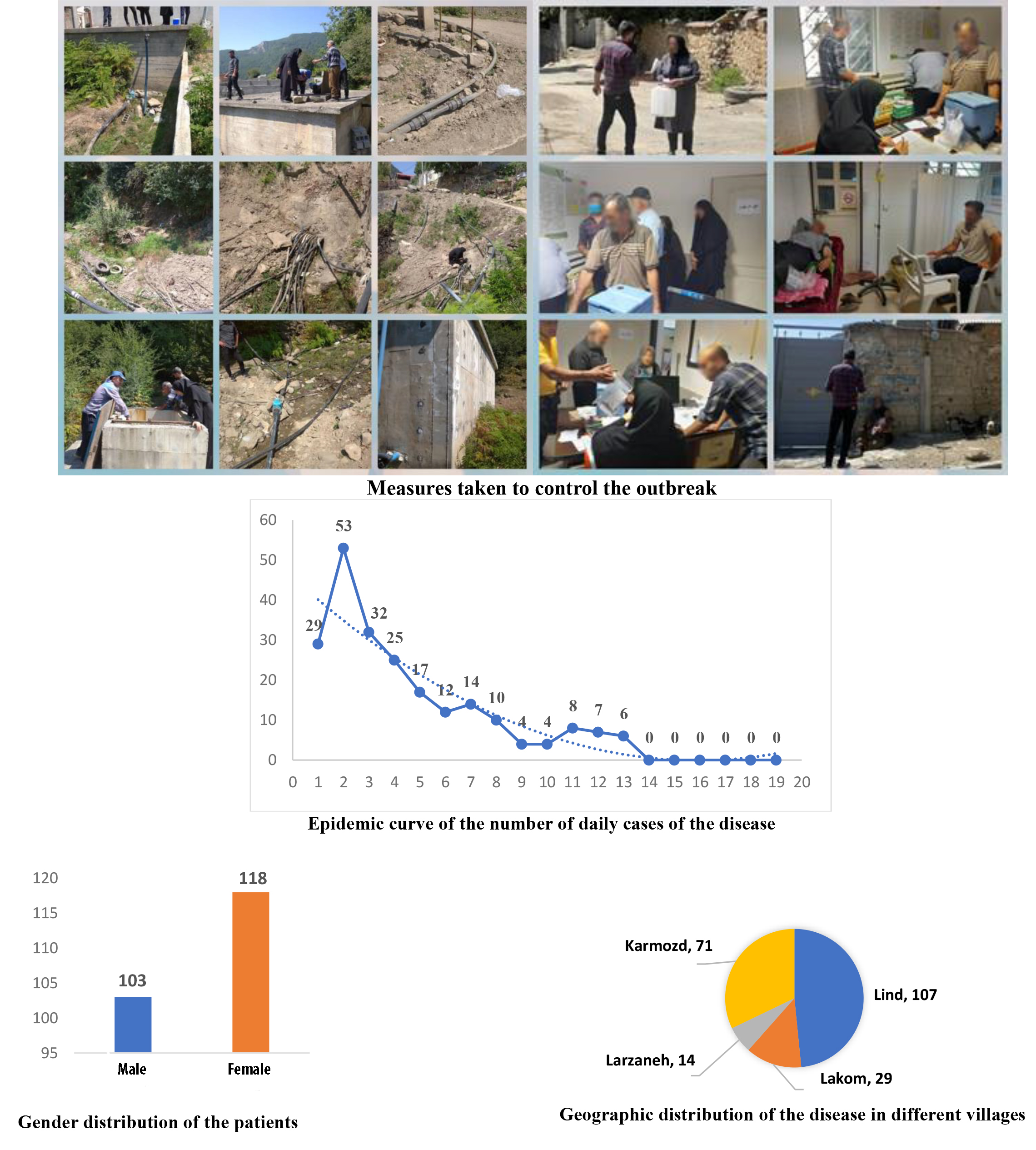
Case Report: On July 28, 2025, multiple cases of acute gastrointestinal illness (nausea, vomiting, diarrhea, and mild fever) were reported among residents and tourists in the villages of Lind, Lakom, Larzeneh, and Karmozd. The rapid epidemic curve and geographical clustering suggested a common-source outbreak. A rapid response team was activated, and immediate control actions were implemented, including water sampling, stool collection from patients, super-chlorination of the local water supply network, provision of safe water via tankers, health education, active surveillance, and rehabilitation of water sources. Stool specimens were analyzed using standard microbiological methods and RT-PCR assays for enteric pathogens, including norovirus. RT-PCR testing confirmed norovirus as the causative agent. Although water samples tested negative, strong epidemiological evidence identified the communal drinking water source (Estel spring) as the primary source of contamination. Additionally, secondary person-to-person transmission was also observed within households. A total of 221 individuals were affected, all of whom received outpatient treatment. The outbreak subsided by the 14th day and was officially declared over on the 19th day after two incubation periods with no new cases.
Conclusion: This outbreak highlighted the importance of preparedness, timely response, intersectoral coordination, and, most importantly, strengthening social determinants of health through community participation and institutional collaboration. The outbreak highlighted the crucial role of the health rapid response team, interagency cooperation, and the integration of clinical, laboratory, and environmental findings in outbreak management
Case Report: On July 28, 2025, multiple cases of acute gastrointestinal illness (nausea, vomiting, diarrhea, and mild fever) were reported among residents and tourists in the villages of Lind, Lakom, Larzeneh, and Karmozd. The rapid epidemic curve and geographical clustering suggested a common-source outbreak. A rapid response team was activated, and immediate control actions were implemented, including water sampling, stool collection from patients, super-chlorination of the local water supply network, provision of safe water via tankers, health education, active surveillance, and rehabilitation of water sources. Stool specimens were analyzed using standard microbiological methods and RT-PCR assays for enteric pathogens, including norovirus. RT-PCR testing confirmed norovirus as the causative agent. Although water samples tested negative, strong epidemiological evidence identified the communal drinking water source (Estel spring) as the primary source of contamination. Additionally, secondary person-to-person transmission was also observed within households. A total of 221 individuals were affected, all of whom received outpatient treatment. The outbreak subsided by the 14th day and was officially declared over on the 19th day after two incubation periods with no new cases.
Conclusion: This outbreak highlighted the importance of preparedness, timely response, intersectoral coordination, and, most importantly, strengthening social determinants of health through community participation and institutional collaboration. The outbreak highlighted the crucial role of the health rapid response team, interagency cooperation, and the integration of clinical, laboratory, and environmental findings in outbreak management
Type of Study: Case Report |
Subject:
Environmental Health
| Rights and permissions | |
 |
This work is licensed under a Creative Commons Attribution-NonCommercial 4.0 International License. |

Articles Copyright © The Author(s). Owned by Mazandaran University of Medical Sciences.
Contact Us
Address: Journal Office, Building No. 2, Mazandaran University of Medical Sciences, Moallem Square, Sari.Tel: +98 (011)34484874 Postal code: 48175-866 E-Mail: jmums@mazums.ac.ir Telefax: +98 (011)33262679
