

Volume 35, Issue 251 (12-2025)
J Mazandaran Univ Med Sci 2025, 35(251): 89-100 |
Back to browse issues page



Download citation:
BibTeX | RIS | EndNote | Medlars | ProCite | Reference Manager | RefWorks
Send citation to:


BibTeX | RIS | EndNote | Medlars | ProCite | Reference Manager | RefWorks
Send citation to:
Abdollahi A, Barmaki H, Mokhtari H, Abdollahi S, Khonakdar A, Musavi H et al . Investigating the Relationship Between Serum Ferritin and D-Dimer Levels and Hematological and Biochemical Parameters in Patients With COVID-19. J Mazandaran Univ Med Sci 2025; 35 (251) :89-100
URL: http://jmums.mazums.ac.ir/article-1-22485-en.html
URL: http://jmums.mazums.ac.ir/article-1-22485-en.html
Amirsalleh Abdollahi 
 , Haleh Barmaki , Hossein Mokhtari , Setayesh Abdollahi , Abbas Khonakdar , Hadis Musavi , Mozhdeh Khamesi
, Haleh Barmaki , Hossein Mokhtari , Setayesh Abdollahi , Abbas Khonakdar , Hadis Musavi , Mozhdeh Khamesi
Abstract: (1666 Views)
Background and purpose: Ferritin and D-dimer, as biomarkers of inflammation and coagulation disorders, respectively, play an important role in assessing the severity of COVID-19. The aim of this study was to investigate the relationship between these two markers and patients’ demographic, biochemical, hematological, and inflammatory characteristics in COVID-19.
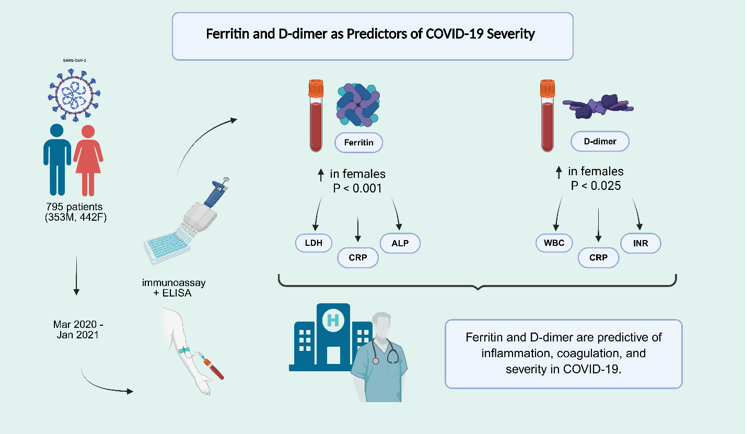
Materials and methods: In this retrospective cross-sectional (record-based) study, all patients with confirmed COVID-19 who were hospitalized at Bu Ali Sina Hospital, Sari, between March 2020 and January 2021 were screened. After applying the inclusion and exclusion criteria, a total of 795 patients (442 women and 353 men) were included in the final analysis. Data on ferritin, D-dimer, urea, creatinine, blood glucose, liver enzymes, bilirubin, electrolytes, ESR, CBC, CRP, and coagulation parameters (PT, INR, PTT) were extracted from patient records.
Results: Ferritin and D-dimer concentrations were significantly higher in women than in men (P<0.001 and P=0.025, respectively). Both markers were significantly elevated in patients with high CRP levels (P<0.001). Ferritin exhibited a positive and significant correlation with inflammatory indices (WBC, neutrophils, ESR), liver enzymes, and renal parameters (urea and creatinine). D-dimer also showed a positive correlation with coagulation indices (INR, PT, PTT), liver enzymes, and renal parameters, and a negative correlation with hemoglobin (Hb), hematocrit (Hct), and mean corpuscular hemoglobin (MCH). In multiple regression analysis, CRP, ALP, and LDH were independently associated with increased ferritin levels, whereas elevated D-dimer was significantly associated with increased CRP, INR, white blood cell count, and phosphorus levels.
Conclusion: Continuous monitoring of ferritin and D-dimer in COVID-19 patients may improve clinical outcomes by guiding the management of inflammation and coagulation-related risks.
Materials and methods: In this retrospective cross-sectional (record-based) study, all patients with confirmed COVID-19 who were hospitalized at Bu Ali Sina Hospital, Sari, between March 2020 and January 2021 were screened. After applying the inclusion and exclusion criteria, a total of 795 patients (442 women and 353 men) were included in the final analysis. Data on ferritin, D-dimer, urea, creatinine, blood glucose, liver enzymes, bilirubin, electrolytes, ESR, CBC, CRP, and coagulation parameters (PT, INR, PTT) were extracted from patient records.
Results: Ferritin and D-dimer concentrations were significantly higher in women than in men (P<0.001 and P=0.025, respectively). Both markers were significantly elevated in patients with high CRP levels (P<0.001). Ferritin exhibited a positive and significant correlation with inflammatory indices (WBC, neutrophils, ESR), liver enzymes, and renal parameters (urea and creatinine). D-dimer also showed a positive correlation with coagulation indices (INR, PT, PTT), liver enzymes, and renal parameters, and a negative correlation with hemoglobin (Hb), hematocrit (Hct), and mean corpuscular hemoglobin (MCH). In multiple regression analysis, CRP, ALP, and LDH were independently associated with increased ferritin levels, whereas elevated D-dimer was significantly associated with increased CRP, INR, white blood cell count, and phosphorus levels.
Conclusion: Continuous monitoring of ferritin and D-dimer in COVID-19 patients may improve clinical outcomes by guiding the management of inflammation and coagulation-related risks.
Type of Study: Research(Original) |
Subject:
Sports biomechanics
| Rights and permissions | |
 |
This work is licensed under a Creative Commons Attribution-NonCommercial 4.0 International License. |

Articles Copyright © The Author(s). Owned by Mazandaran University of Medical Sciences.
Contact Us
Address: Journal Office, Building No. 2, Mazandaran University of Medical Sciences, Moallem Square, Sari.Tel: +98 (011)34484874 Postal code: 48175-866 E-Mail: jmums@mazums.ac.ir Telefax: +98 (011)33262679
