

Volume 36, Issue 257 (5-2026)
J Mazandaran Univ Med Sci 2026, 36(257): 30-41 |
Back to browse issues page



Download citation:
BibTeX | RIS | EndNote | Medlars | ProCite | Reference Manager | RefWorks
Send citation to:


BibTeX | RIS | EndNote | Medlars | ProCite | Reference Manager | RefWorks
Send citation to:
Rashidi I, Pazhouhi M, Khani Hemmatabadi F, Asadollahi M. Modulation of PI3K/AKT/mTOR-Related Gene Expression and Induction of Apoptosis in Pancreatic Cancer Cells by Hemiscorpius lepturus Scorpion Venom. J Mazandaran Univ Med Sci 2026; 36 (257) :30-41
URL: http://jmums.mazums.ac.ir/article-1-22553-en.html
URL: http://jmums.mazums.ac.ir/article-1-22553-en.html


Abstract: (600 Views)
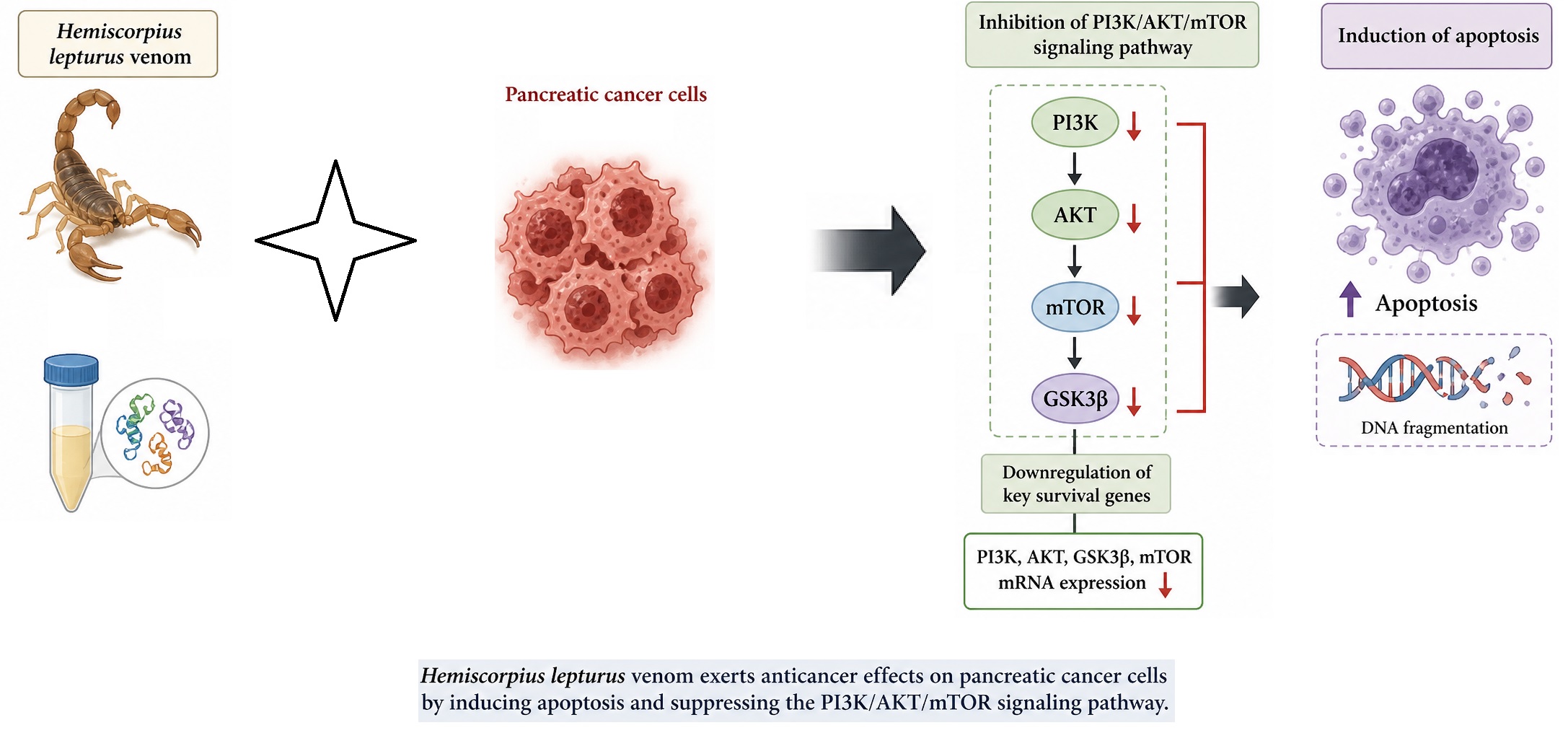
Background and purpose: Pancreatic cancer is one of the most aggressive and lethal malignancies and continues to have a poor prognosis due to its marked resistance to chemotherapy. In recent years, natural compounds, including peptides derived from scorpion venom, have attracted considerable attention as potential novel anticancer agents. The venom of the scorpion Hemiscorpius lepturus, which is considered one of the most potent venoms in Iran, contains bioactive molecules capable of targeting key cellular pathways involved in survival and proliferation. This study aimed to investigate the cytotoxic and apoptotic effects of this scorpion venom on pancreatic cancer cells and to evaluate its role in modulating the PI3K/AKT/mTOR signaling pathway.
Materials and methods: Pancreatic cancer cells and fibroblasts were treated with venom at concentrations of 80, 40, 20, 10, and 5 μg/mL for 24, 48, and 72 hours, and cell viability and cytotoxicity were assessed. Subsequently, after treating the cells with the IC50 concentration of the venom for 24 hours, the apoptosis rate was evaluated using the diphenylamine assay. In addition, to analyze molecular changes, the expression of PI3K, AKT, GSK3β, and mTOR genes was measured using real-time PCR.
Results: H. lepturus venom significantly reduced the viability of pancreatic cancer cells and increased cytotoxicity in a dose- and time-dependent manner. The rate of apoptosis was also significantly increased at all concentrations. Molecular analysis further demonstrated a significant decrease in the expression of PI3K, AKT, GSK3β, and mTOR genes after 24 hours of treatment, indicating inhibition of the survival signaling pathway.
Conclusion: Hemiscorpius lepturus venom exhibits significant anticancer effects on pancreatic cancer cells by inducing apoptosis and inhibiting key components of the PI3K/AKT/mTOR signaling pathway. These findings may facilitate the identification of active peptides and support the development of novel therapeutic agents derived from natural sources for pancreatic cancer treatment.
Materials and methods: Pancreatic cancer cells and fibroblasts were treated with venom at concentrations of 80, 40, 20, 10, and 5 μg/mL for 24, 48, and 72 hours, and cell viability and cytotoxicity were assessed. Subsequently, after treating the cells with the IC50 concentration of the venom for 24 hours, the apoptosis rate was evaluated using the diphenylamine assay. In addition, to analyze molecular changes, the expression of PI3K, AKT, GSK3β, and mTOR genes was measured using real-time PCR.
Results: H. lepturus venom significantly reduced the viability of pancreatic cancer cells and increased cytotoxicity in a dose- and time-dependent manner. The rate of apoptosis was also significantly increased at all concentrations. Molecular analysis further demonstrated a significant decrease in the expression of PI3K, AKT, GSK3β, and mTOR genes after 24 hours of treatment, indicating inhibition of the survival signaling pathway.
Conclusion: Hemiscorpius lepturus venom exhibits significant anticancer effects on pancreatic cancer cells by inducing apoptosis and inhibiting key components of the PI3K/AKT/mTOR signaling pathway. These findings may facilitate the identification of active peptides and support the development of novel therapeutic agents derived from natural sources for pancreatic cancer treatment.
Type of Study: Research(Original) |
Subject:
Internal medicine
Send email to the article author
| Rights and permissions | |
 |
This work is licensed under a Creative Commons Attribution-NonCommercial 4.0 International License. |

Articles Copyright © The Author(s). Owned by Mazandaran University of Medical Sciences.
Contact Us
Address: Journal Office, Building No. 2, Mazandaran University of Medical Sciences, Moallem Square, Sari.Tel: +98 (011)34484874 Postal code: 48175-866 E-Mail: jmums@mazums.ac.ir Telefax: +98 (011)33262679
