

Volume 36, Issue 258 (7-2026)
J Mazandaran Univ Med Sci 2026, 36(258): 171-183 |
Back to browse issues page



Download citation:
BibTeX | RIS | EndNote | Medlars | ProCite | Reference Manager | RefWorks
Send citation to:


BibTeX | RIS | EndNote | Medlars | ProCite | Reference Manager | RefWorks
Send citation to:
Aali S, Rezazadeh F, Sharifi P. A Systematic Review of Biomechanical Risk Factors for Non-Contact Anterior Cruciate Ligament Injury: Discrepancies Between Laboratory Assessments and Ecologically Valid Match Conditions. J Mazandaran Univ Med Sci 2026; 36 (258) :171-183
URL: http://jmums.mazums.ac.ir/article-1-22680-en.html
URL: http://jmums.mazums.ac.ir/article-1-22680-en.html


Abstract: (753 Views)
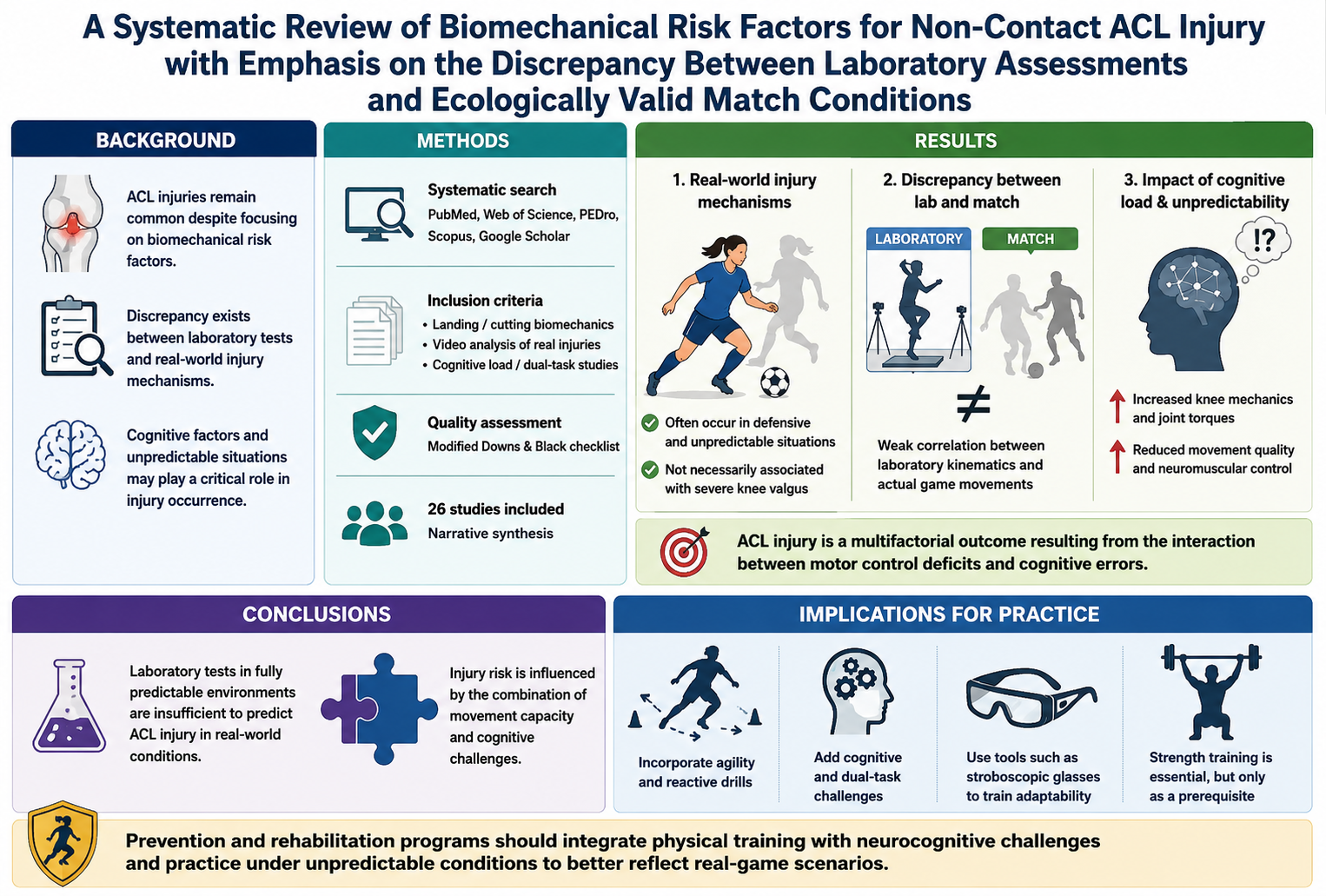
Background and purpose: Despite substantial efforts to correct biomechanical risk factors such as dynamic knee valgus and hip muscle weakness, the incidence of anterior cruciate ligament (ACL) injuries remains high among athletes. This systematic review aimed to examine the discrepancies between laboratory-based kinematic assessments and real-world ACL injury mechanisms, while also evaluating the role of cognitive factors in injury occurrence.
Materials and methods: A comprehensive literature search was conducted across PubMed, Web of Science, PEDro, and Scopus, with Google Scholar searched to identify grey literature. Eligible studies published between January 1, 2010, and January 1, 2025, were identified. Studies investigating landing and cutting biomechanics, systematic video analyses of real ACL injuries, and the effects of cognitive load on movement biomechanics were included. The methodological quality of the 26 eligible studies was assessed using a modified Downs and Black checklist, and the findings were synthesized narratively.
Results: Video analyses consistently demonstrated that real-world ACL injuries often occur during defensive and unpredictable situations and are not necessarily associated with severe knee valgus. In contrast, laboratory-based kinematic measures showed only weak correlations with movement patterns observed during competition. Furthermore, introducing cognitive load and decision-making requirements during cutting maneuvers significantly increased knee joint loading, joint torques, and other biomechanical variables associated with ACL injury risk, yet these factors are seldom incorporated into conventional screening protocols.
Conclusion: The evidence suggests that laboratory tests conducted under fully predictable conditions may be insufficient for predicting ACL injury risk in the dynamic and complex environment of competitive sport. Rather than being solely the consequence of biomechanical deficits, ACL injury appears to result from the interaction between impaired motor control and cognitive demands encountered during sport-specific tasks. Accordingly, screening and injury prevention programmes should extend beyond technique correction to incorporate cognitive challenges and training under unpredictable conditions, thereby improving their ecological validity and better reflecting the demands of real-game situations.
Materials and methods: A comprehensive literature search was conducted across PubMed, Web of Science, PEDro, and Scopus, with Google Scholar searched to identify grey literature. Eligible studies published between January 1, 2010, and January 1, 2025, were identified. Studies investigating landing and cutting biomechanics, systematic video analyses of real ACL injuries, and the effects of cognitive load on movement biomechanics were included. The methodological quality of the 26 eligible studies was assessed using a modified Downs and Black checklist, and the findings were synthesized narratively.
Results: Video analyses consistently demonstrated that real-world ACL injuries often occur during defensive and unpredictable situations and are not necessarily associated with severe knee valgus. In contrast, laboratory-based kinematic measures showed only weak correlations with movement patterns observed during competition. Furthermore, introducing cognitive load and decision-making requirements during cutting maneuvers significantly increased knee joint loading, joint torques, and other biomechanical variables associated with ACL injury risk, yet these factors are seldom incorporated into conventional screening protocols.
Conclusion: The evidence suggests that laboratory tests conducted under fully predictable conditions may be insufficient for predicting ACL injury risk in the dynamic and complex environment of competitive sport. Rather than being solely the consequence of biomechanical deficits, ACL injury appears to result from the interaction between impaired motor control and cognitive demands encountered during sport-specific tasks. Accordingly, screening and injury prevention programmes should extend beyond technique correction to incorporate cognitive challenges and training under unpredictable conditions, thereby improving their ecological validity and better reflecting the demands of real-game situations.
Type of Study: Review |
Subject:
Sports biomechanics
Send email to the article author
| Rights and permissions | |
 |
This work is licensed under a Creative Commons Attribution-NonCommercial 4.0 International License. |

Articles Copyright © The Author(s). Owned by Mazandaran University of Medical Sciences.
Contact Us
Address: Journal Office, Building No. 2, Mazandaran University of Medical Sciences, Moallem Square, Sari.Tel: +98 (011)34484874 Postal code: 48175-866 E-Mail: jmums@mazums.ac.ir Telefax: +98 (011)33262679
