

Volume 36, Issue 261 (10-2026)
J Mazandaran Univ Med Sci 2026, 36(261): 31-40 |
Back to browse issues page



Download citation:
BibTeX | RIS | EndNote | Medlars | ProCite | Reference Manager | RefWorks
Send citation to:


BibTeX | RIS | EndNote | Medlars | ProCite | Reference Manager | RefWorks
Send citation to:
Naghizadeh H, Alizadehkhatir A, Chehrazi M, Pourkia R. Association between Stroke Severity and Echocardiographic and Electrocardiographic Findings. J Mazandaran Univ Med Sci 2026; 36 (261) :31-40
URL: http://jmums.mazums.ac.ir/article-1-22737-en.html
URL: http://jmums.mazums.ac.ir/article-1-22737-en.html


Abstract: (18 Views)
Background and purpose: Cerebrovascular accidents (strokes) are a major cause of disability and mortality worldwide. Since structural heart diseases and cardiac arrhythmias are known risk factors for cerebrovascular events, this study aimed to investigate the association between stroke severity and echocardiographic and electrocardiographic findings.
Materials and methods: This cross-sectional study was conducted over a two-year period and included 220 patients with cerebrovascular accidents who were hospitalized at Rouhani Hospital, Babol. Patients were divided into mild and severe stroke groups according to stroke severity, based on the modified Rankin Scale (mRS) and National Institutes of Health Stroke Scale (NIHSS) scores. Patient information, including sex, age, cerebrovascular risk factors, underlying diseases, echocardiographic findings, and electrocardiographic abnormalities, was extracted from medical records and compared between the groups.
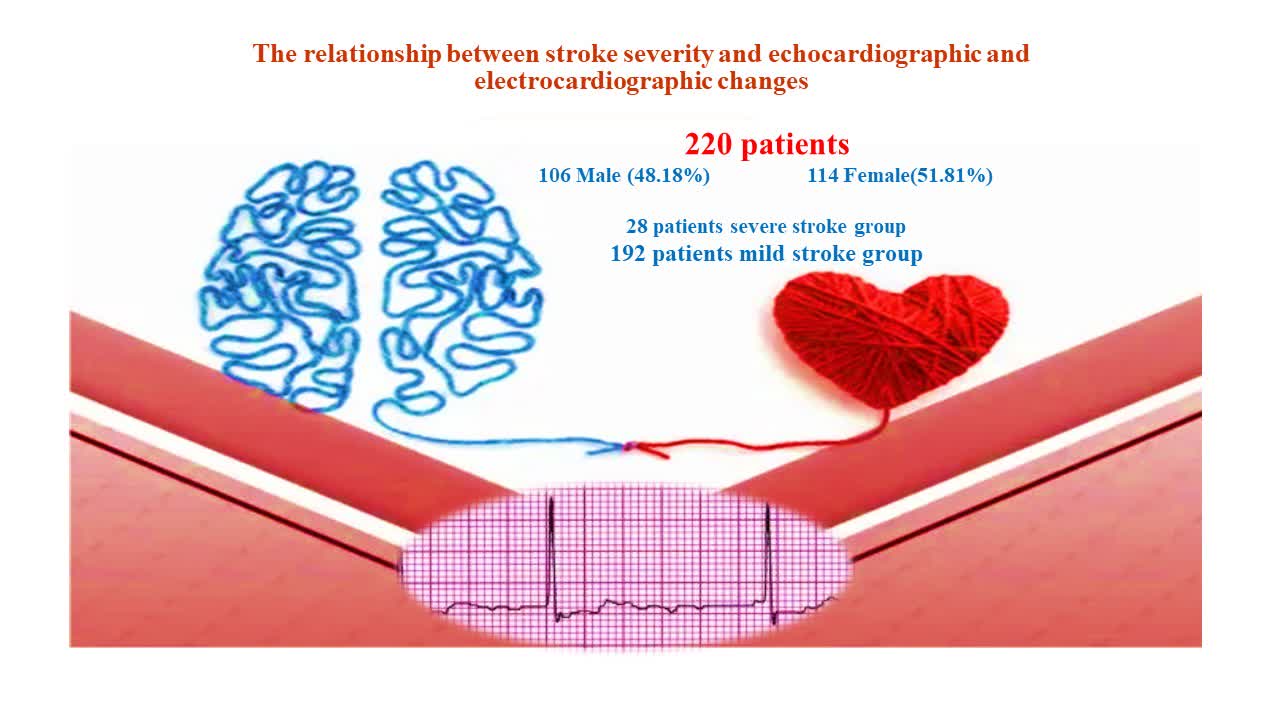
Results: The mean age of the patients was 70.11 ± 13.27 years. Of the 220 patients, 106 (48.18%) were male and 114 (51.81%) were female. Based on NIHSS scores, 28 patients were in the severe stroke group and 192 were in the mild stroke group. Atrial fibrillation was detected in 18.23% of patients, ST-T changes in 39.09%, tachyarrhythmias in 81.36%, and bradycardia in 72.7%. The frequency of left atrial (LA) enlargement was 64.28% in patients with severe stroke and 27.6% in patients with mild stroke (P < 0.001). ST-T changes, tachyarrhythmias, left ventricular (LV) dysfunction, LA enlargement, and valvular abnormalities were more frequent in patients with severe stroke. A significant association was observed between ST-T changes and stroke severity based on NIHSS scores.
Conclusion: The study showed that greater stroke severity was associated with cardiac abnormalities, including left ventricular dysfunction, left atrial enlargement, and valvular abnormalities, as well as ECG abnormalities such as ST-T changes and tachyarrhythmias.
Materials and methods: This cross-sectional study was conducted over a two-year period and included 220 patients with cerebrovascular accidents who were hospitalized at Rouhani Hospital, Babol. Patients were divided into mild and severe stroke groups according to stroke severity, based on the modified Rankin Scale (mRS) and National Institutes of Health Stroke Scale (NIHSS) scores. Patient information, including sex, age, cerebrovascular risk factors, underlying diseases, echocardiographic findings, and electrocardiographic abnormalities, was extracted from medical records and compared between the groups.
Results: The mean age of the patients was 70.11 ± 13.27 years. Of the 220 patients, 106 (48.18%) were male and 114 (51.81%) were female. Based on NIHSS scores, 28 patients were in the severe stroke group and 192 were in the mild stroke group. Atrial fibrillation was detected in 18.23% of patients, ST-T changes in 39.09%, tachyarrhythmias in 81.36%, and bradycardia in 72.7%. The frequency of left atrial (LA) enlargement was 64.28% in patients with severe stroke and 27.6% in patients with mild stroke (P < 0.001). ST-T changes, tachyarrhythmias, left ventricular (LV) dysfunction, LA enlargement, and valvular abnormalities were more frequent in patients with severe stroke. A significant association was observed between ST-T changes and stroke severity based on NIHSS scores.
Conclusion: The study showed that greater stroke severity was associated with cardiac abnormalities, including left ventricular dysfunction, left atrial enlargement, and valvular abnormalities, as well as ECG abnormalities such as ST-T changes and tachyarrhythmias.
Type of Study: Research(Original) |
Subject:
Eco cardiography
Send email to the article author
| Rights and permissions | |
 |
This work is licensed under a Creative Commons Attribution-NonCommercial 4.0 International License. |

Articles Copyright © The Author(s). Owned by Mazandaran University of Medical Sciences.
Contact Us
Address: Journal Office, Building No. 2, Mazandaran University of Medical Sciences, Moallem Square, Sari.Tel: +98 (011)34484874 Postal code: 48175-866 E-Mail: jmums@mazums.ac.ir Telefax: +98 (011)33262679
