




BibTeX | RIS | EndNote | Medlars | ProCite | Reference Manager | RefWorks
Send citation to:


URL: http://jmums.mazums.ac.ir/article-1-22848-en.html

 , Hatam Boostani , Neda Sadrizadeh , Esmaeel Mousavi Asl , Firoozeh Mohtashamzadeh *
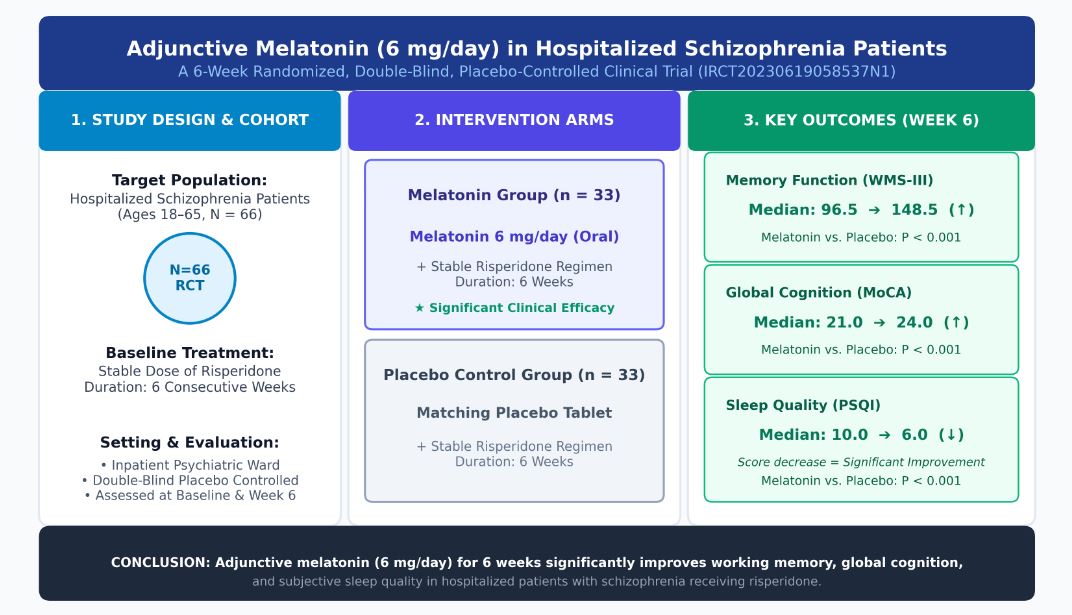
Background and purpose: Persistent cognitive deficits in schizophrenia contribute substantially to functional disability and often respond poorly to conventional antipsychotic treatment. Given its neuroprotective and antioxidant properties, melatonin may have potential as an adjunctive treatment. This study evaluated the effects of adjunctive melatonin on neurocognitive performance and sleep quality in patients with schizophrenia whose symptoms were stabilised with risperidone.
Materials and methods: In this six-week, double-blind, randomised controlled trial, 66 patients with schizophrenia were randomly allocated to receive either melatonin (6 mg/day) or placebo alongside risperidone. Cognitive performance and sleep quality were assessed at baseline and at weeks 4 and 6 using the Montreal Cognitive Assessment (MoCA), Wechsler Memory Scale-III (WMS-III), and Pittsburgh Sleep Quality Index (PSQI). As the data were not normally distributed (Shapiro–Wilk test, P < 0.05), non-parametric tests were used, including the Friedman test, Mann–Whitney U test, and Wilcoxon signed-rank test with Bonferroni correction. Effect sizes were calculated using r = Z/√N.
Results: At week 6, the melatonin group showed significant improvements in WMS-III general memory scores (P < 0.001, r = 0.74) and MoCA scores (P < 0.001, r = 0.61), whereas changes in the placebo group were not statistically significant (P > 0.05, r = 0.07). PSQI scores decreased significantly only in the melatonin group (P < 0.001, r = 0.61), indicating improved sleep quality. Week 6 between-group comparisons showed statistically significant differences favouring melatonin across the assessed cognitive and sleep outcomes (P = 0.001). Within-group analyses showed significant changes across the three assessment time points (P < 0.001). Adverse events were mild and did not differ significantly between groups (P > 0.05).
Conclusion: Adjunctive melatonin was associated with improvements in neurocognitive performance and sleep quality in patients with schizophrenia receiving risperidone, with no significant between-group difference in adverse events observed. These findings suggest that melatonin may be a promising adjunctive approach for addressing residual cognitive deficits and sleep disturbances in this population.
Clinical Trial Registration: IRCT20230619058537N1
| Rights and permissions | |
 |
This work is licensed under a Creative Commons Attribution-NonCommercial 4.0 International License. |

Articles Copyright © The Author(s). Owned by Mazandaran University of Medical Sciences.
Contact Us
Address: Journal Office, Building No. 2, Mazandaran University of Medical Sciences, Moallem Square, Sari.Tel: +98 (011)34484874 Postal code: 48175-866 E-Mail: jmums@mazums.ac.ir Telefax: +98 (011)33262679
