

Volume 36, Issue 262 (Special Issue 2026)
J Mazandaran Univ Med Sci 2026, 36(262): 128-141 |
Back to browse issues page



Download citation:
BibTeX | RIS | EndNote | Medlars | ProCite | Reference Manager | RefWorks
Send citation to:


BibTeX | RIS | EndNote | Medlars | ProCite | Reference Manager | RefWorks
Send citation to:
Banouei H, Arsalani N, Norouzi Tabrizi K, Seyed-Al-Shohadaei F, Vahedi M. The Effect of Nursing Rehabilitation Interventions on the Quality of Life of Liver Transplant Candidates: A Controlled Pretest–Posttest Study. , J Mazandaran Univ Med Sci. 2026; 36 (262) :128-141
URL: http://jmums.mazums.ac.ir/article-1-22891-en.html
URL: http://jmums.mazums.ac.ir/article-1-22891-en.html
Hadiseh Banouei 
 , Narges Arsalani * , Kian Norouzi Tabrizi , Fariba Seyed-Al-Shohadaei , Mohsen Vahedi
Abstract: (38 Views)
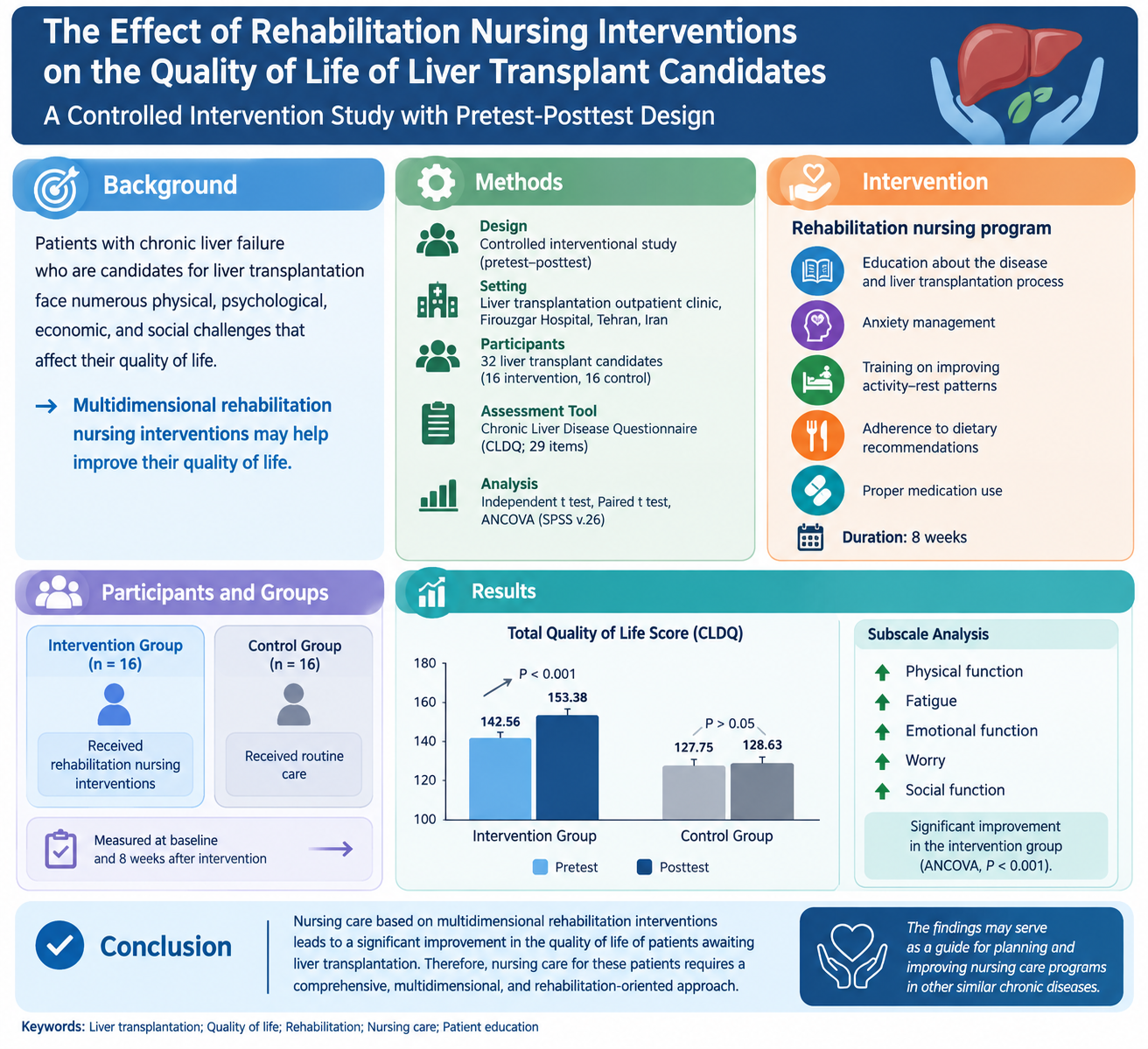
Background and purpose: Liver transplant candidates face physical, psychological, financial, and social challenges that may adversely affect their quality of life. Multidimensional nursing rehabilitation interventions may help improve quality of life in this population. This study aimed to evaluate the effect of nursing rehabilitation interventions on the quality of life of liver transplant candidates attending the Liver Transplant Clinic at Firouzgar Hospital in Tehran, Iran.
Materials and methods: This controlled pretest-posttest intervention study involved 32 liver transplant candidates divided into an intervention group (n = 16) and a control group (n = 16) at the Liver Transplant Clinic of Firouzgar Hospital, Tehran, Iran. The intervention group received a nursing rehabilitation programme comprising education on the transplant process, anxiety management, optimisation of activity and rest patterns, adherence to dietary recommendations, and correct medication use. Quality of life was assessed at baseline and eight weeks after the intervention using the 29-item Chronic Liver Disease Questionnaire (CLDQ). Data were analysed using independent-samples and paired-samples t-tests and analysis of covariance (ANCOVA) in SPSS version 26.
Results: The mean quality-of-life score in the intervention group increased from 142.56 at baseline to 153.38 after the intervention (P < 0.001). In contrast, no statistically significant change was observed in the control group, whose mean score increased from 127.75 to 128.63 (P > 0.05). The intervention effect remained statistically significant after adjustment for baseline quality-of-life scores using ANCOVA (P < 0.001).
Conclusion: Multidimensional nursing rehabilitation interventions significantly improved the quality of life of liver transplant candidates, highlighting the importance of a multidimensional, rehabilitation-oriented approach to their care.
Type of Study: Research(Original) |
Subject:
nursing
Send email to the article author
| Rights and permissions | |
 |
This work is licensed under a Creative Commons Attribution-NonCommercial 4.0 International License. |

Articles Copyright © The Author(s). Owned by Mazandaran University of Medical Sciences.
Contact Us
Address: Journal Office, Building No. 2, Mazandaran University of Medical Sciences, Moallem Square, Sari.Tel: +98 (011)34484874 Postal code: 48175-866 E-Mail: jmums@mazums.ac.ir Telefax: +98 (011)33262679
