

Volume 36, Issue 260 (9-2026)
J Mazandaran Univ Med Sci 2026, 36(260): 115-128 |
Back to browse issues page



Download citation:
BibTeX | RIS | EndNote | Medlars | ProCite | Reference Manager | RefWorks
Send citation to:


BibTeX | RIS | EndNote | Medlars | ProCite | Reference Manager | RefWorks
Send citation to:
Hojjati H, Rohani F, Zahirnia A H, Salehzadeh A, Nikookar S H. Species Diversity of Hard Ticks (Ixodidae) Infesting Livestock in Western Golestan Province, Iran: A Cross-Sectional Study, 2022–2023. J Mazandaran Univ Med Sci 2026; 36 (260) :115-128
URL: http://jmums.mazums.ac.ir/article-1-22928-en.html
URL: http://jmums.mazums.ac.ir/article-1-22928-en.html


Abstract: (15 Views)
Background and purpose: Hard ticks (family Ixodidae) are obligatory ectoparasites of humans and animals and serve as vectors for a wide range of medically and veterinarily important pathogens, including bacteria, viruses, rickettsiae, protozoa, and fungi. Identifying and assessing the diversity of tick species infesting livestock in specific regions is essential for developing effective tick control and disease prevention strategies. This study aimed to determine the species diversity of hard ticks infesting livestock in the western districts of Golestan Province to support local surveillance and control programs.
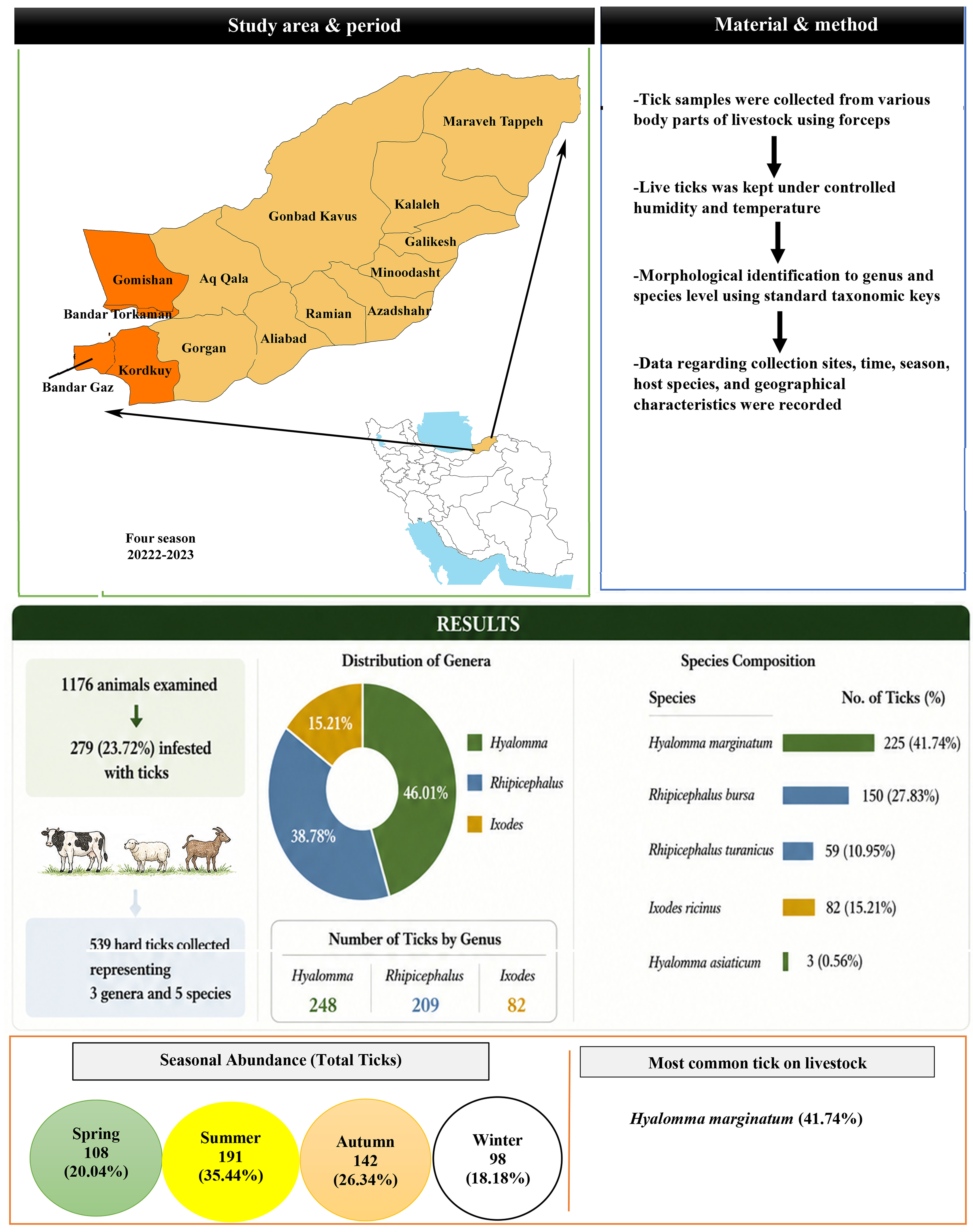
Materials and methods: A descriptive cross-sectional study was conducted over four seasons from 2022 to 2023. Tick samples were collected from various body parts of livestock in rural areas of Kordkuy, Bandar-e Torkaman, Bandar-e Gaz, and Gomishan counties. Live ticks were carefully removed using forceps, kept under controlled temperature and humidity conditions, and transported to the Medical Entomology Laboratory of Hamadan University of Medical Sciences for morphological identification at the genus and species levels using standard taxonomic keys. Data on collection sites, collection time, season, host species, and geographical characteristics were recorded and analyzed.
Results: Of the 1,176 animals examined, 279 (23.72%) were infested with ticks. A total of 539 hard ticks were collected, representing three genera and five species. The recorded genera included Hyalomma (46.01%), Rhipicephalus (38.78%), and Ixodes (15.21%). Hyalomma marginatum was the most abundant species (41.74%), whereas Hyalomma asiaticum was the least abundant (0.56%).
Conclusion: This study demonstrates considerable diversity and distinct seasonal variation in the abundance of hard ticks, particularly Hyalomma marginatum, among livestock in western Golestan Province. The findings underscore the need for targeted tick control measures and continuous epidemiological monitoring to mitigate the risk of tick-borne diseases in the region.
Materials and methods: A descriptive cross-sectional study was conducted over four seasons from 2022 to 2023. Tick samples were collected from various body parts of livestock in rural areas of Kordkuy, Bandar-e Torkaman, Bandar-e Gaz, and Gomishan counties. Live ticks were carefully removed using forceps, kept under controlled temperature and humidity conditions, and transported to the Medical Entomology Laboratory of Hamadan University of Medical Sciences for morphological identification at the genus and species levels using standard taxonomic keys. Data on collection sites, collection time, season, host species, and geographical characteristics were recorded and analyzed.
Results: Of the 1,176 animals examined, 279 (23.72%) were infested with ticks. A total of 539 hard ticks were collected, representing three genera and five species. The recorded genera included Hyalomma (46.01%), Rhipicephalus (38.78%), and Ixodes (15.21%). Hyalomma marginatum was the most abundant species (41.74%), whereas Hyalomma asiaticum was the least abundant (0.56%).
Conclusion: This study demonstrates considerable diversity and distinct seasonal variation in the abundance of hard ticks, particularly Hyalomma marginatum, among livestock in western Golestan Province. The findings underscore the need for targeted tick control measures and continuous epidemiological monitoring to mitigate the risk of tick-borne diseases in the region.
Type of Study: Research(Original) |
Subject:
Medical Entomology
Send email to the article author
| Rights and permissions | |
 |
This work is licensed under a Creative Commons Attribution-NonCommercial 4.0 International License. |

Articles Copyright © The Author(s). Owned by Mazandaran University of Medical Sciences.
Contact Us
Address: Journal Office, Building No. 2, Mazandaran University of Medical Sciences, Moallem Square, Sari.Tel: +98 (011)34484874 Postal code: 48175-866 E-Mail: jmums@mazums.ac.ir Telefax: +98 (011)33262679
