

Volume 36, Issue 260 (9-2026)
J Mazandaran Univ Med Sci 2026, 36(260): 30-43 |
Back to browse issues page



Download citation:
BibTeX | RIS | EndNote | Medlars | ProCite | Reference Manager | RefWorks
Send citation to:


BibTeX | RIS | EndNote | Medlars | ProCite | Reference Manager | RefWorks
Send citation to:
Sadeghimahalli F, Amiri A, Siahposht-Khachaki A. Effects of Salsalate on Traumatic Brain Injury in Male Rats: Neurological Function, Blood-Brain Barrier Permeability, Cerebral Edema, and Inflammatory Responses. J Mazandaran Univ Med Sci 2026; 36 (260) :30-43
URL: http://jmums.mazums.ac.ir/article-1-22964-en.html
URL: http://jmums.mazums.ac.ir/article-1-22964-en.html


Abstract: (17 Views)
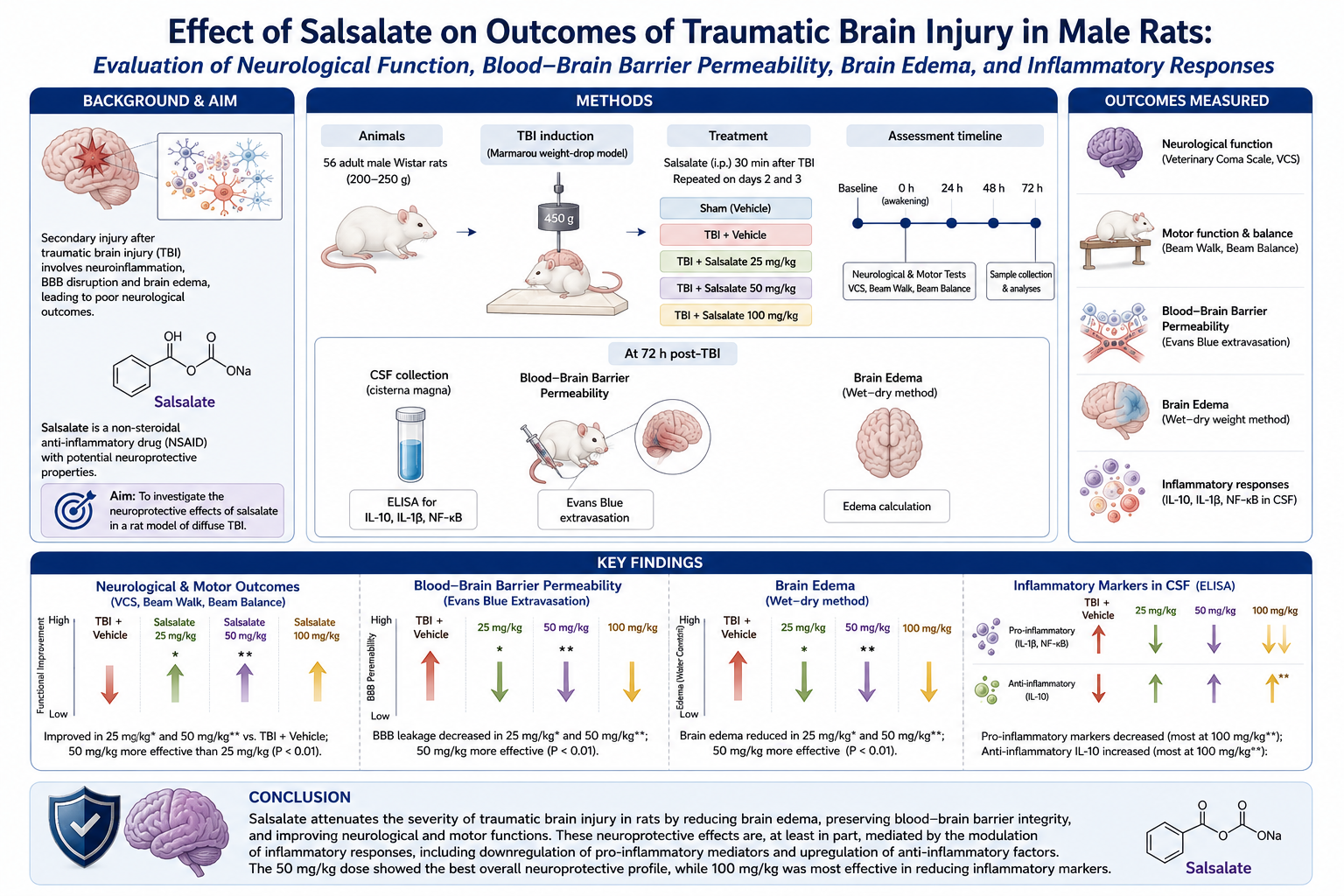
Background and purpose: Given the critical role of secondary injury in the progression of traumatic brain injury (TBI), identifying effective pharmacological therapies to attenuate neuroinflammation and improve neurological outcomes is of considerable importance. Salsalate is a nonsteroidal anti-inflammatory drug (NSAID). This study investigated the potential neuroprotective effects of salsalate following TBI in rats.
Materials and methods: Fifty-six Wistar rats underwent TBI using the Marmarou method. Thirty minutes after injury, salsalate was administered intraperitoneally at doses of 25, 50, or 100 mg/kg body weight, with subsequent doses administered on the second and third days after injury. The Veterinary Coma Scale and Beam Walk and Beam Balance tests were performed before injury, immediately after recovery of consciousness, and at 24, 48, and 72 hours after injury. After 72 hours, cerebrospinal fluid (CSF) was collected from the cisterna magna and analyzed by enzyme-linked immunosorbent assay (ELISA) to determine the levels of IL-10, IL-1β, and NF-κB. Blood-brain barrier permeability was assessed using Evans blue dye.
Results: Intraperitoneal administration of salsalate at doses of 25 (P< 0.05) and 50 (P< 0.01) mg/kg significantly reduced cerebral edema and blood-brain barrier disruption and improved neurological and motor performance compared with the control group. The 50 mg/kg dose produced the greatest overall improvement in these outcomes (P< 0.01). The 100 mg/kg dose produced a greater reduction in the measured inflammatory markers.
Conclusion: Salsalate attenuated several manifestations of secondary brain injury following TBI, including cerebral edema and blood-brain barrier disruption, and improved neurological and balance function. These effects may be partly mediated by modulation of the inflammatory response.
Materials and methods: Fifty-six Wistar rats underwent TBI using the Marmarou method. Thirty minutes after injury, salsalate was administered intraperitoneally at doses of 25, 50, or 100 mg/kg body weight, with subsequent doses administered on the second and third days after injury. The Veterinary Coma Scale and Beam Walk and Beam Balance tests were performed before injury, immediately after recovery of consciousness, and at 24, 48, and 72 hours after injury. After 72 hours, cerebrospinal fluid (CSF) was collected from the cisterna magna and analyzed by enzyme-linked immunosorbent assay (ELISA) to determine the levels of IL-10, IL-1β, and NF-κB. Blood-brain barrier permeability was assessed using Evans blue dye.
Results: Intraperitoneal administration of salsalate at doses of 25 (P< 0.05) and 50 (P< 0.01) mg/kg significantly reduced cerebral edema and blood-brain barrier disruption and improved neurological and motor performance compared with the control group. The 50 mg/kg dose produced the greatest overall improvement in these outcomes (P< 0.01). The 100 mg/kg dose produced a greater reduction in the measured inflammatory markers.
Conclusion: Salsalate attenuated several manifestations of secondary brain injury following TBI, including cerebral edema and blood-brain barrier disruption, and improved neurological and balance function. These effects may be partly mediated by modulation of the inflammatory response.
Keywords: salsalate, neuroprotection, traumatic brain injury, cerebral edema, blood-brain barrier, NF-κB
Type of Study: Research(Original) |
Subject:
physiology
Send email to the article author
| Rights and permissions | |
 |
This work is licensed under a Creative Commons Attribution-NonCommercial 4.0 International License. |

Articles Copyright © The Author(s). Owned by Mazandaran University of Medical Sciences.
Contact Us
Address: Journal Office, Building No. 2, Mazandaran University of Medical Sciences, Moallem Square, Sari.Tel: +98 (011)34484874 Postal code: 48175-866 E-Mail: jmums@mazums.ac.ir Telefax: +98 (011)33262679
