

Volume 36, Issue 262 (Special Issue 2026)
J Mazandaran Univ Med Sci 2026, 36(262): 196-201 |
Back to browse issues page



Download citation:
BibTeX | RIS | EndNote | Medlars | ProCite | Reference Manager | RefWorks
Send citation to:


BibTeX | RIS | EndNote | Medlars | ProCite | Reference Manager | RefWorks
Send citation to:
Abbasi Y, Babazadeh-Zavieh S S, Pooladi M, Jafar Haeri S M. Bilateral Anterior Meniscocapsular Ligament of the Lateral Meniscus: A Case Report. , J Mazandaran Univ Med Sci. 2026; 36 (262) :196-201
URL: http://jmums.mazums.ac.ir/article-1-23001-en.html
URL: http://jmums.mazums.ac.ir/article-1-23001-en.html


Abstract: (38 Views)
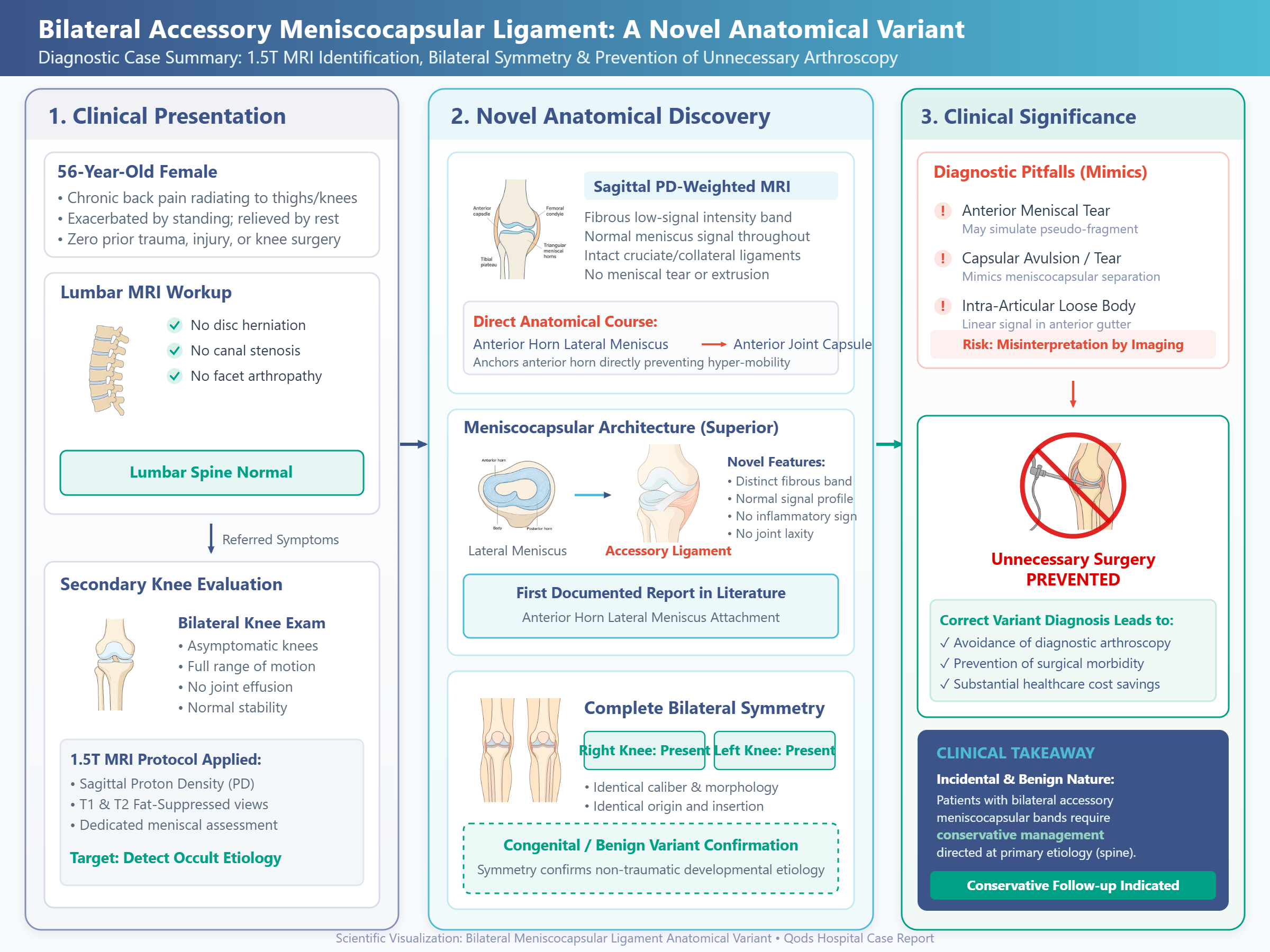
The knee joint is one of the most anatomically and biomechanically complex joints in the human body. Meniscocapsular ligaments are essential structures that attach the menisci to the joint capsule and limit excessive meniscal displacement. Anatomical variations in these attachments are rare but clinically significant, as they may pose diagnostic challenges and potentially lead to unnecessary surgical intervention. A 56-year-old woman with a several-month history of chronic low back pain presented to Qods Hospital in Arak. During history-taking, the patient reported pain radiating to the thighs and knees that was exacerbated by walking and standing and relieved by rest and physiotherapy. She had no history of trauma, falls, or previous knee surgery. Because magnetic resonance imaging (MRI) of the lumbar spine showed no abnormalities, including disc herniation, spinal canal stenosis, or facet arthropathy, MRI of both knees was subsequently performed using a 1.5-Tesla scanner with a sagittal proton density-weighted sequence. Detailed evaluation of the images revealed a band of fibrous tissue with appropriate signal characteristics arising from the anterior horn of the lateral meniscus and extending to the anterior joint capsule. This accessory ligament was observed bilaterally and was completely symmetrical in both knees. No evidence of meniscal tear, extrusion, ligamentous injury, including injury to the cruciate or collateral ligaments, or joint effusion was identified. This bilateral anatomical variant, consisting of an accessory meniscocapsular ligament arising from the anterior horn of the lateral meniscus, has not previously been reported in the scientific literature. As the patient had no knee-related symptoms, the finding was considered incidental and benign. Recognition of this anatomical variant is important for radiologists and orthopedic surgeons to avoid misinterpreting it as a meniscal tear, capsular injury, or loose body and thereby prevent unnecessary arthroscopic intervention.
Type of Study: Case Report |
Subject:
anatomy
| Rights and permissions | |
 |
This work is licensed under a Creative Commons Attribution-NonCommercial 4.0 International License. |

Articles Copyright © The Author(s). Owned by Mazandaran University of Medical Sciences.
Contact Us
Address: Journal Office, Building No. 2, Mazandaran University of Medical Sciences, Moallem Square, Sari.Tel: +98 (011)34484874 Postal code: 48175-866 E-Mail: jmums@mazums.ac.ir Telefax: +98 (011)33262679
