

Volume 36, Issue 261 (10-2026)
J Mazandaran Univ Med Sci 2026, 36(261): 178-194 |
Back to browse issues page



Download citation:
BibTeX | RIS | EndNote | Medlars | ProCite | Reference Manager | RefWorks
Send citation to:


BibTeX | RIS | EndNote | Medlars | ProCite | Reference Manager | RefWorks
Send citation to:
soltani S A, Mahmoudi G, jahani M, Yazdani Charati J. Title: Cancer Care Management in Urban Family Physician Programs: A Scoping Review with Quality Appraisal. J Mazandaran Univ Med Sci 2026; 36 (261) :178-194
URL: http://jmums.mazums.ac.ir/article-1-23014-en.html
URL: http://jmums.mazums.ac.ir/article-1-23014-en.html


Abstract: (17 Views)
Background and purpose: Cancer has become a major global health challenge, and its increasing incidence in Iran, driven by population aging and the growing prevalence of risk factors, underscores the need to reassess current approaches to cancer care. This study aimed to examine the role of the urban family physician program in cancer care management through a scoping review and assessment of the available evidence.
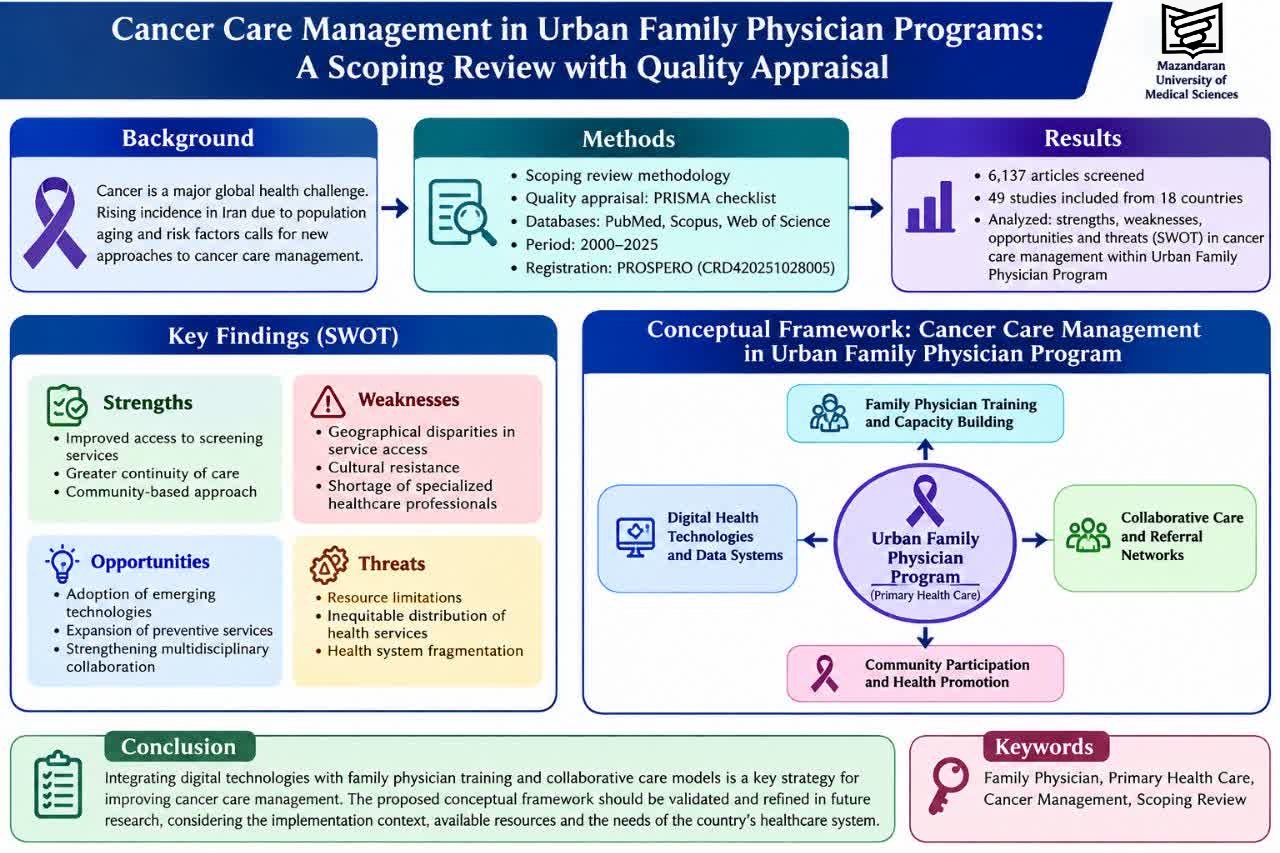
Materials and methods: This scoping review was conducted by systematically searching PubMed, Scopus, and Web of Science for studies published between 2000 and 2025. Studies that addressed the management of common cancers and the role of family physician programs in this context were selected according to predefined inclusion and exclusion criteria. Study quality was assessed using the PRISMA checklist, and the findings were analyzed using a strengths, weaknesses, opportunities, and threats (SWOT) analysis. The study protocol was registered in PROSPERO under registration number CRD420251028005.
Results: Of the 6,137 records identified, 49 studies from 18 countries were included in the final analysis. The findings indicated that the urban family physician program has the potential to improve cancer care management by enhancing access to preventive and screening services and strengthening coordination between different levels of care. In addition, the use of digital technologies, electronic health records, and diagnostic tools may provide opportunities to improve diagnostic accuracy and reduce delays in treatment initiation. However, geographical inequalities in access to services, cultural barriers, shortages of specialized healthcare personnel, and inadequate intersectoral coordination were identified as major barriers to effective implementation.
Conclusion: Integrating digital technologies, strengthening family physician training, and developing collaborative care models may contribute to improved cancer care management. The proposed conceptual framework requires further validation and adaptation to the local implementation context, available resources, and healthcare needs in Iran.
Materials and methods: This scoping review was conducted by systematically searching PubMed, Scopus, and Web of Science for studies published between 2000 and 2025. Studies that addressed the management of common cancers and the role of family physician programs in this context were selected according to predefined inclusion and exclusion criteria. Study quality was assessed using the PRISMA checklist, and the findings were analyzed using a strengths, weaknesses, opportunities, and threats (SWOT) analysis. The study protocol was registered in PROSPERO under registration number CRD420251028005.
Results: Of the 6,137 records identified, 49 studies from 18 countries were included in the final analysis. The findings indicated that the urban family physician program has the potential to improve cancer care management by enhancing access to preventive and screening services and strengthening coordination between different levels of care. In addition, the use of digital technologies, electronic health records, and diagnostic tools may provide opportunities to improve diagnostic accuracy and reduce delays in treatment initiation. However, geographical inequalities in access to services, cultural barriers, shortages of specialized healthcare personnel, and inadequate intersectoral coordination were identified as major barriers to effective implementation.
Conclusion: Integrating digital technologies, strengthening family physician training, and developing collaborative care models may contribute to improved cancer care management. The proposed conceptual framework requires further validation and adaptation to the local implementation context, available resources, and healthcare needs in Iran.
Type of Study: Review |
Subject:
Health Services Management
Send email to the article author
| Rights and permissions | |
 |
This work is licensed under a Creative Commons Attribution-NonCommercial 4.0 International License. |

Articles Copyright © The Author(s). Owned by Mazandaran University of Medical Sciences.
Contact Us
Address: Journal Office, Building No. 2, Mazandaran University of Medical Sciences, Moallem Square, Sari.Tel: +98 (011)34484874 Postal code: 48175-866 E-Mail: jmums@mazums.ac.ir Telefax: +98 (011)33262679
