

Volume 36, Issue 259 (8-2026)
J Mazandaran Univ Med Sci 2026, 36(259): 95-107 |
Back to browse issues page



Download citation:
BibTeX | RIS | EndNote | Medlars | ProCite | Reference Manager | RefWorks
Send citation to:


BibTeX | RIS | EndNote | Medlars | ProCite | Reference Manager | RefWorks
Send citation to:
Tavassoli E, Elhami Fard H, Ganji F, Raeisi A. Determinants of Health Literacy and Preventive Behaviours Related to Helicobacter pylori: A Cross-Sectional Study. J Mazandaran Univ Med Sci 2026; 36 (259) :95-107
URL: http://jmums.mazums.ac.ir/article-1-23035-en.html
URL: http://jmums.mazums.ac.ir/article-1-23035-en.html


Abstract: (550 Views)
Background and purpose: Health literacy is an important factor in preventing chronic diseases, including cancer. It helps individuals understand health-related information, manage health-related issues, and make informed health decisions. The present study aimed to identify the determinants of health literacy and preventive behaviours related to Helicobacter pylori infection in a cross-sectional study.
Materials and methods: This cross-sectional study was conducted in 1404 among 201 individuals attending comprehensive health service centres in Shahrekord. Participants were selected using stratified sampling. Data were collected using a standard questionnaire assessing health literacy and preventive health behaviours related to Helicobacter pylori infection. The collected data were coded and analysed using SPSS version 20, with descriptive and analytical statistical tests.
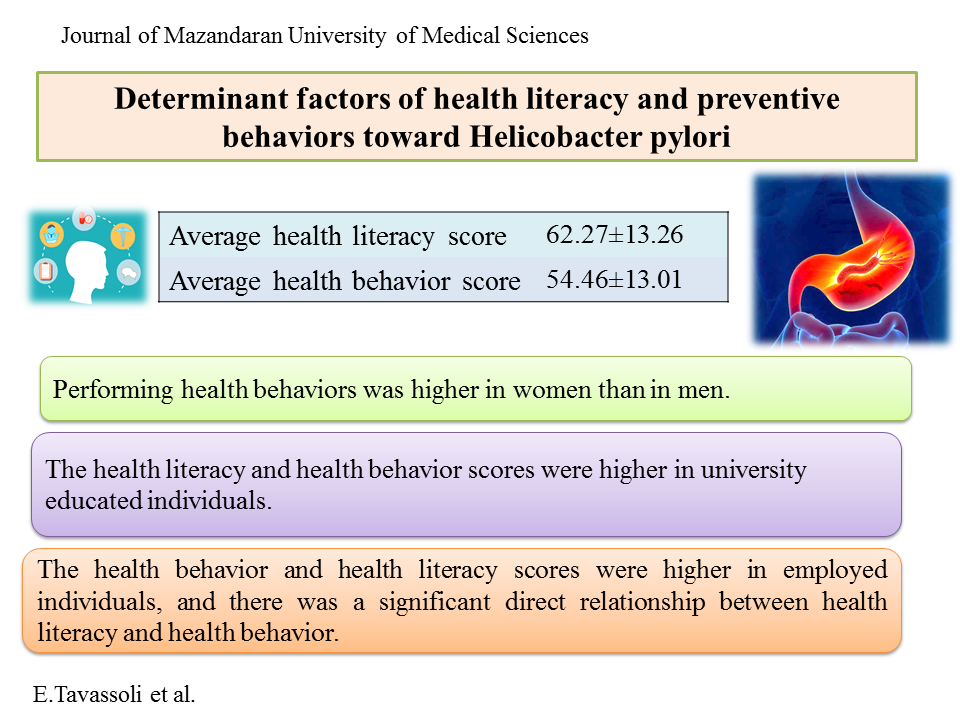
Results: The mean age of the participants was 33.37 ± 10.12 years. The mean health literacy score was 62.27 ± 13.26, and the mean health behaviour score was 54.46 ± 13.01. The performance of preventive health behaviours was significantly higher among women than men (P=0.001). Health literacy and health behaviour scores were significantly higher among participants with a university education (P=0.001). Similarly, health literacy and health behaviour scores were significantly higher among employed participants (P=0.001). A significant positive association was also observed between health literacy and health behaviour (P=0.001).
Conclusion: Improving health literacy may be an effective strategy for promoting preventive health behaviours related to Helicobacter pylori infection. Therefore, developing comprehensive programmes that use simple and accessible educational materials, together with effective educational interventions for individuals with inadequate health literacy, may help strengthen health literacy skills in the community.
Materials and methods: This cross-sectional study was conducted in 1404 among 201 individuals attending comprehensive health service centres in Shahrekord. Participants were selected using stratified sampling. Data were collected using a standard questionnaire assessing health literacy and preventive health behaviours related to Helicobacter pylori infection. The collected data were coded and analysed using SPSS version 20, with descriptive and analytical statistical tests.
Results: The mean age of the participants was 33.37 ± 10.12 years. The mean health literacy score was 62.27 ± 13.26, and the mean health behaviour score was 54.46 ± 13.01. The performance of preventive health behaviours was significantly higher among women than men (P=0.001). Health literacy and health behaviour scores were significantly higher among participants with a university education (P=0.001). Similarly, health literacy and health behaviour scores were significantly higher among employed participants (P=0.001). A significant positive association was also observed between health literacy and health behaviour (P=0.001).
Conclusion: Improving health literacy may be an effective strategy for promoting preventive health behaviours related to Helicobacter pylori infection. Therefore, developing comprehensive programmes that use simple and accessible educational materials, together with effective educational interventions for individuals with inadequate health literacy, may help strengthen health literacy skills in the community.
Type of Study: Research(Original) |
Subject:
Health Education
Send email to the article author
| Rights and permissions | |
 |
This work is licensed under a Creative Commons Attribution-NonCommercial 4.0 International License. |

Articles Copyright © The Author(s). Owned by Mazandaran University of Medical Sciences.
Contact Us
Address: Journal Office, Building No. 2, Mazandaran University of Medical Sciences, Moallem Square, Sari.Tel: +98 (011)34484874 Postal code: 48175-866 E-Mail: jmums@mazums.ac.ir Telefax: +98 (011)33262679
