

Volume 36, Issue 261 (10-2026)
J Mazandaran Univ Med Sci 2026, 36(261): 327-334 |
Back to browse issues page



Download citation:
BibTeX | RIS | EndNote | Medlars | ProCite | Reference Manager | RefWorks
Send citation to:


BibTeX | RIS | EndNote | Medlars | ProCite | Reference Manager | RefWorks
Send citation to:
Ziaei Hezarjaribi H, Hosseini E S, Moradi E, Ghahghaei-Nezamabadi A, Montazeri M. Control and Prevention of Trichomoniasis in Iran:
A Policy Brief. J Mazandaran Univ Med Sci 2026; 36 (261) :327-334
URL: http://jmums.mazums.ac.ir/article-1-23062-en.html
URL: http://jmums.mazums.ac.ir/article-1-23062-en.html
Hajar Ziaei Hezarjaribi 
 , Elahe Sadat Hosseini , Elahe Moradi , Akram Ghahghaei-Nezamabadi , Mahbobeh Montazeri
, Elahe Sadat Hosseini , Elahe Moradi , Akram Ghahghaei-Nezamabadi , Mahbobeh Montazeri
Abstract: (21 Views)
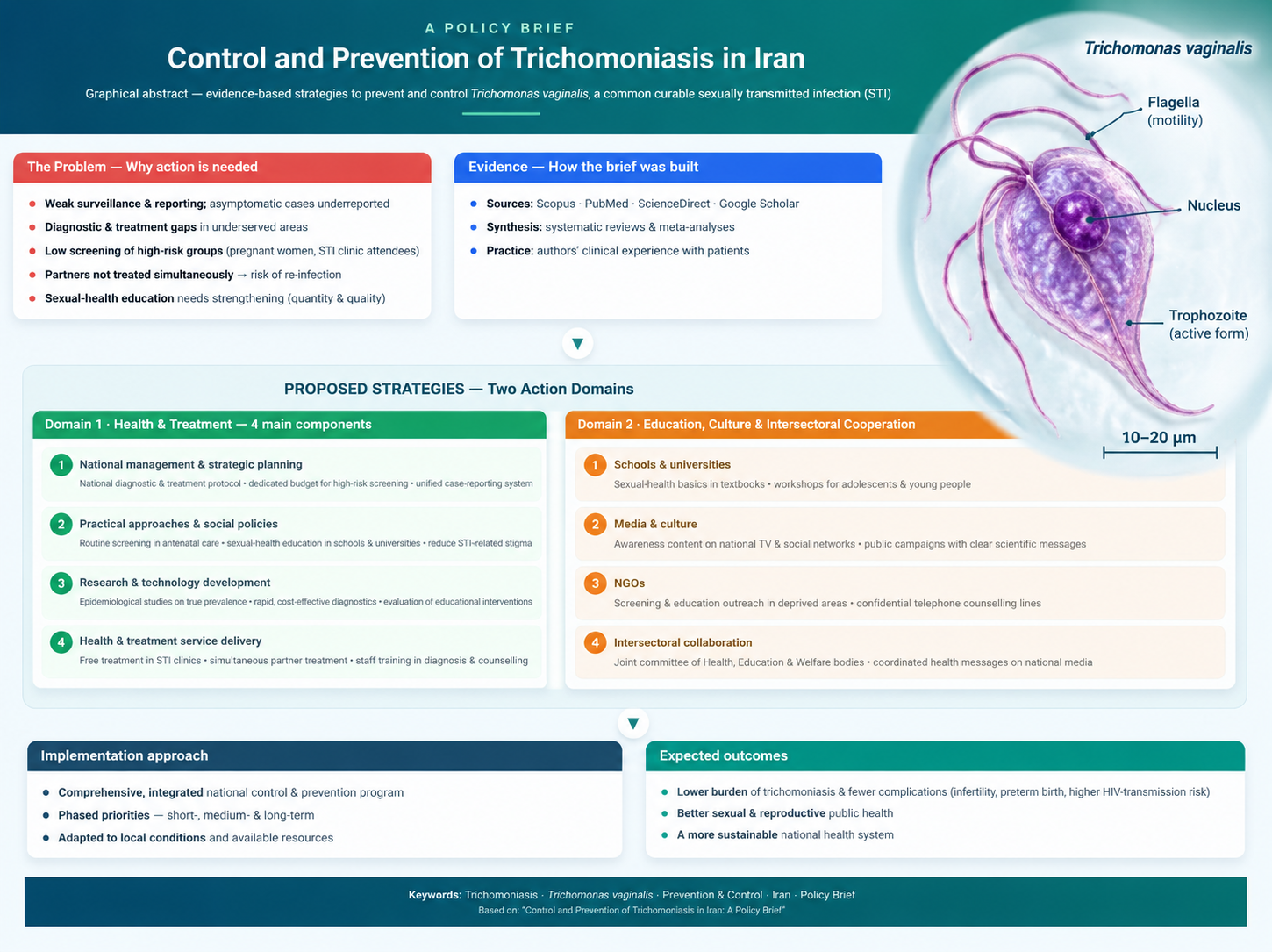
Trichomoniasis, caused by the protozoan parasite Trichomonas vaginalis, is one of the most common curable sexually transmitted infections worldwide. In Iran, its prevention and control are challenged by an ineffective surveillance and reporting system, underreporting of asymptomatic cases, diagnostic and treatment limitations in underserved areas, inadequate screening of high-risk groups, especially pregnant women, failure to provide simultaneous treatment to sexual partners, and insufficient sexual health education.
This policy brief is based on a review of evidence published in major scientific databases, including Scopus, PubMed, ScienceDirect, and Google Scholar, as well as findings from systematic reviews and meta-analyses and the authors' operational experience in patient care.
The proposed evidence-based solutions are presented in two sections: healthcare and treatment, and education and awareness. In the healthcare and treatment section, actions are organized around four main components: national-level management and strategic planning, practical approaches and social policies, research and technology development, and the provision of health and medical services. In the education and awareness section, emphasis is placed on sexual health education in schools and universities, the production of informative media content, reducing social stigma, regular screening during prenatal care, free and simultaneous treatment of sexual partners, improved access to diagnostic and treatment services, and expanded intersectoral collaboration between the health, education, and media sectors. These measures should be designed and implemented as a comprehensive and integrated prevention and control programme, with short-, medium-, and long-term priorities aligned with the country's local conditions.
The gradual and coordinated implementation of these strategies, with adequate resources and strengthened intersectoral collaboration, can effectively reduce the burden of trichomoniasis and its associated complications, including infertility, preterm birth, and an increased risk of HIV transmission, thereby contributing to improved public health and the sustainability of the national health system.
This policy brief is based on a review of evidence published in major scientific databases, including Scopus, PubMed, ScienceDirect, and Google Scholar, as well as findings from systematic reviews and meta-analyses and the authors' operational experience in patient care.
The proposed evidence-based solutions are presented in two sections: healthcare and treatment, and education and awareness. In the healthcare and treatment section, actions are organized around four main components: national-level management and strategic planning, practical approaches and social policies, research and technology development, and the provision of health and medical services. In the education and awareness section, emphasis is placed on sexual health education in schools and universities, the production of informative media content, reducing social stigma, regular screening during prenatal care, free and simultaneous treatment of sexual partners, improved access to diagnostic and treatment services, and expanded intersectoral collaboration between the health, education, and media sectors. These measures should be designed and implemented as a comprehensive and integrated prevention and control programme, with short-, medium-, and long-term priorities aligned with the country's local conditions.
The gradual and coordinated implementation of these strategies, with adequate resources and strengthened intersectoral collaboration, can effectively reduce the burden of trichomoniasis and its associated complications, including infertility, preterm birth, and an increased risk of HIV transmission, thereby contributing to improved public health and the sustainability of the national health system.
Type of Study: Policy Brief |
Subject:
parasitology
Send email to the article author
| Rights and permissions | |
 |
This work is licensed under a Creative Commons Attribution-NonCommercial 4.0 International License. |

Articles Copyright © The Author(s). Owned by Mazandaran University of Medical Sciences.
Contact Us
Address: Journal Office, Building No. 2, Mazandaran University of Medical Sciences, Moallem Square, Sari.Tel: +98 (011)34484874 Postal code: 48175-866 E-Mail: jmums@mazums.ac.ir Telefax: +98 (011)33262679
