

Volume 36, Issue 263 (11-2026)
J Mazandaran Univ Med Sci 2026, 36(263): 20-35 |
Back to browse issues page



Download citation:
BibTeX | RIS | EndNote | Medlars | ProCite | Reference Manager | RefWorks
Send citation to:


BibTeX | RIS | EndNote | Medlars | ProCite | Reference Manager | RefWorks
Send citation to:
Yousefi M, Jafarnezhadgero A A, Aali S. Effects of Progressive Combined Training on the Frequency Spectrum of Ground Reaction Forces During Running in Overweight Women with Pronated Feet. , J Mazandaran Univ Med Sci. 2026; 36 (263) :20-35
URL: http://jmums.mazums.ac.ir/article-1-23119-en.html
URL: http://jmums.mazums.ac.ir/article-1-23119-en.html


Abstract: (26 Views)
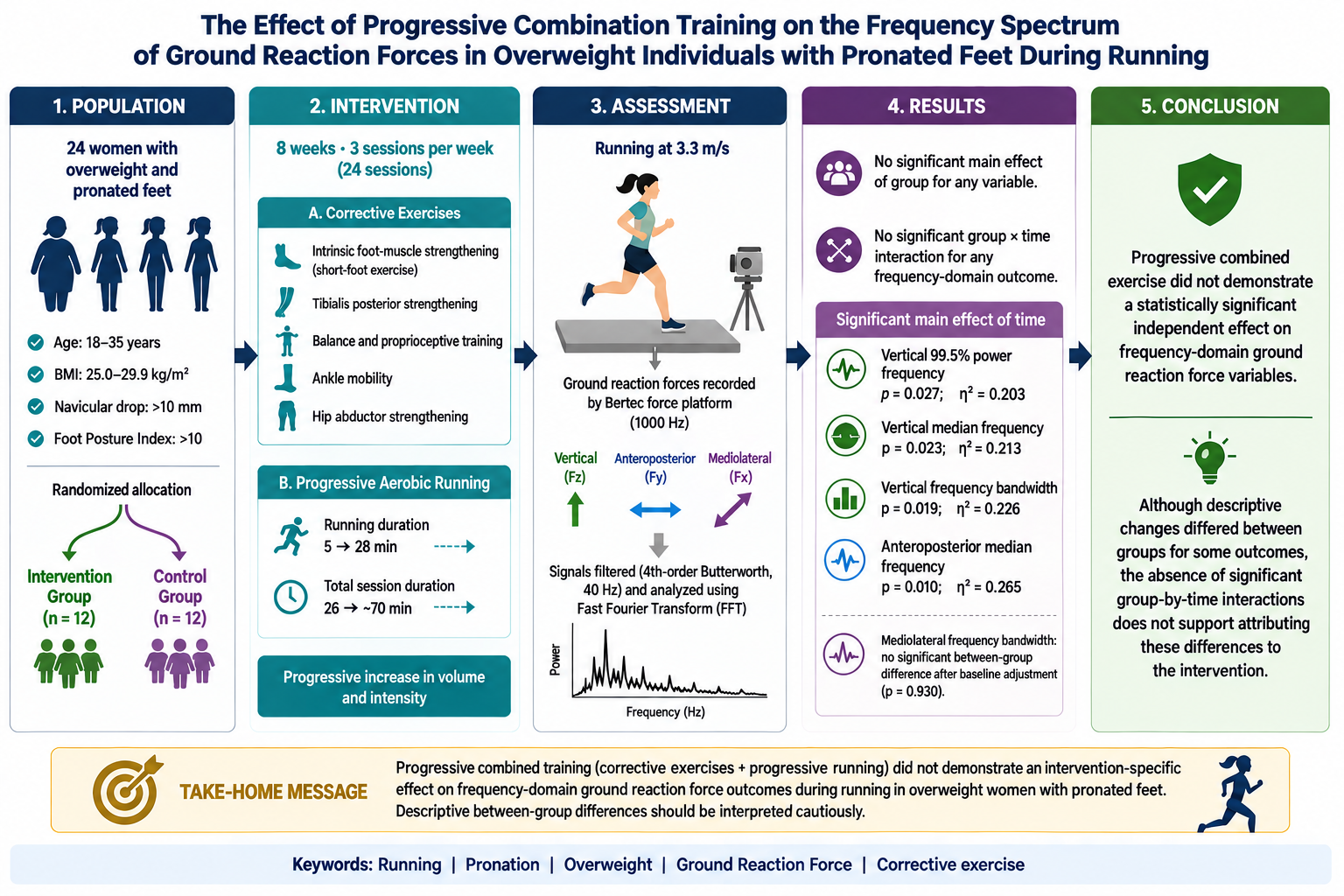
Background and purpose: Overweight and excessive foot pronation may alter shock-absorption mechanisms and the frequency content of ground reaction forces (GRFs) during running. Frequency-domain analysis provides insight into the distribution of mechanical loading across different frequencies and the temporal characteristics of loading patterns. This study investigated the effects of an eight-week progressive combined exercise programme on the GRF frequency spectrum during running in overweight women with pronated feet.
Materials and methods: In this randomized clinical trial, 24 female university students aged 18–35 years, with a body mass index of 25–29.9 kg/m², a navicular drop of greater than 10 mm, and a Foot Posture Index score greater than 10, were randomly allocated to intervention and control groups. The intervention group undertook a combination of foot and lower-limb corrective exercises and progressive aerobic running, three times per week for eight weeks. GRFs were recorded during running at 3.3 m/s using a Bertec force platform sampling at 1000 Hz. Following filtering, the vertical, anteroposterior, and mediolateral force components were analysed using the fast Fourier transform. The 99.5% power frequency, median frequency, frequency bandwidth, and number of essential harmonics were calculated. Two-way repeated-measures ANOVA and ANCOVA were performed.
Results: Neither the main effect of group nor the group-by-time interaction was statistically significant for any frequency-domain outcome. Significant main effects of time were observed for the vertical component's 99.5% power frequency (P = 0.027), median frequency (P = 0.023), and frequency bandwidth (P = 0.019), as well as the median frequency of the anteroposterior component (P = 0.010). After adjustment for baseline values, no significant between-group difference was observed in the mediolateral frequency bandwidth (P = 0.930).
Conclusion: The eight-week progressive combined exercise programme had no statistically significant intervention-specific effect on the frequency-domain characteristics of GRFs during running. Although descriptive changes differed between groups for some outcomes, the absence of significant group-by-time interactions provides insufficient evidence to attribute these changes to the intervention.
(Clinical Trials Registry Number: IRCT20260209068806N1
Type of Study: Research(Original) |
Subject:
Sports biomechanics
Send email to the article author
| Rights and permissions | |
 |
This work is licensed under a Creative Commons Attribution-NonCommercial 4.0 International License. |

Articles Copyright © The Author(s). Owned by Mazandaran University of Medical Sciences.
Contact Us
Address: Journal Office, Building No. 2, Mazandaran University of Medical Sciences, Moallem Square, Sari.Tel: +98 (011)34484874 Postal code: 48175-866 E-Mail: jmums@mazums.ac.ir Telefax: +98 (011)33262679
