




BibTeX | RIS | EndNote | Medlars | ProCite | Reference Manager | RefWorks
Send citation to:


URL: http://jmums.mazums.ac.ir/article-1-23153-en.html


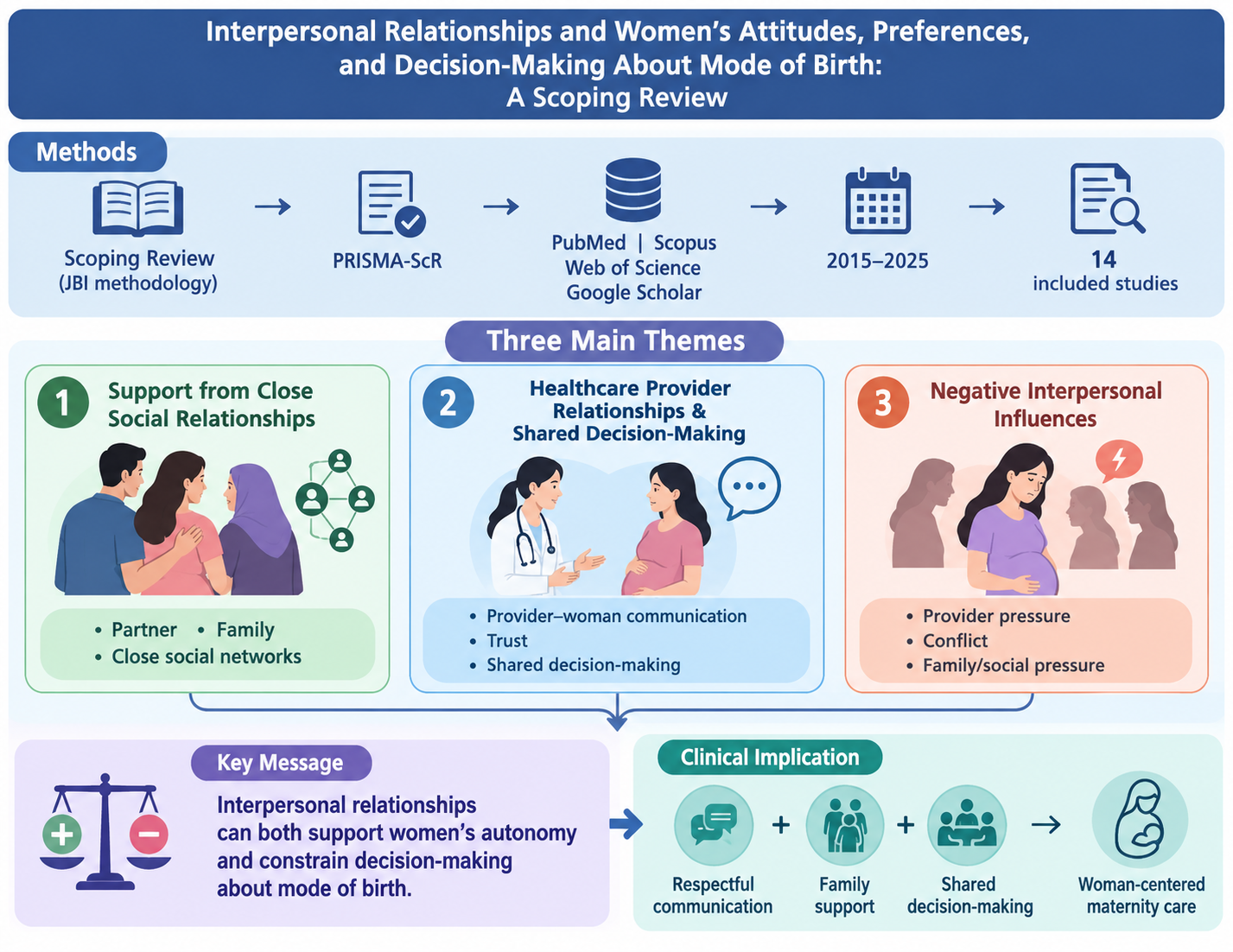
Background and purpose: Decision-making regarding the mode of birth is a complex, multidimensional process influenced by individual and clinical factors, as well as interpersonal relationships and social interactions. Despite the growing body of research in this field, the evidence on how interpersonal factors shape women’s attitudes, preferences, and decisions regarding the mode of birth has not yet been comprehensively mapped and synthesised. This study aimed to identify, map, and synthesise the existing evidence on the role of interpersonal factors in shaping women’s attitudes, preferences, and decisions regarding the mode of birth.
Materials and methods: Guided by the Joanna Briggs Institute (JBI) framework and reported in accordance with the PRISMA-ScR guidelines, this scoping review involved a systematic search of PubMed, Scopus, Web of Science, and Google Scholar. The search covered studies published in English and Persian between January 2015 and December 2025. Studies were screened against predefined eligibility criteria, and 14 were included in the review. Data were extracted using a structured approach and synthesised through thematic analysis.
Results: The synthesis identified three main themes: (1) Support from close social networks, highlighting the influence of partners, family members, and wider social networks; (2) Healthcare provider-patient interactions, focusing on the effects of communication quality, trust, and shared decision-making with healthcare professionals; and (3) Negative interpersonal pressures, encompassing conflicts and social constraints that influence women’s choices.
Conclusion: Decision-making regarding the mode of birth is a relational process shaped by interactions between women, their families, healthcare providers, and the wider social and cultural context. Strengthening respectful communication, promoting shared decision-making, supporting family involvement where appropriate, and respecting women’s autonomy may help women participate more fully in informed decisions about their mode of birth.
| Rights and permissions | |
 |
This work is licensed under a Creative Commons Attribution-NonCommercial 4.0 International License. |

Articles Copyright © The Author(s). Owned by Mazandaran University of Medical Sciences.
Contact Us
Address: Journal Office, Building No. 2, Mazandaran University of Medical Sciences, Moallem Square, Sari.Tel: +98 (011)34484874 Postal code: 48175-866 E-Mail: jmums@mazums.ac.ir Telefax: +98 (011)33262679
