

Volume 36, Issue 261 (10-2026)
J Mazandaran Univ Med Sci 2026, 36(261): 18-30 |
Back to browse issues page



Download citation:
BibTeX | RIS | EndNote | Medlars | ProCite | Reference Manager | RefWorks
Send citation to:


BibTeX | RIS | EndNote | Medlars | ProCite | Reference Manager | RefWorks
Send citation to:
Saeb M, Ghasemian Z, Jafari S, Shams A, Moghareabed R, Nikzad S. Dosimetric Comparison of Three-Dimensional Conformal Radiotherapy under Deep Inspiration Breath-Hold and Free-Breathing Conditions and Volumetric Modulated Arc Therapy for Left-Sided Breast Cancer. J Mazandaran Univ Med Sci 2026; 36 (261) :18-30
URL: http://jmums.mazums.ac.ir/article-1-23183-en.html
URL: http://jmums.mazums.ac.ir/article-1-23183-en.html


Abstract: (15 Views)
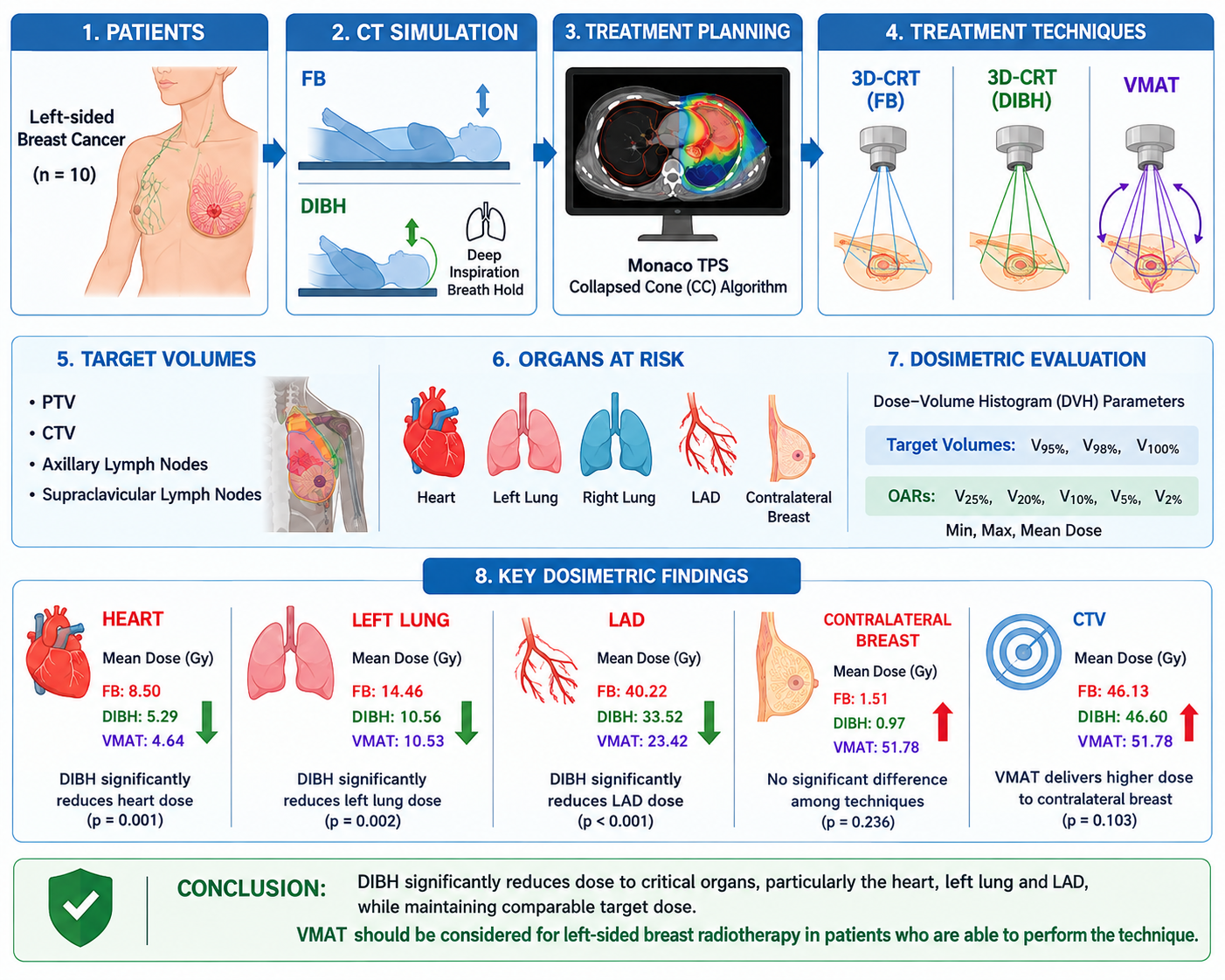
Background and purpose: Radiotherapy for left-sided breast cancer may result in unintended radiation to the heart and left lung, and deep inspiration breath-hold (DIBH) can reduce this dose by increasing the distance between the heart and the chest wall. The aim of this study was to compare the dose received by the target volume and organs at risk in 3D-CRT techniques during free breathing (FB) and breath-hold, as well as in VMAT, in patients with left-sided breast cancer.
Materials and methods: In this dosimetric comparative study, ten patients with left-sided breast cancer scheduled for radiotherapy were enrolled. For each patient, CT simulation were acquired under FB and DIBH conditions. The mean doses to the target volume (CTV) and OARs, along with dose-volume parameters, including V95%, V98%, and V100% for the CTV and V25%, V20%, V10%, V5%, and V2% for the OARs, were extracted from dose-volume histograms (DVHs). Data were analysed using SPSS version 22 (P < 0.05).
Results: Significant differences were observed among techniques in the mean doses to the heart (P = 0.001), left lung (P = 0.002), and LAD (P < 0.001). DIBH reduced the mean doses to the heart (5.29 vs. 8.50 Gy), left lung (10.56 vs. 14.46 Gy), and LAD (33.52 vs. 40.22 Gy). Of the three techniques, VMAT produced the lowest mean doses to the heart (4.64 Gy) and LAD (23.42 Gy), but the highest dose to the contralateral breast (2.50 Gy). The mean CTV doses for FB, DIBH, and VMAT were 46.13, 46.60, and 51.78 Gy, respectively, with no significant difference among the three techniques.
Conclusion: DIBH was associated with significantly lower mean doses to the heart, left lung, and LAD compared with FB. VMAT resulted in the lowest mean doses to the heart and LAD but the highest dose to the contralateral breast.
Materials and methods: In this dosimetric comparative study, ten patients with left-sided breast cancer scheduled for radiotherapy were enrolled. For each patient, CT simulation were acquired under FB and DIBH conditions. The mean doses to the target volume (CTV) and OARs, along with dose-volume parameters, including V95%, V98%, and V100% for the CTV and V25%, V20%, V10%, V5%, and V2% for the OARs, were extracted from dose-volume histograms (DVHs). Data were analysed using SPSS version 22 (P < 0.05).
Results: Significant differences were observed among techniques in the mean doses to the heart (P = 0.001), left lung (P = 0.002), and LAD (P < 0.001). DIBH reduced the mean doses to the heart (5.29 vs. 8.50 Gy), left lung (10.56 vs. 14.46 Gy), and LAD (33.52 vs. 40.22 Gy). Of the three techniques, VMAT produced the lowest mean doses to the heart (4.64 Gy) and LAD (23.42 Gy), but the highest dose to the contralateral breast (2.50 Gy). The mean CTV doses for FB, DIBH, and VMAT were 46.13, 46.60, and 51.78 Gy, respectively, with no significant difference among the three techniques.
Conclusion: DIBH was associated with significantly lower mean doses to the heart, left lung, and LAD compared with FB. VMAT resulted in the lowest mean doses to the heart and LAD but the highest dose to the contralateral breast.
Keywords: breast cancer, deep inspiration breath-hold, free breathing, volumetric modulated arc therapy, radiotherapy planning
Type of Study: Research(Original) |
Subject:
Medical physics
Send email to the article author
| Rights and permissions | |
 |
This work is licensed under a Creative Commons Attribution-NonCommercial 4.0 International License. |

Articles Copyright © The Author(s). Owned by Mazandaran University of Medical Sciences.
Contact Us
Address: Journal Office, Building No. 2, Mazandaran University of Medical Sciences, Moallem Square, Sari.Tel: +98 (011)34484874 Postal code: 48175-866 E-Mail: jmums@mazums.ac.ir Telefax: +98 (011)33262679
