

Volume 36, Issue 262 (Special Issue 2026)
J Mazandaran Univ Med Sci 2026, 36(262): 272-280 |
Back to browse issues page



Download citation:
BibTeX | RIS | EndNote | Medlars | ProCite | Reference Manager | RefWorks
Send citation to:


BibTeX | RIS | EndNote | Medlars | ProCite | Reference Manager | RefWorks
Send citation to:
Moghadami A, Mirzaee F, Vesgari Kiasari Z, Yousefi S S. Potential of Morus nigra for the Management of Radio- or Chemotherapy-Induced Oral Mucositis: An Integrative Review from Persian Medicine to Modern Evidence. , J Mazandaran Univ Med Sci. 2026; 36 (262) :272-280
URL: http://jmums.mazums.ac.ir/article-1-23186-en.html
URL: http://jmums.mazums.ac.ir/article-1-23186-en.html


Abstract: (36 Views)
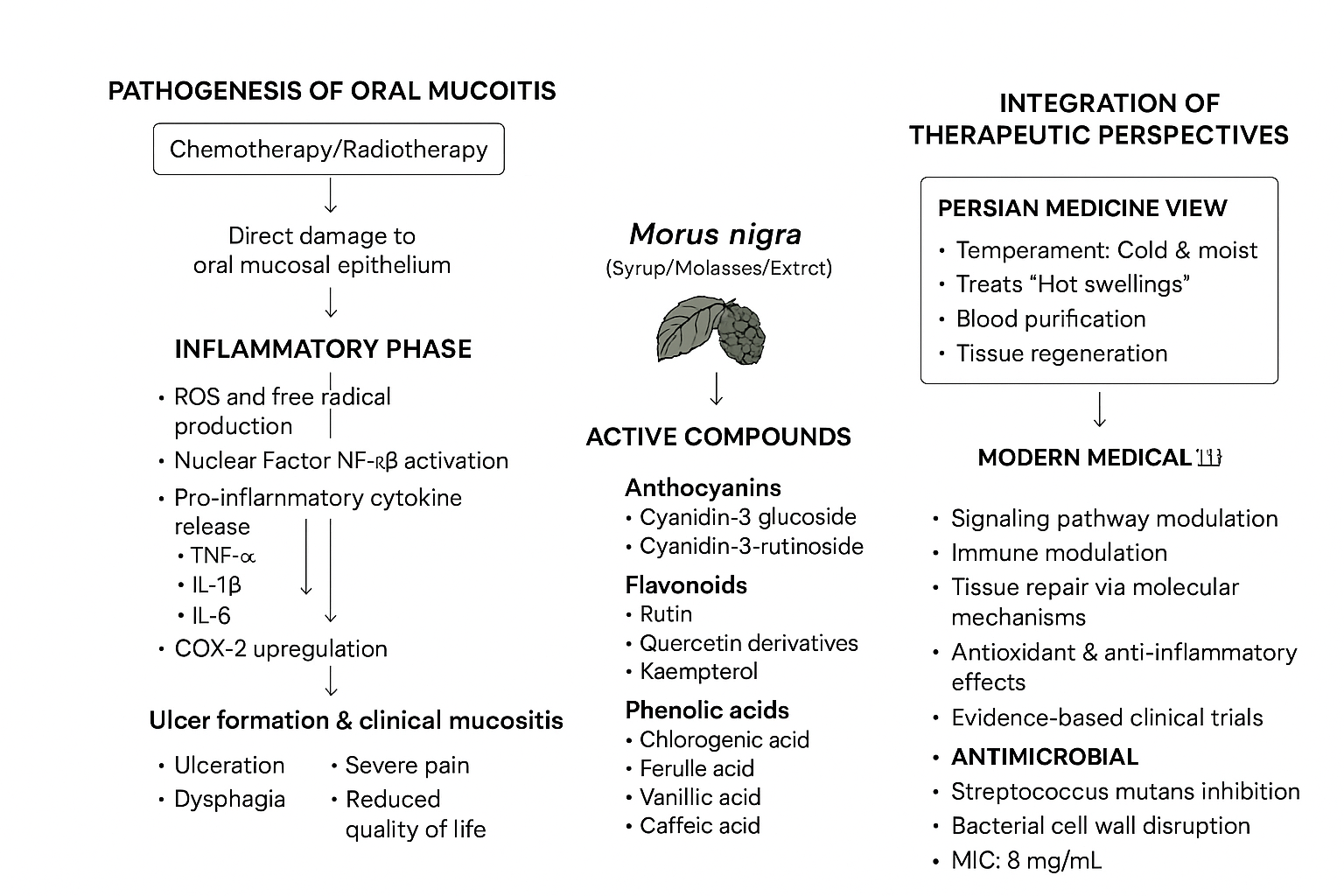
Oral mucositis (OM) is a frequent and debilitating complication of chemotherapy and radiotherapy, particularly in patients with head and neck cancers. It causes painful ulcerations that impair nutrition, interfere with treatment adherence, and diminish quality of life. In Persian medicine, Morus nigra (black mulberry) has long been used to treat oral ulcers and inflammatory conditions. Contemporary research has investigated its bioactive compounds and potential therapeutic role in the management of OM.
A narrative review was conducted by searching PubMed, Scopus, Web of Science, Embase, and Google Scholar using MeSH and free-text terms related to M. nigra, oral mucositis, chemotherapy, radiotherapy, and Persian medicine. Classical Persian medicine texts, including the Canon of Medicine, Al-Hawi, Makhzan al-Advia, Zakhireye Kharazmshahi, and Tohfat al-Mu’minin, were also reviewed. Preclinical and clinical studies evaluating M. nigra or its compounds in relation to OM, inflammation, or wound healing were included.
In Persian medicine, M. nigra is described as having a cold and moist temperament and is traditionally used for oral ulcers. Phytochemical studies have demonstrated high levels of anthocyanins, flavonoids, and phenolic acids with antioxidant and anti-inflammatory activities. Experimental evidence suggests that M. nigra scavenges free radicals, inhibits NF-κB signaling, enhances collagen deposition, and promotes mucosal repair. Liposomal formulations have demonstrated superior wound closure (99.7% at 48 h) compared with crude extract. Clinical studies have reported reductions in OM severity, pain, and healing time in patients receiving black mulberry syrup, molasses, or extract during chemotherapy or radiotherapy, with improved weight maintenance and oral hydration reported in some studies.
M. nigra demonstrates promising antioxidant, anti-inflammatory, antimicrobial, and wound-healing properties that may be relevant to the prevention and treatment of OM. The traditional use of M. nigra in Persian medicine is supported by available biomedical evidence; however, clinical studies remain limited. Large, well-designed randomized trials are needed to confirm efficacy, determine optimal formulations, and establish safety before its routine incorporation into supportive oncology care.
Keywords: stomatitis, chemotherapy, radiotherapy, complementary therapies, phytotherapy, Persian medicine
Type of Study: Review |
Subject:
general practitioner
Send email to the article author
| Rights and permissions | |
 |
This work is licensed under a Creative Commons Attribution-NonCommercial 4.0 International License. |

Articles Copyright © The Author(s). Owned by Mazandaran University of Medical Sciences.
Contact Us
Address: Journal Office, Building No. 2, Mazandaran University of Medical Sciences, Moallem Square, Sari.Tel: +98 (011)34484874 Postal code: 48175-866 E-Mail: jmums@mazums.ac.ir Telefax: +98 (011)33262679
