

Volume 36, Issue 264 (11-2026)
J Mazandaran Univ Med Sci 2026, 36(264): 218-233 |
Back to browse issues page



Download citation:
BibTeX | RIS | EndNote | Medlars | ProCite | Reference Manager | RefWorks
Send citation to:


BibTeX | RIS | EndNote | Medlars | ProCite | Reference Manager | RefWorks
Send citation to:
Safaeinejad F, Soltany-Rezaee-Rad M, Mottaghi-Dastjerdi N. Decoding and Overcoming Cancer Drug Resistance through the Integration of Artificial Intelligence and Network Pharmacology: From Molecular Mechanisms to Therapeutic Vulnerabilities. , J Mazandaran Univ Med Sci. 2026; 36 (264) :218-233
URL: http://jmums.mazums.ac.ir/article-1-23187-en.html
URL: http://jmums.mazums.ac.ir/article-1-23187-en.html


Abstract: (22 Views)
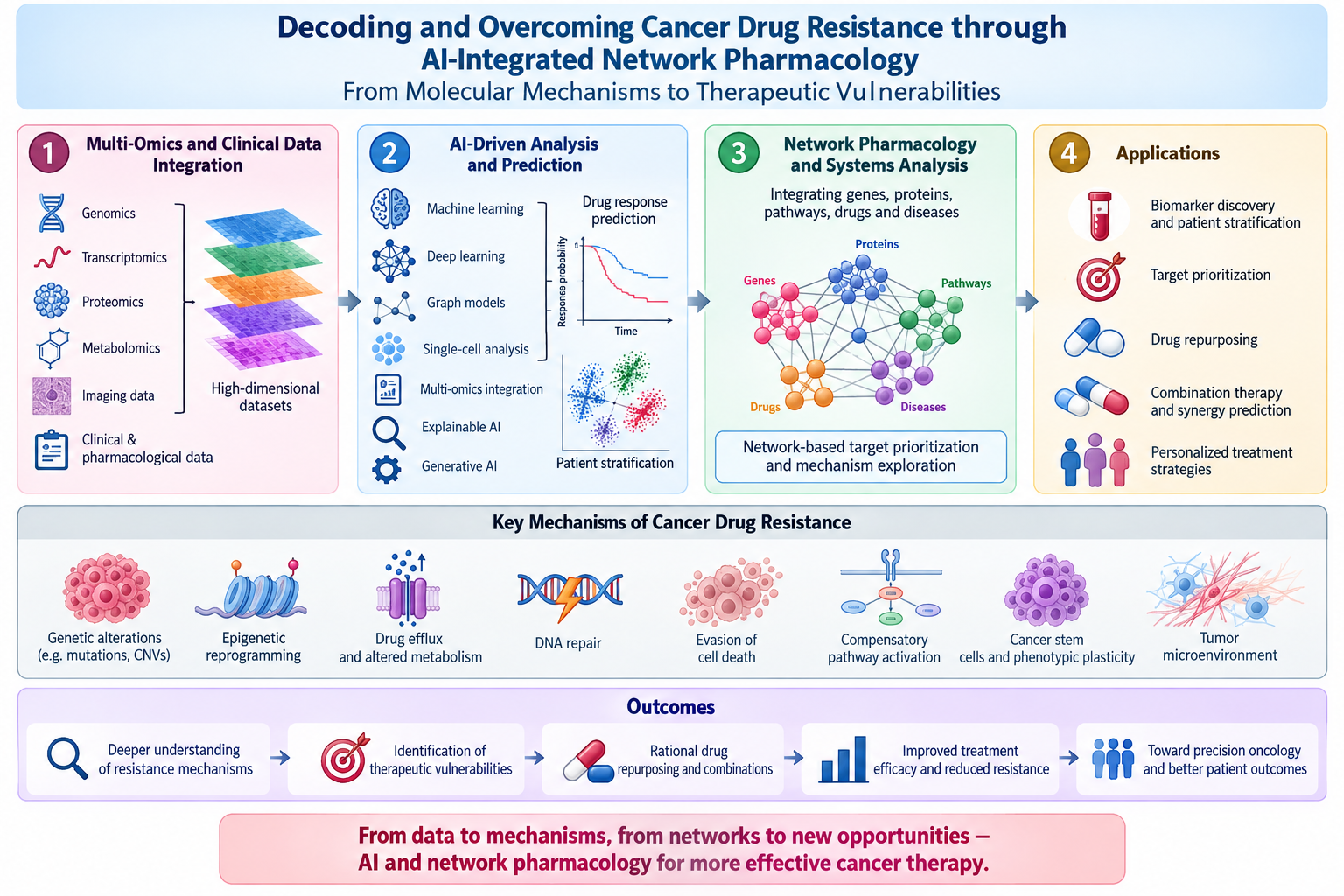
Cancer drug resistance is an evolutionary process driven by genetic alterations, epigenetic reprogramming, drug transport and metabolism, DNA repair, dysregulated cell death, activation of compensatory pathways, phenotypic plasticity, and interactions with the tumour microenvironment. Interactions among these mechanisms limit treatment efficacy and challenge explanations of resistance based on single molecular targets. Artificial intelligence (AI) can analyse molecular, imaging, pharmacological, and clinical data to uncover patterns, predict drug responses, identify biomarkers, and stratify patients. However, predictive performance alone does not establish mechanistic validity or clinical utility. Network pharmacology provides a complementary framework for mapping interactions among genes, proteins, pathways, drugs, and molecular targets. This critical narrative review, informed by a structured literature search conducted through August 2026, examines how integrating AI with network pharmacology can help elucidate adaptive drug resistance and identify therapeutically actionable vulnerabilities. It distinguishes the respective contributions of machine learning, deep learning, graph modelling, single-cell analysis, multi-omics integration, explainable AI, and generative AI and network-based analytical methods, and evaluates their combined use in biomarker discovery, target prioritisation, drug repurposing, the prediction of synergistic drug combinations, and personalised treatment design. Selected studies across major cancer types are compared according to the strength of evidence supporting statistical associations, predictive performance, experimentally validated mechanisms, and clinical applications. Particular attention is given to resistance mediated by bypass pathways, efflux transporters, drug-target alterations, DNA repair, cancer stem cells, metabolic adaptation, and interactions within the tumour microenvironment. Clinical translation remains constrained by data heterogeneity, limited sample sizes, overfitting, algorithmic and population biases, incomplete biological networks, limited interpretability, poor reproducibility, and insufficient external or prospective validation. Future progress will require standardised datasets, transparent reporting, robust model evaluation, and multidisciplinary workflows that link computational predictions to pharmacological and clinical evidence. Integrating predictive models with mechanistic network analysis and experimental validation may provide a more reliable route from computational predictions to experimentally testable hypotheses and rational therapeutic strategies for overcoming drug resistance.
Keywords: cancer drug resistance, artificial intelligence, network pharmacology, adaptive resistance, multi-omics drug repurposing, combination thrapy, precision
Type of Study: Review |
Subject:
Artificial Intelligence
| Rights and permissions | |
 |
This work is licensed under a Creative Commons Attribution-NonCommercial 4.0 International License. |

Articles Copyright © The Author(s). Owned by Mazandaran University of Medical Sciences.
Contact Us
Address: Journal Office, Building No. 2, Mazandaran University of Medical Sciences, Moallem Square, Sari.Tel: +98 (011)34484874 Postal code: 48175-866 E-Mail: jmums@mazums.ac.ir Telefax: +98 (011)33262679
