

Volume 36, Issue 262 (Special Issue 2026)
J Mazandaran Univ Med Sci 2026, 36(262): 202-219 |
Back to browse issues page



Download citation:
BibTeX | RIS | EndNote | Medlars | ProCite | Reference Manager | RefWorks
Send citation to:


BibTeX | RIS | EndNote | Medlars | ProCite | Reference Manager | RefWorks
Send citation to:
Omidi B, Maleki Bonehkohal S, SarveAhrabi Y. Immunoepigenetic Interactions in Colorectal Carcinogenesis: Introducing the PDS3 Phenotype as an Integrative Multi-Omics Framework. , J Mazandaran Univ Med Sci. 2026; 36 (262) :202-219
URL: http://jmums.mazums.ac.ir/article-1-23203-en.html
URL: http://jmums.mazums.ac.ir/article-1-23203-en.html


Abstract: (50 Views)
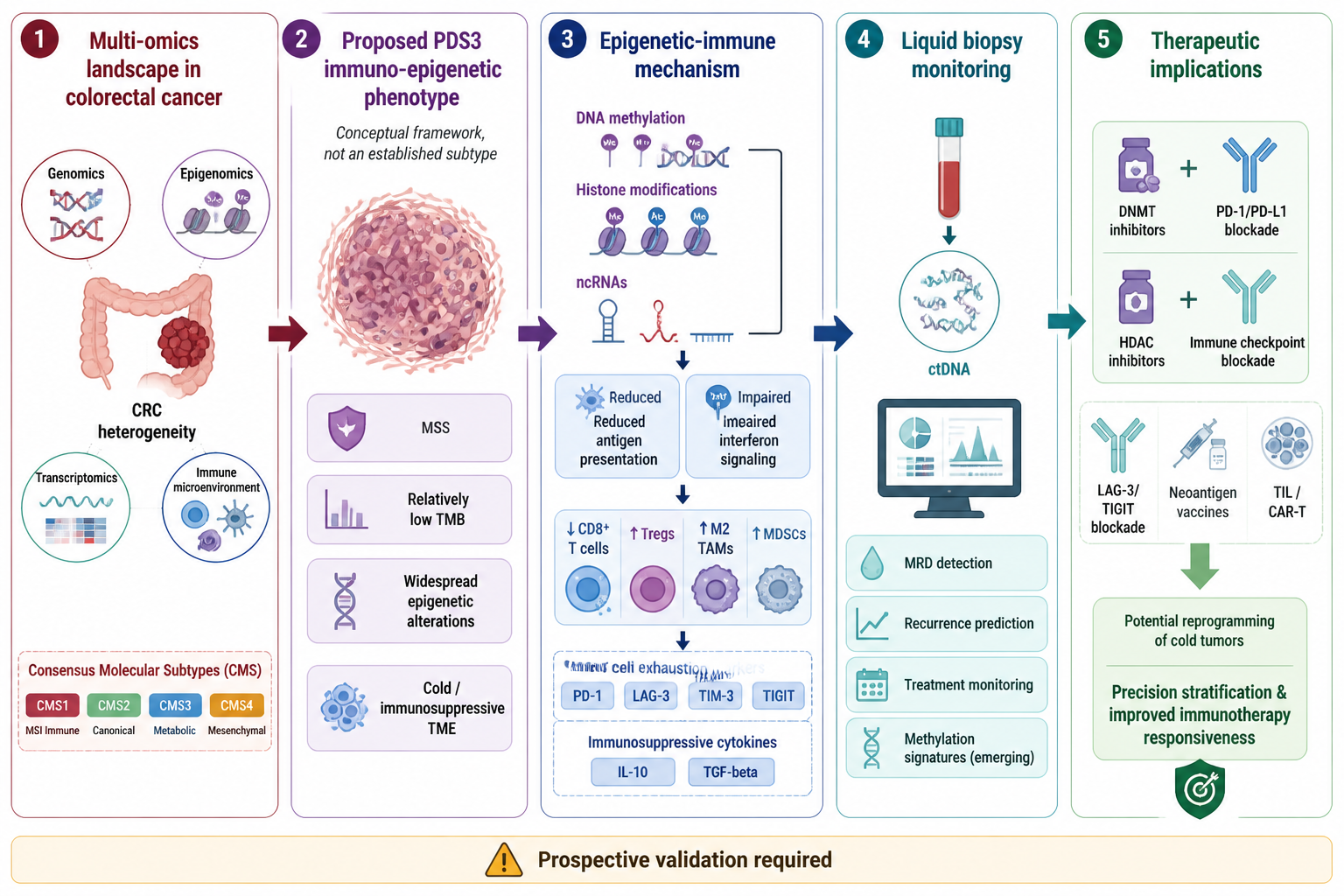
Background and purpose: Colorectal cancer (CRC) exhibits high genetic, epigenetic, and immunological heterogeneity, contributing to variable therapeutic responses. This study introduces a conceptual biological framework, designated as PDS3, which integrates multi-omics data to refine tumor characterization and facilitate personalized treatment strategies.
Materials and methods: This systematic review was conducted and reported in accordance with the PRISMA 2020 statement and SWiM guidelines. A comprehensive search was performed in PubMed/MEDLINE, Scopus, Web of Science, Embase, and the Cochrane Library for studies published between January 2015 and December 2025. Two independent reviewers conducted study screening, data extraction, and risk of bias assessment using validated tools (Cochrane RoB 2, ROBINS-I, and the Newcastle-Ottawa Scale). Ultimately, data from 67 eligible studies on integrative multi-omics, epigenetic alterations, the tumor immune microenvironment, liquid biopsy (ctDNA), and combinatorial immunotherapy in CRC were qualitatively synthesized.
Results: Aberrant DNA methylation patterns and epigenetic dysregulation of critical cell signaling pathways were found to be closely associated with the establishment of an immunosuppressive and immune-cold tumor microenvironment. This phenotype was associated with poor clinical responses to standard immune checkpoint inhibitors (ICIs). Emerging evidence from preclinical and early-phase clinical studies suggests that the concurrent administration of epigenetic-modifying agents (e.g., DNMT or HDAC inhibitors) alongside immunotherapy may enhance antitumor immune responses and help overcome primary resistance. Furthermore, novel non-invasive modalities, particularly the analysis of circulating tumor DNA (ctDNA) via liquid biopsy, have demonstrated considerable promise as tools for longitudinal molecular profiling of tumors and real-time monitoring of disease dynamics.
Conclusion: The conceptual PDS3 framework underscores that the integrative analysis of multi-omics data holds substantial potential to deepen our understanding of CRC complexity and enable more precise treatment tailoring based on individual tumor biology. However, to translate this framework into routine clinical practice, large-scale, prospective interventional studies are imperative to rigorously validate its clinical utility and prognostic value.
Keywords: colorectal cancer, integrative biological data, immuno-epigenetic pattern, epigenetics, liquid biopsy, combination immunotherapy
Send email to the article author
| Rights and permissions | |
 |
This work is licensed under a Creative Commons Attribution-NonCommercial 4.0 International License. |

Articles Copyright © The Author(s). Owned by Mazandaran University of Medical Sciences.
Contact Us
Address: Journal Office, Building No. 2, Mazandaran University of Medical Sciences, Moallem Square, Sari.Tel: +98 (011)34484874 Postal code: 48175-866 E-Mail: jmums@mazums.ac.ir Telefax: +98 (011)33262679
