

Volume 36, Issue 261 (10-2026)
J Mazandaran Univ Med Sci 2026, 36(261): 132-143 |
Back to browse issues page



Download citation:
BibTeX | RIS | EndNote | Medlars | ProCite | Reference Manager | RefWorks
Send citation to:


BibTeX | RIS | EndNote | Medlars | ProCite | Reference Manager | RefWorks
Send citation to:
Mohammadi M, Farid M, Yazdkhasti M, Akbari Kamrani M. From Challenges to Opportunities: Exploring Infrastructure and Healthcare Providers’ Perspectives on Telelactation Counselling. J Mazandaran Univ Med Sci 2026; 36 (261) :132-143
URL: http://jmums.mazums.ac.ir/article-1-23209-en.html
URL: http://jmums.mazums.ac.ir/article-1-23209-en.html


Abstract: (18 Views)
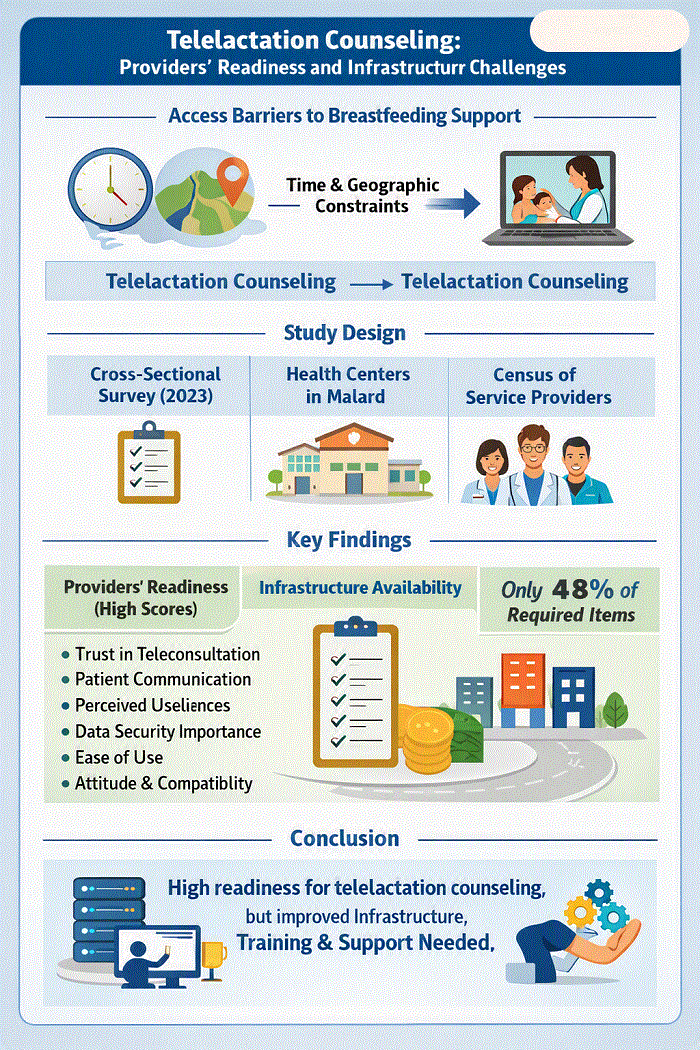
Background and purpose: Breastfeeding counselling is one of the most effective interventions for improving maternal and neonatal health; however, geographical and time-related barriers often limit mothers’ access to specialized services. Telelactation counselling has emerged as a promising approach to addressing these barriers. This study aimed to assess the feasibility of implementing telelactation counselling from the perspective of healthcare providers.
Materials and methods: This cross-sectional study was conducted using a census sampling approach among 50 healthcare providers working in comprehensive health centres and health posts in Malard County. Data were collected using a standardized Telehealth Feasibility Questionnaire and analysed using descriptive statistics and inferential tests, including the Pearson correlation, independent-samples t-test, and Mann-Whitney U test, in SPSS version 23.
Results: The mean age of the participants was 30.30 ± 4.95 years. Healthcare providers demonstrated a high level of readiness across all assessed domains, including attitude, behavioural intention, perceived usefulness, perceived ease of use, compatibility, and data security. The highest mean scores were observed for “trust in the telehealth centre” (29.28 ± 3.69) and “patient communication” (27.36 ± 3.63). Regarding infrastructure, only 48% of the required technical and equipment resources were available at the centres. Inferential analyses revealed that the total acceptance score was not significantly associated with age or work experience; however, it was significantly higher among health post staff than among health centre staff (P = 0.014) and among participants with previous telemedicine experience (P = 0.007).
Conclusion: Despite healthcare providers’ positive attitudes and favourable behavioural readiness towards implementing remote breastfeeding counselling, substantial infrastructure limitations remain. This discrepancy suggests that the primary challenge to implementing this service lies not in workforce acceptance but in the availability of appropriate technical infrastructure and equipment. Successful implementation therefore requires investment in infrastructure, equipment upgrades, and organisational support.
Materials and methods: This cross-sectional study was conducted using a census sampling approach among 50 healthcare providers working in comprehensive health centres and health posts in Malard County. Data were collected using a standardized Telehealth Feasibility Questionnaire and analysed using descriptive statistics and inferential tests, including the Pearson correlation, independent-samples t-test, and Mann-Whitney U test, in SPSS version 23.
Results: The mean age of the participants was 30.30 ± 4.95 years. Healthcare providers demonstrated a high level of readiness across all assessed domains, including attitude, behavioural intention, perceived usefulness, perceived ease of use, compatibility, and data security. The highest mean scores were observed for “trust in the telehealth centre” (29.28 ± 3.69) and “patient communication” (27.36 ± 3.63). Regarding infrastructure, only 48% of the required technical and equipment resources were available at the centres. Inferential analyses revealed that the total acceptance score was not significantly associated with age or work experience; however, it was significantly higher among health post staff than among health centre staff (P = 0.014) and among participants with previous telemedicine experience (P = 0.007).
Conclusion: Despite healthcare providers’ positive attitudes and favourable behavioural readiness towards implementing remote breastfeeding counselling, substantial infrastructure limitations remain. This discrepancy suggests that the primary challenge to implementing this service lies not in workforce acceptance but in the availability of appropriate technical infrastructure and equipment. Successful implementation therefore requires investment in infrastructure, equipment upgrades, and organisational support.
Keywords: breastfeeding counselling, telehealth, feasibility, healthcare providers, comprehensive health center
Type of Study: Research(Original) |
Subject:
Midwifery
Send email to the article author
| Rights and permissions | |
 |
This work is licensed under a Creative Commons Attribution-NonCommercial 4.0 International License. |

Articles Copyright © The Author(s). Owned by Mazandaran University of Medical Sciences.
Contact Us
Address: Journal Office, Building No. 2, Mazandaran University of Medical Sciences, Moallem Square, Sari.Tel: +98 (011)34484874 Postal code: 48175-866 E-Mail: jmums@mazums.ac.ir Telefax: +98 (011)33262679
