

Volume 36, Issue 264 (11-2026)
J Mazandaran Univ Med Sci 2026, 36(264): 27-38 |
Back to browse issues page



Download citation:
BibTeX | RIS | EndNote | Medlars | ProCite | Reference Manager | RefWorks
Send citation to:


BibTeX | RIS | EndNote | Medlars | ProCite | Reference Manager | RefWorks
Send citation to:
Saeedi K, Shayesteh S. Effect of Gliclazide on Serum Endocan Levels, Oxidative Stress, and Aortic Histopathological Injury in Streptozotocin-Induced Diabetic Rats. , J Mazandaran Univ Med Sci. 2026; 36 (264) :27-38
URL: http://jmums.mazums.ac.ir/article-1-23219-en.html
URL: http://jmums.mazums.ac.ir/article-1-23219-en.html


Abstract: (18 Views)
Background and purpose: Diabetes mellitus can lead to cardiovascular complications through mechanisms involving oxidative stress, inflammation, and vascular injury. Endocan, a biomarker associated with endothelial injury, may be useful for assessing diabetes-associated vascular changes. This study aimed to investigate the effects of gliclazide on serum endocan levels, oxidative stress, inflammation, and aortic histopathological changes in diabetic rats.
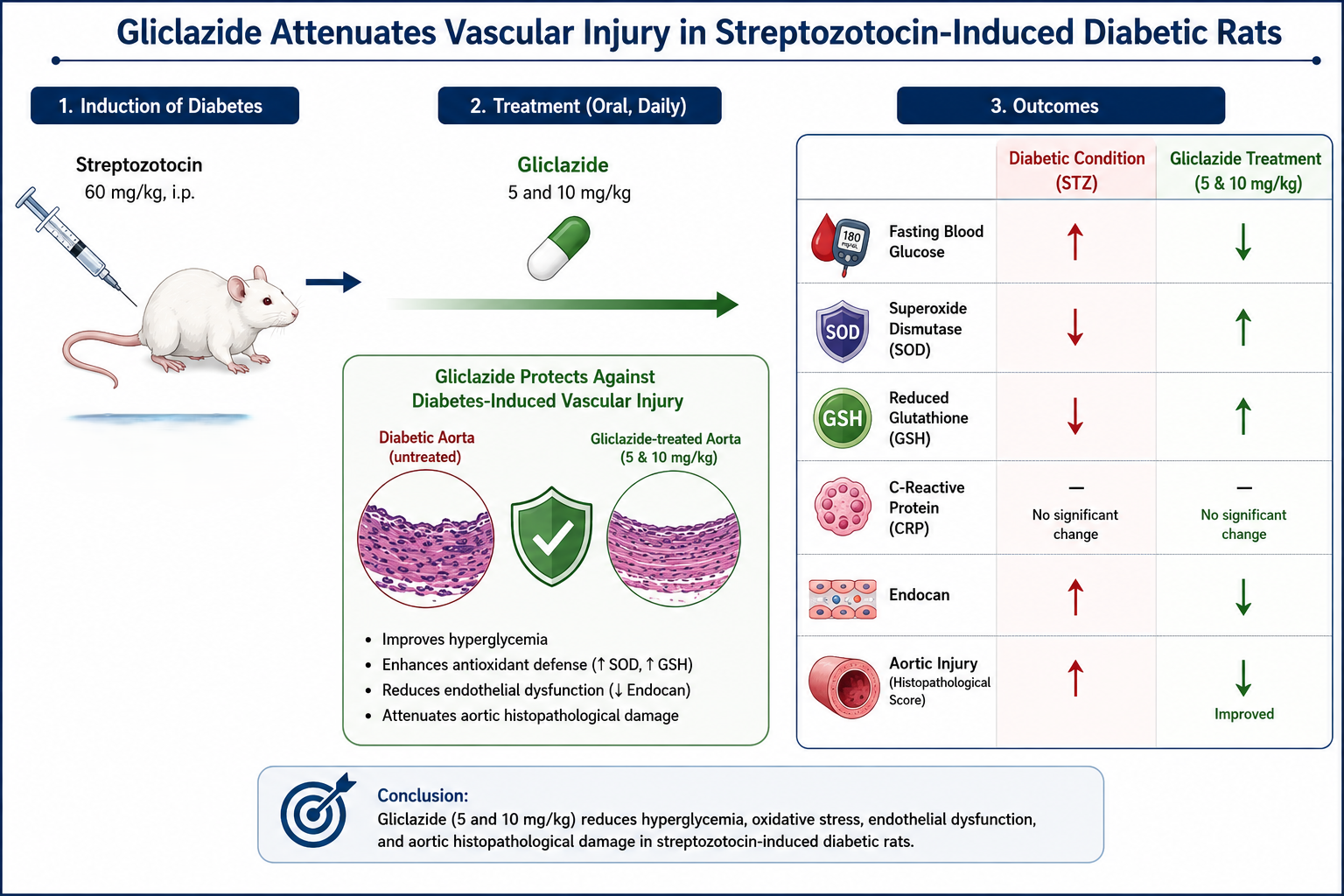
Materials and methods: In this experimental study, 32 male Wistar rats weighing 250-300 g were randomly allocated to four groups: a control group, a diabetic group, and two diabetic groups treated with gliclazide at doses of 5 and 10 mg/kg, respectively. Diabetes was induced by an intraperitoneal injection of streptozotocin (60 mg/kg). Fasting blood glucose, superoxide dismutase (SOD) activity, reduced glutathione (GSH) levels, C-reactive protein (CRP) levels, and serum endocan levels were measured. Aortic tissue was also examined histopathologically.
Results: Diabetes significantly increased serum endocan levels and aortic injury scores while decreasing SOD activity and GSH levels. Gliclazide significantly reduced fasting blood glucose levels and increased SOD activity at both doses. GSH levels increased significantly, while serum endocan levels and aortic injury scores decreased significantly, only in the group receiving gliclazide at 10 mg/kg. Changes in CRP levels were not statistically significant.
Conclusion: Gliclazide, particularly at a dose of 10 mg/kg, was associated with reduced serum endocan levels and less severe aortic histopathological injury, as well as improvements in some oxidative stress indices in diabetic rats. As direct measures of endothelial function were not assessed, these findings do not establish that gliclazide improves endothelial function. Further studies are needed to investigate the underlying mechanisms and determine the relevance of these findings to humans.
Type of Study: Research(Original) |
Subject:
pharmacology
Send email to the article author
| Rights and permissions | |
 |
This work is licensed under a Creative Commons Attribution-NonCommercial 4.0 International License. |

Articles Copyright © The Author(s). Owned by Mazandaran University of Medical Sciences.
Contact Us
Address: Journal Office, Building No. 2, Mazandaran University of Medical Sciences, Moallem Square, Sari.Tel: +98 (011)34484874 Postal code: 48175-866 E-Mail: jmums@mazums.ac.ir Telefax: +98 (011)33262679
