

Volume 36, Issue 264 (11-2026)
J Mazandaran Univ Med Sci 2026, 36(264): 3-13 |
Back to browse issues page



Download citation:
BibTeX | RIS | EndNote | Medlars | ProCite | Reference Manager | RefWorks
Send citation to:


BibTeX | RIS | EndNote | Medlars | ProCite | Reference Manager | RefWorks
Send citation to:
Kashani S, Vatankhah Tarbehbar M, Adibi P, Jarineshin H, Mohammadi M, Mehrdad Z et al . Comparative Effects of Gabapentin and Clonidine on Haemodynamic Responses and Postoperative Pain After Laparoscopic Cholecystectomy: A Randomised, Double-Blind, Placebo-Controlled Trial. , J Mazandaran Univ Med Sci. 2026; 36 (264) :3-13
URL: http://jmums.mazums.ac.ir/article-1-23221-en.html
URL: http://jmums.mazums.ac.ir/article-1-23221-en.html
Saeed Kashani 
 , Majid Vatankhah Tarbehbar , Pourya Adibi * , Hashem Jarineshin , Milad Mohammadi , Zahra Mehrdad , Masoume Mahmudi
Abstract: (17 Views)
Background and purpose: Laparoscopic cholecystectomy is the standard surgical treatment for symptomatic gallstones; however, CO₂ pneumoperitoneum can cause haemodynamic changes. This study aimed to compare the effects of gabapentin and clonidine premedication on intraoperative haemodynamic parameters and postoperative pain.
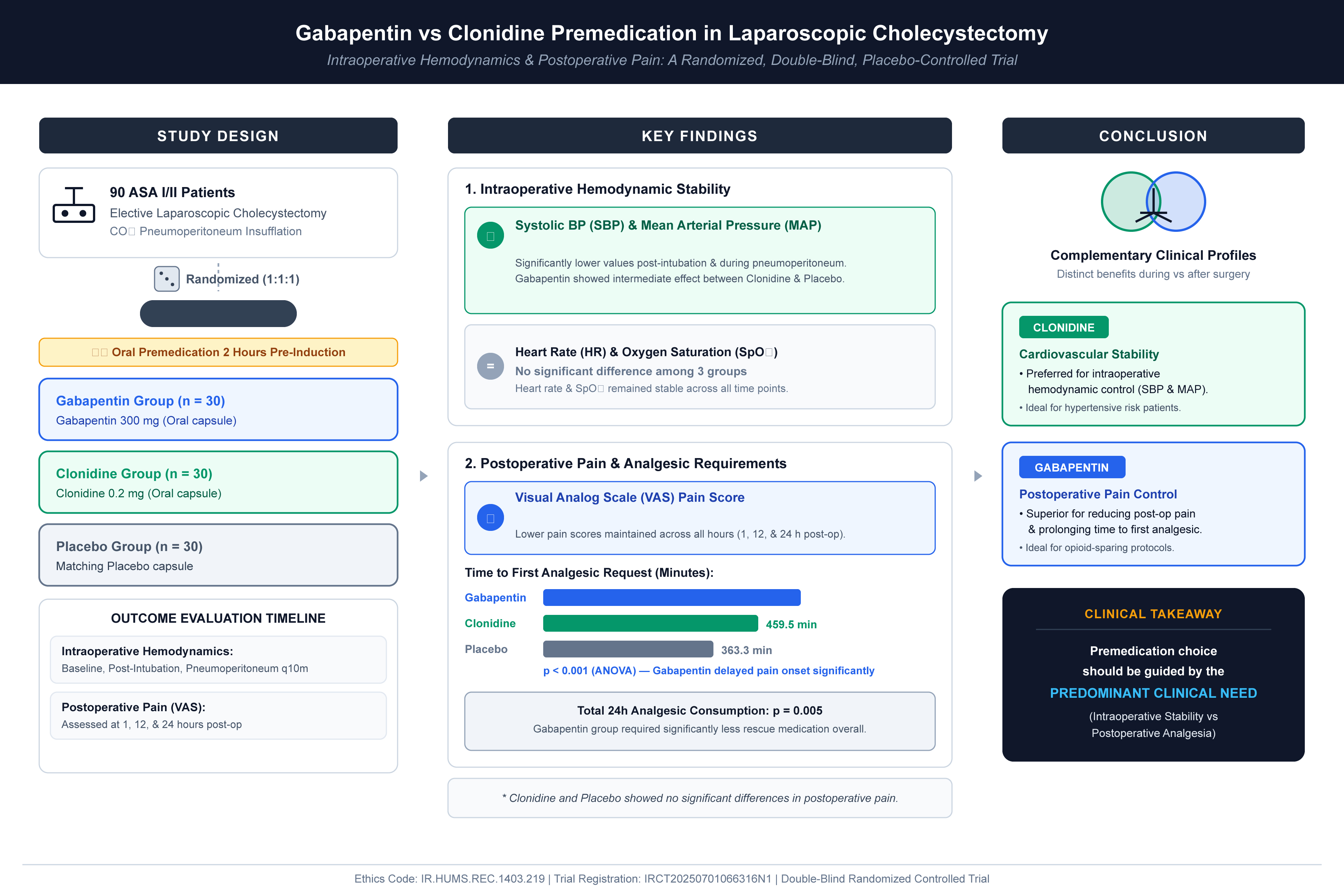
Materials and methods: A randomised, double-blind, placebo-controlled clinical trial was conducted at Shahid Mohammadi Hospital, Bandar Abbas, Iran, between 2024 and 2025. Ninety patients with ASA physical status I or II were randomly allocated in equal numbers to three groups to receive gabapentin 300 mg, clonidine 0.2 mg, or placebo two hours before induction of anaesthesia. Haemodynamic parameters were recorded at predefined time points, and postoperative pain was assessed using the visual analogue scale (VAS) at 1, 12, and 24 hours.
Results: The three groups were comparable in age and sex, although body mass index differed significantly (P = 0.001). Clonidine was associated with greater haemodynamic stability, particularly in systolic blood pressure and mean arterial pressure (MAP) following intubation and during pneumoperitoneum. Systolic blood pressure and MAP were significantly lower in the clonidine group than in the gabapentin and placebo groups across the reported time points. Gabapentin showed an intermediate effect on these parameters. Heart rate and peripheral oxygen saturation (SpO₂) did not differ significantly among the groups at any time point. Regarding postoperative pain, VAS scores at 1, 12, and 24 hours were significantly lower in the gabapentin group than in either the clonidine or placebo group (P < 0.001). The mean time to the first analgesic request was longer in the gabapentin group (549.87 min) than in the clonidine (459.47 min) and placebo (363.33 min) groups. Total analgesic consumption over 24 hours was also significantly lower in the gabapentin group (P = 0.005). No significant differences in postoperative pain outcomes were observed between the clonidine and placebo groups.
Conclusion: Clonidine may offer better intraoperative haemodynamic control, whereas gabapentin appears more effective for postoperative pain management. The choice of premedication should take into account the desired clinical outcome and the individual patient's needs.
Type of Study: Research(Original) |
Subject:
anesthesia
| Rights and permissions | |
 |
This work is licensed under a Creative Commons Attribution-NonCommercial 4.0 International License. |

Articles Copyright © The Author(s). Owned by Mazandaran University of Medical Sciences.
Contact Us
Address: Journal Office, Building No. 2, Mazandaran University of Medical Sciences, Moallem Square, Sari.Tel: +98 (011)34484874 Postal code: 48175-866 E-Mail: jmums@mazums.ac.ir Telefax: +98 (011)33262679
