

Volume 36, Issue 262 (Special Issue 2026)
J Mazandaran Univ Med Sci 2026, 36(262): 281-287 |
Back to browse issues page


Download citation:
BibTeX | RIS | EndNote | Medlars | ProCite | Reference Manager | RefWorks
Send citation to:


BibTeX | RIS | EndNote | Medlars | ProCite | Reference Manager | RefWorks
Send citation to:
Habibisaravi R. AI Disclosure Policies in Scholarly Publishing:
Challenges and Policy Options. , J Mazandaran Univ Med Sci. 2026; 36 (262) :281-287
URL: http://jmums.mazums.ac.ir/article-1-23223-en.html
URL: http://jmums.mazums.ac.ir/article-1-23223-en.html


Abstract: (42 Views)
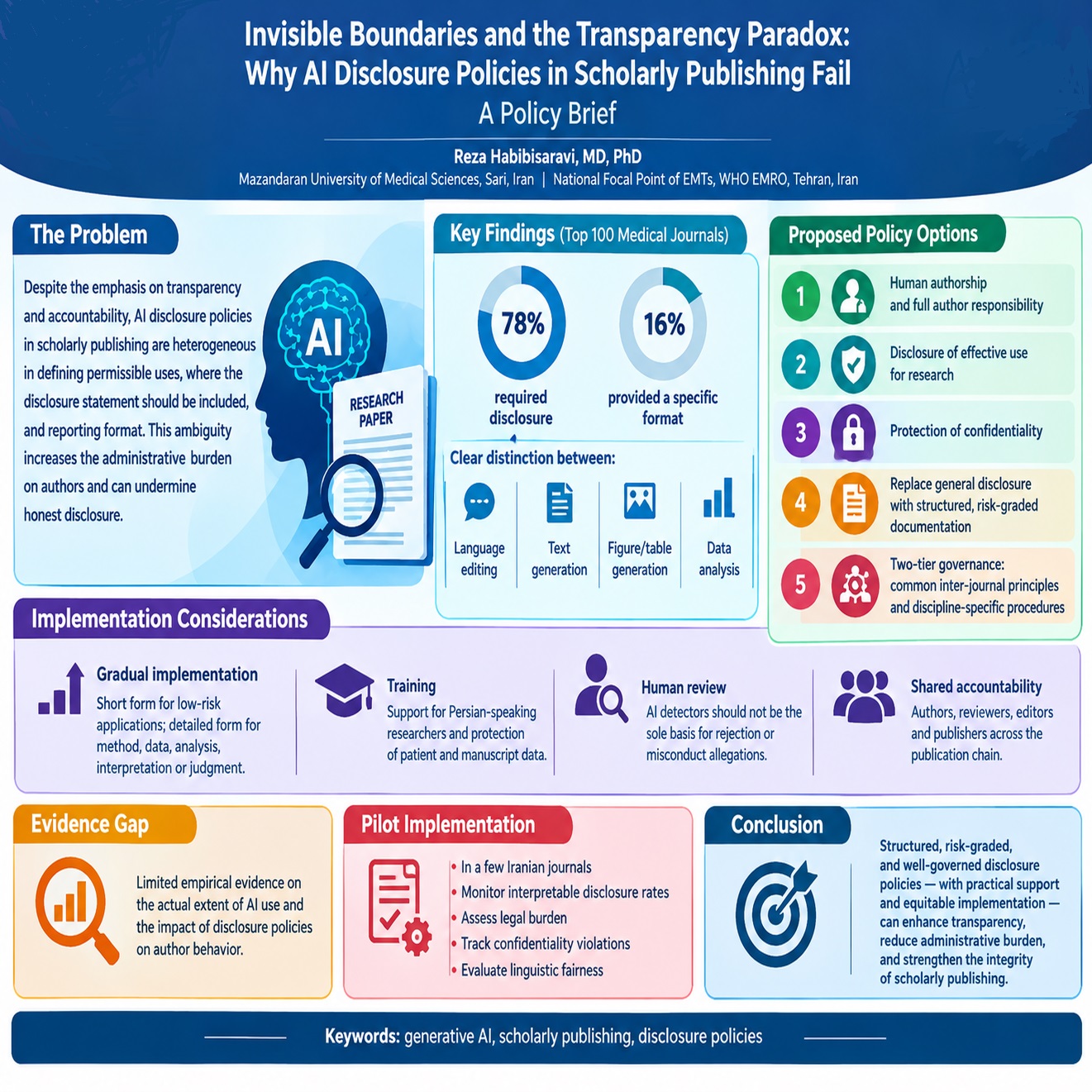
Disclosure policies for the use of generative AI in scientific publishing, despite their emphasis on transparency and accountability, are heterogeneous in terms of what uses are permissible, where disclosure statements should be included in the manuscript, and how such disclosures should be reported. In a survey of the top 100 medical journals, 78% of journals required disclosure, but only 16% provided a specific format for disclosure; there was also a clear distinction between language editing, text generation, figure or table generation, and data analysis. This ambiguity increases the administrative burden on authors and can undermine meaningful disclosure. This policy brief is based on a targeted review of the scientific evidence and normative documents, from which the following policy options are proposed: credible evidence and guidelines emphasize human authorship, full author responsibility, disclosure of AI use in research, and protection of confidentiality. A proposed approach is to replace general disclosure requirements with structured, risk-graded documentation based on two-tier governance: common inter-journal principles and discipline-specific procedures. However, empirical evidence on the actual extent of AI use and the impact of disclosure policies on author behavior remains limited.
Policy implementation should be gradual, with a short form for low-risk applications and a detailed form for applications that affect methods, data, analysis, interpretation, or decision-making. Training, protection of patient and manuscript data, support for Persian-speaking researchers, and human review are essential. AI detectors should not be the sole basis for article rejection or allegations of misconduct, as bias against authors who are not native English speakers has been reported. Accountability for AI use should not be limited to authors; reviewers, editors, and publishers should also be included in the framework of transparency and accountability throughout the publication chain. Pilot implementation in a small number of Iranian journals, with monitoring of disclosure rates, administrative burden, confidentiality violations, and linguistic fairness, is recommended.
Policy implementation should be gradual, with a short form for low-risk applications and a detailed form for applications that affect methods, data, analysis, interpretation, or decision-making. Training, protection of patient and manuscript data, support for Persian-speaking researchers, and human review are essential. AI detectors should not be the sole basis for article rejection or allegations of misconduct, as bias against authors who are not native English speakers has been reported. Accountability for AI use should not be limited to authors; reviewers, editors, and publishers should also be included in the framework of transparency and accountability throughout the publication chain. Pilot implementation in a small number of Iranian journals, with monitoring of disclosure rates, administrative burden, confidentiality violations, and linguistic fairness, is recommended.
Type of Study: Policy Brief |
Subject:
Artificial Intelligence
| Rights and permissions | |
 |
This work is licensed under a Creative Commons Attribution-NonCommercial 4.0 International License. |

Articles Copyright © The Author(s). Owned by Mazandaran University of Medical Sciences.
Contact Us
Address: Journal Office, Building No. 2, Mazandaran University of Medical Sciences, Moallem Square, Sari.Tel: +98 (011)34484874 Postal code: 48175-866 E-Mail: jmums@mazums.ac.ir Telefax: +98 (011)33262679
