

Volume 36, Issue 264 (11-2026)
J Mazandaran Univ Med Sci 2026, 36(264): 52-63 |
Back to browse issues page



Download citation:
BibTeX | RIS | EndNote | Medlars | ProCite | Reference Manager | RefWorks
Send citation to:


BibTeX | RIS | EndNote | Medlars | ProCite | Reference Manager | RefWorks
Send citation to:
Salehi M, Noeparvar N, Papi S, Baghbanian M, HosseinNataj A, Shajari F et al . Evaluation of Oral Health Indicators in Patients with Multiple Sclerosis: A Cross-Sectional Study at a Neurology Centre in Sari, Iran. , J Mazandaran Univ Med Sci. 2026; 36 (264) :52-63
URL: http://jmums.mazums.ac.ir/article-1-23240-en.html
URL: http://jmums.mazums.ac.ir/article-1-23240-en.html
Maedeh Salehi 
 , Nasim Noeparvar , Shahab Papi , Mohammad Baghbanian , Abolfazl HosseinNataj , Faezeh Shajari , Tahereh Molania *
Abstract: (23 Views)
Background and purpose: Multiple sclerosis (MS) is a chronic inflammatory disease of the central nervous system that may impair oral self-care and adversely affect oral health. Previous studies have reported inconsistent findings regarding oral health status and factors associated with it in patients with MS. This study aimed to evaluate oral health indices and examine their associations with demographic characteristics, behavioural factors, and neurological disability in patients with MS.
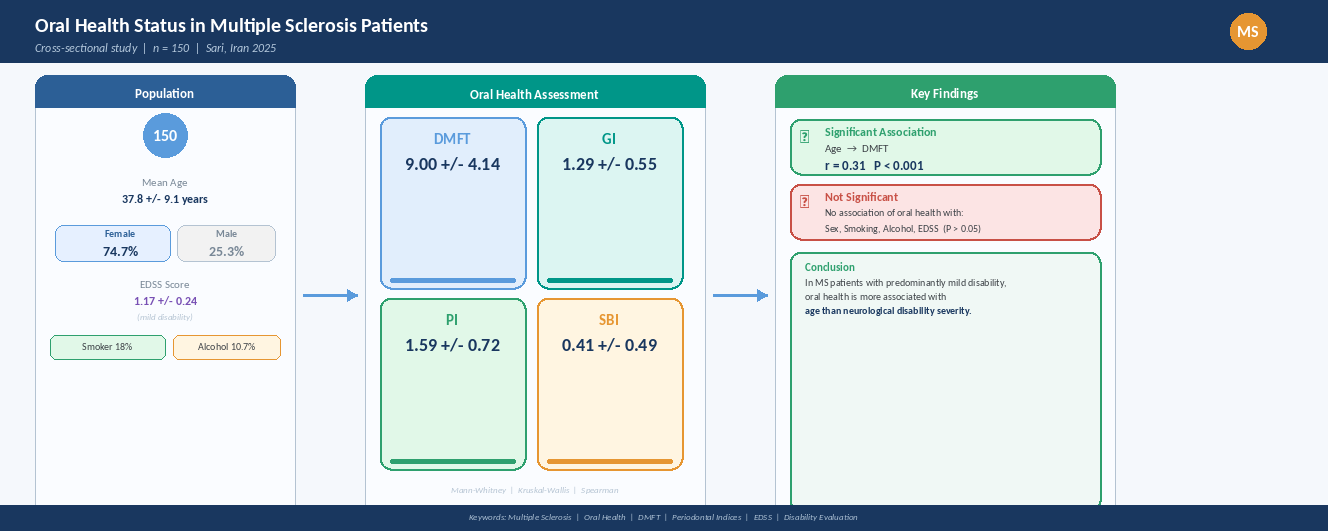
Materials and methods: This descriptive cross-sectional study included 150 patients with confirmed MS who attended a neurology clinic in Sari, Iran, in 2025. Participants were recruited using convenience sampling. Oral health was assessed using the Decayed, Missing, and Filled Teeth (DMFT) index, Gingival Index (GI), Plaque Index (PI), and Sulcus Bleeding Index (SBI). Neurological disability was assessed using the Expanded Disability Status Scale (EDSS). Data were analysed using SPSS version 26. The Mann-Whitney U test and Kruskal-Wallis test were used for group comparisons, and Spearman’s rank correlation coefficient was used to assess correlations.
Results: The mean age of participants was 37.81 ± 9.13 years, and 74.7% were female. The mean DMFT, GI, PI, SBI, and EDSS scores were 9.00 ± 4.14, 1.29 ± 0.55, 1.59 ± 0.72, 0.41 ± 0.49, and 1.17 ± 0.24, respectively. No significant associations were found between oral health indices and sex, smoking, alcohol consumption, or EDSS score (P > 0.05). Age was positively correlated with the DMFT index (P < 0.001).
Conclusion: In this study population, older age was associated with greater cumulative dental caries experience, as reflected by higher DMFT scores, whereas no significant associations were observed between EDSS scores and oral health indices. Given the predominantly mild disability among participants and the cross-sectional design, these findings should be interpreted cautiously.
Type of Study: Research(Original) |
Subject:
Dentistry
Send email to the article author
| Rights and permissions | |
 |
This work is licensed under a Creative Commons Attribution-NonCommercial 4.0 International License. |

Articles Copyright © The Author(s). Owned by Mazandaran University of Medical Sciences.
Contact Us
Address: Journal Office, Building No. 2, Mazandaran University of Medical Sciences, Moallem Square, Sari.Tel: +98 (011)34484874 Postal code: 48175-866 E-Mail: jmums@mazums.ac.ir Telefax: +98 (011)33262679
