

Volume 36, Issue 263 (11-2026)
J Mazandaran Univ Med Sci 2026, 36(263): 330-343 |
Back to browse issues page



Download citation:
BibTeX | RIS | EndNote | Medlars | ProCite | Reference Manager | RefWorks
Send citation to:


BibTeX | RIS | EndNote | Medlars | ProCite | Reference Manager | RefWorks
Send citation to:
Jorbonyan A, Khosrozadeh M, Gharib M, Aliakbari Khoei R. Empowerment of Older Adults in Health Care: A Scoping Review of Antecedents, Mechanisms, and Outcomes. , J Mazandaran Univ Med Sci. 2026; 36 (263) :330-343
URL: http://jmums.mazums.ac.ir/article-1-23282-en.html
URL: http://jmums.mazums.ac.ir/article-1-23282-en.html


Abstract: (10 Views)
Background and purpose: Empowerment plays an important role in promoting the health and improving the quality of life of older adults, although its definition and application remain variable across different contexts. This scoping review aimed to map the existing evidence on empowerment among older adults, with a particular focus on self-management, independence, and health literacy.
Materials and methods: This scoping review was conducted using the framework proposed by Arksey and O’Malley (2005) and following the PRISMA-ScR guidelines. A systematic search was performed in PubMed, Web of Science, Scopus, SID, Magiran, and Google Scholar to identify studies published from 2015 to June 2026. Studies were selected according to predefined inclusion and exclusion criteria, and data were extracted using a standardized form. The findings were synthesized through thematic analysis using a framework comprising contextual factors, attributes and mechanisms, and outcomes.
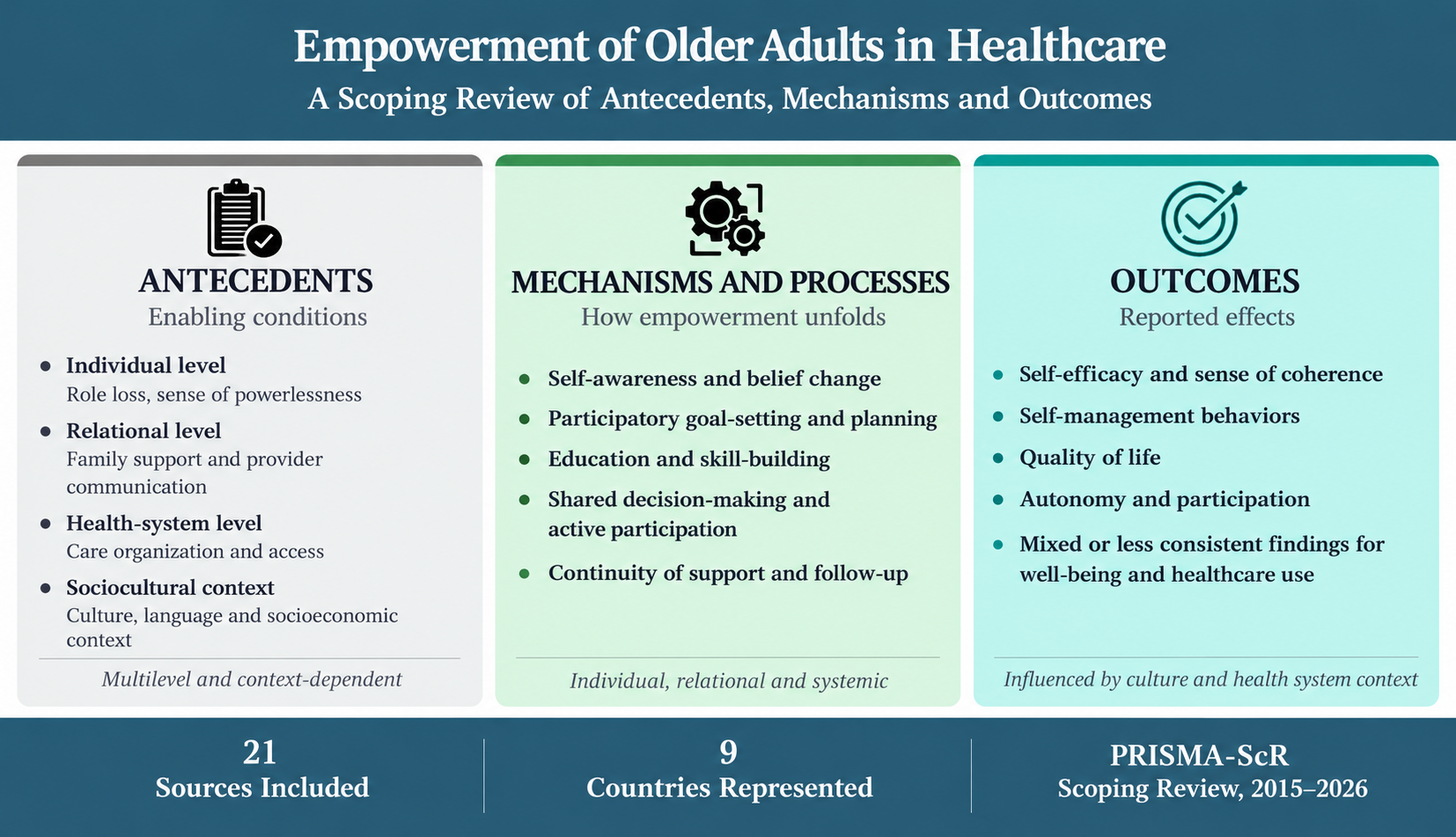
Results: Twenty-one sources representing nine countries were included. Factors contributing to empowerment were identified at the individual, interpersonal, and health system levels. Key attributes included self-awareness, goal setting, and shared decision-making. Reported outcomes included improvements in self-efficacy, sense of coherence, and self-management, whereas findings regarding psychological well-being and healthcare utilization were inconsistent. Cultural contexts and health system characteristics emerged as important factors influencing the outcomes of empowerment interventions.
Conclusion: This scoping review highlighted the lack of a standardized definition and measurement approach for empowerment among older adults. The implementation and effectiveness of empowerment initiatives appear to depend on cultural context, health system structure, and care delivery settings. Future research should focus on the long-term sustainability of outcomes by promoting the active involvement of older adults, adopting interdisciplinary approaches, and using mixed-methods research designs. Achieving this goal requires the integration of person-centred interventions with structural reforms, improved care coordination, and the development of a supportive professional culture within healthcare systems.
Keywords: empowerment, older adults, self-management, autonomy, health literacy, health promotion, scoping review
Type of Study: Review |
Subject:
Geriatrics
| Rights and permissions | |
 |
This work is licensed under a Creative Commons Attribution-NonCommercial 4.0 International License. |

Articles Copyright © The Author(s). Owned by Mazandaran University of Medical Sciences.
Contact Us
Address: Journal Office, Building No. 2, Mazandaran University of Medical Sciences, Moallem Square, Sari.Tel: +98 (011)34484874 Postal code: 48175-866 E-Mail: jmums@mazums.ac.ir Telefax: +98 (011)33262679
