

Volume 36, Issue 264 (11-2026)
J Mazandaran Univ Med Sci 2026, 36(264): 101-110 |
Back to browse issues page



Download citation:
BibTeX | RIS | EndNote | Medlars | ProCite | Reference Manager | RefWorks
Send citation to:


BibTeX | RIS | EndNote | Medlars | ProCite | Reference Manager | RefWorks
Send citation to:
Jafari M H, Mahmoodi G, Yazdani Charati J. Epidemiological Characteristics and Spatial Distribution of Cutaneous Leishmaniasis in Mazandaran Province, Iran, 2018-2024. , J Mazandaran Univ Med Sci. 2026; 36 (264) :101-110
URL: http://jmums.mazums.ac.ir/article-1-23289-en.html
URL: http://jmums.mazums.ac.ir/article-1-23289-en.html


Abstract: (10 Views)
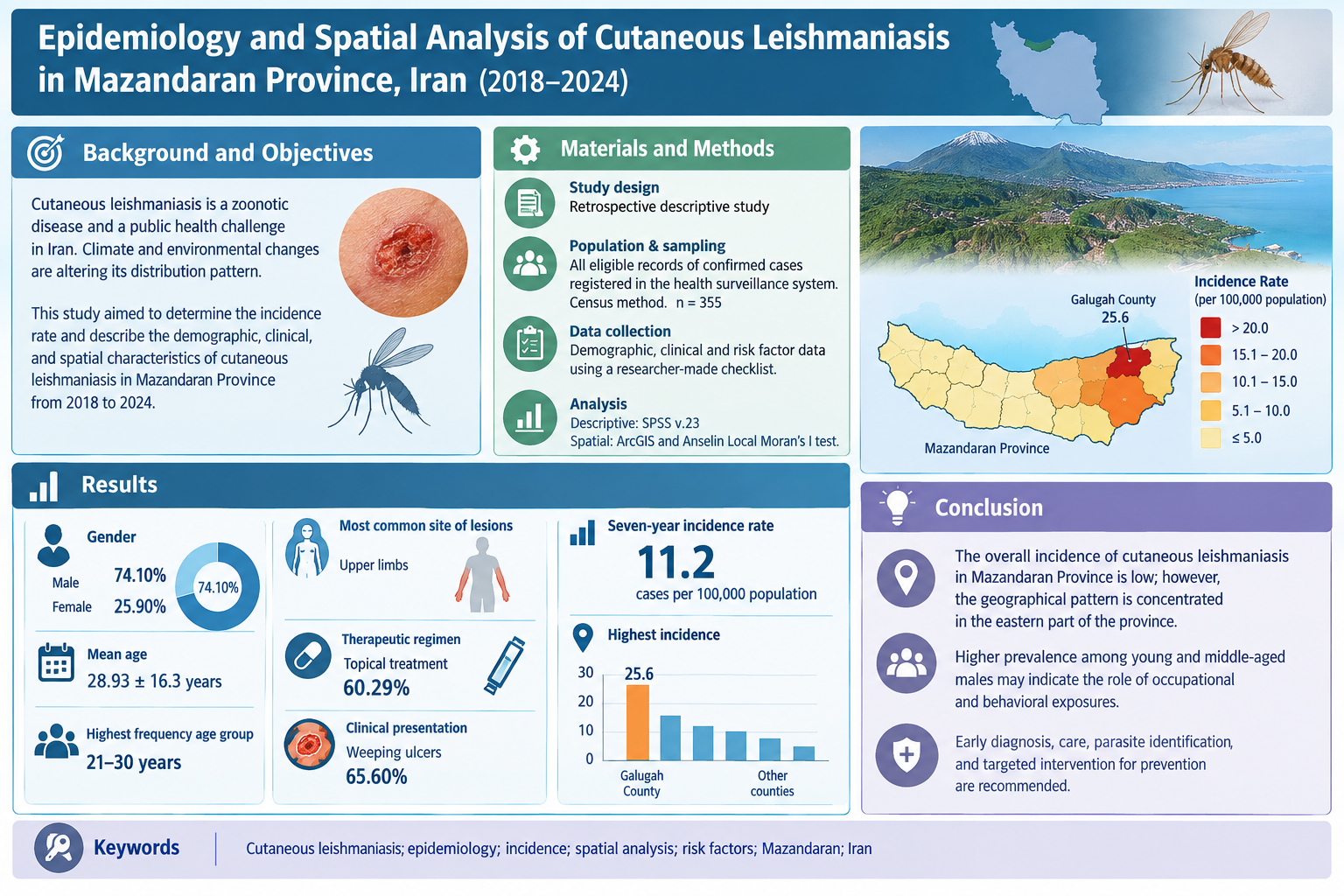
Background and purpose: Cutaneous leishmaniasis is a vector-borne parasitic disease and an important public health concern in Iran. Climate and environmental changes may influence its geographical distribution. This study aimed to determine the incidence rate and describe the demographic, clinical, and spatial characteristics of cutaneous leishmaniasis in Mazandaran Province between 2018 and 2024.
Materials and methods: This retrospective descriptive study included all eligible records of patients with confirmed cutaneous leishmaniasis recorded in the provincial health surveillance system of Mazandaran. A census approach was used, and 355 patient records were included. Demographic and clinical characteristics, as well as potential risk factors, were extracted using a researcher-developed checklist. Descriptive analyses were performed using SPSS version 23, and spatial analyses were conducted using ArcGIS and Anselin's local Moran's I statistic.
Results: Of the 355 patients, 74.10% were male, and the mean age was 36.38 ± 17.93 years. Patients aged 21-30 years accounted for the largest proportion of cases. The upper limbs were the most common site of lesions. The incidence rate was 2.11 cases per 100,000 population in the province during the study period, with the highest rate observed in Galugah (6.25 cases per 100,000 population).The reported incidence rate over the seven-year study period was 2.11 cases per 100,000 population in the province, with the highest incidence rate observed in Galugah (6.25 cases per 100,000 population). Topical treatment was the most commonly used treatment approach (60.29%), and 65.40% of patients presented with ulcerative lesions characterised by exudation.
Conclusion: The reported incidence of cutaneous leishmaniasis in Mazandaran Province was relatively low overall, but cases were geographically concentrated in the eastern part of the province. The higher proportion of cases among males and younger adults may reflect occupational or behavioural exposures, although these factors cannot be established from the descriptive findings alone. Early diagnosis, appropriate clinical management, parasite identification, and geographically targeted preventive interventions may help improve disease control.
Keywords: cutaneous leishmaniasis, epidemiology, incidence, spatial analysis, risk factors, Mazandaran, Iran
Type of Study: Research(Original) |
Subject:
Epidemiology
Send email to the article author
| Rights and permissions | |
 |
This work is licensed under a Creative Commons Attribution-NonCommercial 4.0 International License. |

Articles Copyright © The Author(s). Owned by Mazandaran University of Medical Sciences.
Contact Us
Address: Journal Office, Building No. 2, Mazandaran University of Medical Sciences, Moallem Square, Sari.Tel: +98 (011)34484874 Postal code: 48175-866 E-Mail: jmums@mazums.ac.ir Telefax: +98 (011)33262679
