

Volume 36, Issue 264 (11-2026)
J Mazandaran Univ Med Sci 2026, 36(264): 166-177 |
Back to browse issues page



Download citation:
BibTeX | RIS | EndNote | Medlars | ProCite | Reference Manager | RefWorks
Send citation to:


BibTeX | RIS | EndNote | Medlars | ProCite | Reference Manager | RefWorks
Send citation to:
Khanaghaii M, Hashemi Dezzaki F, Mohammadi Sarab S, Alipour S, Marashi T. Association Between Frailty and Life Satisfaction Among Older Adults Attending Comprehensive Health Service Centres in Sahneh, Iran: A Cross-Sectional Study. , J Mazandaran Univ Med Sci. 2026; 36 (264) :166-177
URL: http://jmums.mazums.ac.ir/article-1-23360-en.html
URL: http://jmums.mazums.ac.ir/article-1-23360-en.html
Mobina Khanaghaii 
 , Fatemeh Hashemi Dezzaki , Soma Mohammadi Sarab , Shahab Alipour , Tayebeh Marashi *
Abstract: (13 Views)
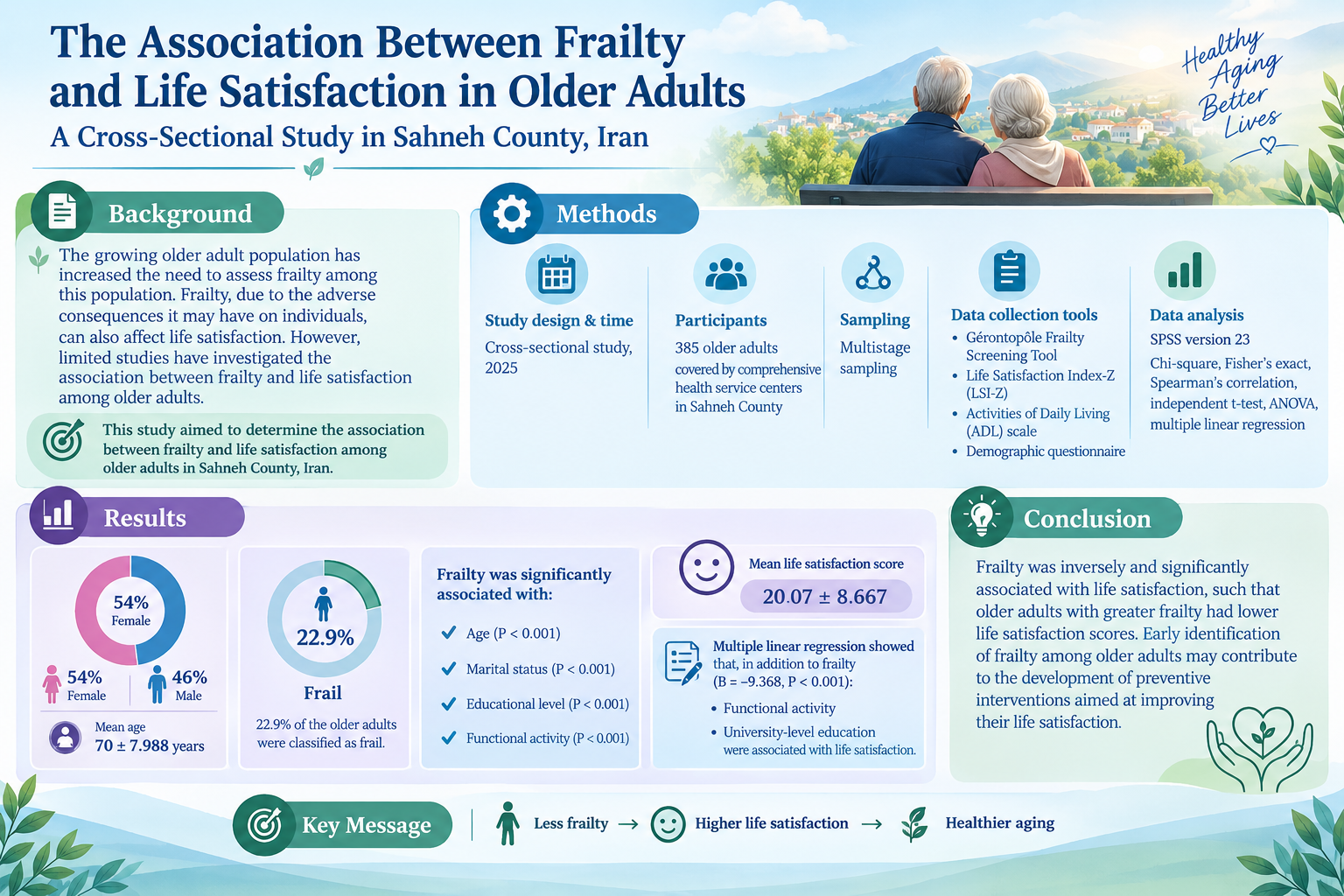
Background and purpose: The growing older adult population has increased the need for frailty assessment. Frailty can have adverse consequences for individuals and may also be associated with lower life satisfaction. However, few studies have examined the relationship between frailty and life satisfaction in older adults. This study aimed to examine the association between frailty and life satisfaction among older adults in Sahneh, Iran.
Materials and methods: This cross-sectional study was conducted in 2025 among 385 older adults receiving services from comprehensive health service centres in Sahneh County. Participants were selected using multistage sampling. Data were collected using the Gérontopôle Frailty Screening Tool, the Life Satisfaction Index-Z (LSI-Z), the Activities of Daily Living (ADL) scale, and a demographic characteristics questionnaire. Data were analysed using SPSS version 23. Statistical analyses included the chi-square test, Fisher’s exact test, independent-samples t test, one-way analysis of variance (ANOVA), Spearman’s correlation coefficient, and multiple linear regression.
Results: Women accounted for 54% of the participants, with men comprising the remainder. The mean age was 70 ± 7.988 years. Overall, 22.9% of participants were classified as frail. Age, marital status, educational level, and functional activity were significantly associated with frailty (P < 0.001). The mean life satisfaction score was 20.07 ± 8.667. Multiple linear regression analysis showed that frailty was significantly associated with lower life satisfaction scores (B = −9.368, P < 0.001). Functional activity and university-level education were also significantly associated with life satisfaction scores.
Conclusion: Frailty was significantly and inversely associated with life satisfaction, with greater frailty associated with lower life satisfaction scores. Early identification of frailty among older adults may help inform preventive interventions to support life satisfaction.
Type of Study: Research(Original) |
Subject:
health
Send email to the article author
| Rights and permissions | |
 |
This work is licensed under a Creative Commons Attribution-NonCommercial 4.0 International License. |

Articles Copyright © The Author(s). Owned by Mazandaran University of Medical Sciences.
Contact Us
Address: Journal Office, Building No. 2, Mazandaran University of Medical Sciences, Moallem Square, Sari.Tel: +98 (011)34484874 Postal code: 48175-866 E-Mail: jmums@mazums.ac.ir Telefax: +98 (011)33262679
