

Volume 36, Issue 263 (11-2026)
J Mazandaran Univ Med Sci 2026, 36(263): 7-19 |
Back to browse issues page



Download citation:
BibTeX | RIS | EndNote | Medlars | ProCite | Reference Manager | RefWorks
Send citation to:


BibTeX | RIS | EndNote | Medlars | ProCite | Reference Manager | RefWorks
Send citation to:
Rahbar M, Rajabi M, Eslamian F, Mobasseri M, Dolatkhah N. Effects of Melissa officinalis Supplementation on Glycaemic Control, Neuropathic Symptoms, and Nerve Function in Patients with Type 2 Diabetes and Moderate Peripheral Neuropathy: A Randomized, Double-Blind, Placebo-Controlled. , J Mazandaran Univ Med Sci. 2026; 36 (263) :7-19
URL: http://jmums.mazums.ac.ir/article-1-22065-en.html
URL: http://jmums.mazums.ac.ir/article-1-22065-en.html


Abstract: (26 Views)
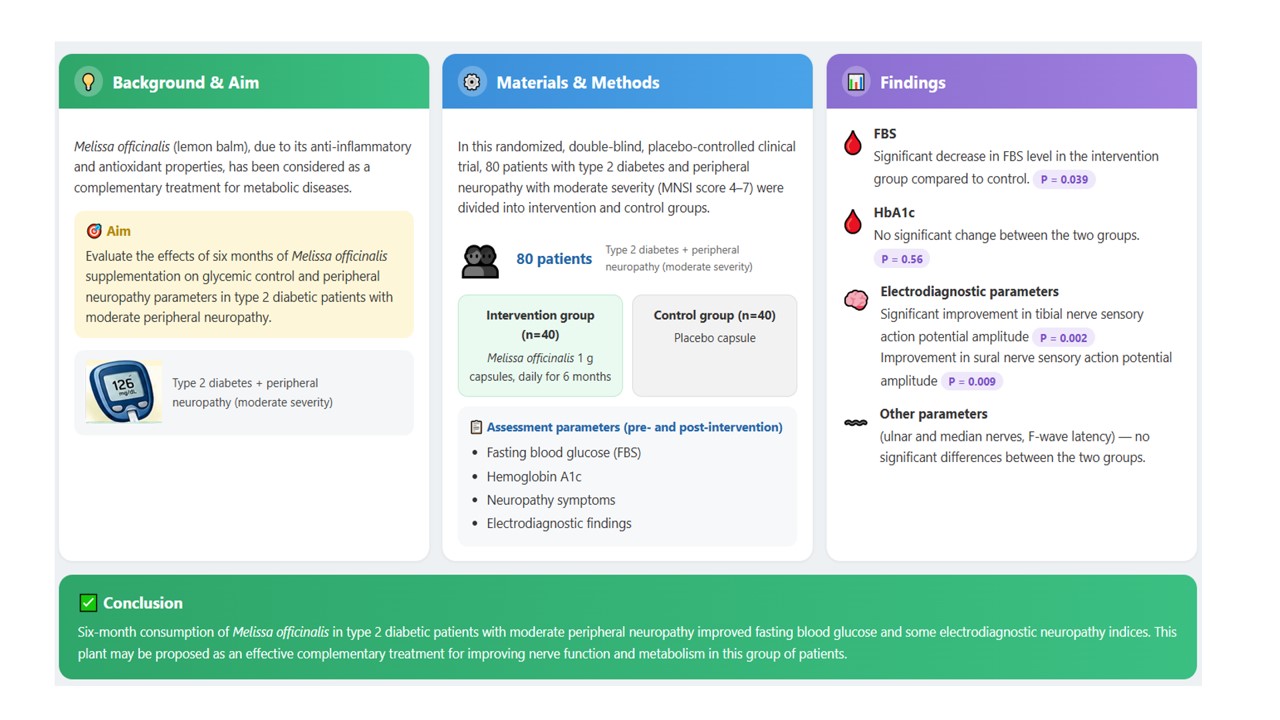
Background and purpose: Melissa officinalis (lemon balm) has been investigated as a potential complementary therapy for metabolic disorders because of its anti-inflammatory and antioxidant properties. This study aimed to evaluate the effects of six months of Melissa officinalis supplementation on glycaemic control and peripheral neuropathy parameters in patients with type 2 diabetes and moderate neuropathy.
Materials and methods: In this randomized, double-blind, placebo-controlled clinical trial, 80 patients with type 2 diabetes and moderate peripheral neuropathy (MNSI score of 4-7) were randomly allocated to receive either Melissa officinalis capsules (1 g daily for six months) or matching placebo capsules. Fasting blood glucose (FBS), glycated haemoglobin (HbA1c), neuropathic symptoms, and electrodiagnostic parameters were assessed at baseline and after the intervention.
Results: Following the intervention, fasting blood glucose levels decreased significantly in the intervention group compared with the placebo group (P = 0.039). However, the between-group difference in HbA1c changes was not statistically significant (P = 0.56). Regarding electrodiagnostic parameters, the intervention group showed significant improvements in tibial nerve and sural nerve potential amplitudes (P = 0.002 and P = 0.009, respectively). No significant between-group differences were observed in the other assessed parameters, including those of the ulnar and median nerves and F-wave latency.
Conclusion: Six months of Melissa officinalis supplementation was associated with improvements in fasting blood glucose and selected electrodiagnostic parameters in patients with type 2 diabetes and moderate peripheral neuropathy. However, the absence of a significant effect on HbA1c and other electrodiagnostic parameters warrants cautious interpretation of these findings. Further studies are needed to establish the potential role of Melissa officinalis as a complementary intervention for diabetic peripheral neuropathy.
Type of Study: Research(Original) |
Subject:
Nutrition
| Rights and permissions | |
 |
This work is licensed under a Creative Commons Attribution-NonCommercial 4.0 International License. |

Articles Copyright © The Author(s). Owned by Mazandaran University of Medical Sciences.
Contact Us
Address: Journal Office, Building No. 2, Mazandaran University of Medical Sciences, Moallem Square, Sari.Tel: +98 (011)34484874 Postal code: 48175-866 E-Mail: jmums@mazums.ac.ir Telefax: +98 (011)33262679
