

Volume 36, Issue 255 (3-2026)
J Mazandaran Univ Med Sci 2026, 36(255): 30-45 |
Back to browse issues page


Download citation:
BibTeX | RIS | EndNote | Medlars | ProCite | Reference Manager | RefWorks
Send citation to:


BibTeX | RIS | EndNote | Medlars | ProCite | Reference Manager | RefWorks
Send citation to:
Malekzadeh R, Khazaee-Pool M, Abedi G, Bagherinezhad Z. Explaining the Components of Academic Social Responsibility in Iran’s Health Higher Education System: A Qualitative Study Based on Stakeholders’ Experiences. J Mazandaran Univ Med Sci 2026; 36 (255) :30-45
URL: http://jmums.mazums.ac.ir/article-1-22138-en.html
URL: http://jmums.mazums.ac.ir/article-1-22138-en.html


Abstract: (82 Views)
Background and purpose: Universities, as knowledge-generating institutions, play a key role in improving quality of life, promoting social justice, and responding to societal needs. In this context, the social responsibility of medical universities is recognized as a fundamental component for advancing public health and reducing health inequalities. Considering the necessity of contextualizing this concept within the country’s health higher education system, this qualitative study aimed to identify and elucidate the components of university social responsibility in Iran from stakeholders’ perspectives.
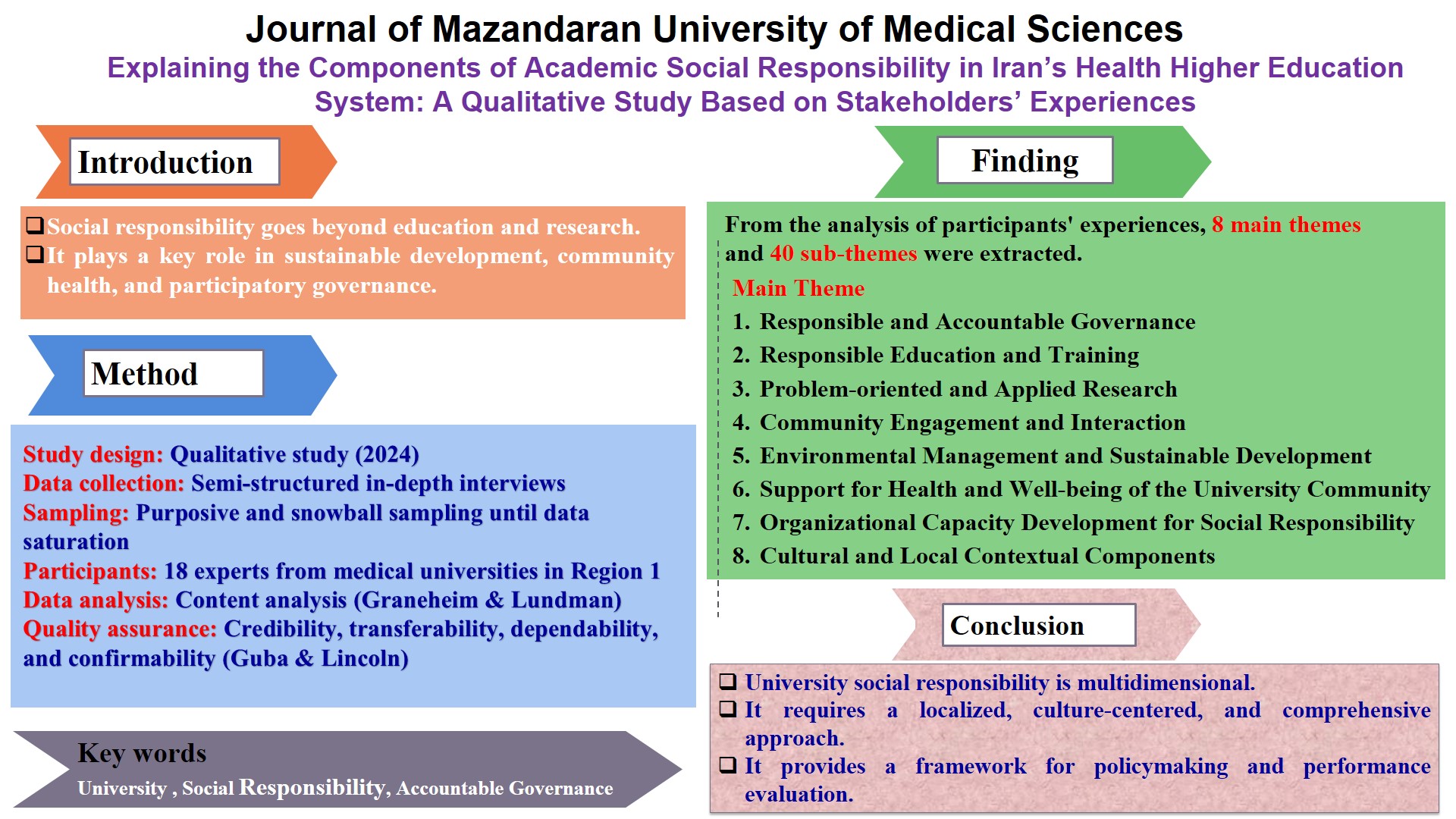
Materials and methods: This qualitative study was conducted in 2024 through semi-structured interviews with 18 experts from Planning Region One. Participants were recruited through purposive sampling followed by snowball sampling until data saturation was achieved. Interviews were transcribed verbatim, and qualitative content analysis was used to extract meaning units, generate codes, organize categories, and develop themes based on similarities and patterns.
Results: Analysis identified eight main themes and 40 subthemes in the domain of university social responsibility. These themes included responsible and accountable governance, responsible education, problem-oriented and applied research, community engagement and interaction, environmental management and sustainable development, support for health and well-being, development of organizational capacity for social responsibility, and culturally grounded and context-specific components. Collectively, these themes illustrate the multidimensional nature of academic social responsibility.
Conclusion: The social responsibility of medical universities extends beyond theoretical commitments and requires participatory governance, problem-oriented education, applied research, and a deep understanding of the country’s cultural and social context. These findings can provide a basis for developing models and informing national policies to strengthen the role of universities in Iran’s health system.
Materials and methods: This qualitative study was conducted in 2024 through semi-structured interviews with 18 experts from Planning Region One. Participants were recruited through purposive sampling followed by snowball sampling until data saturation was achieved. Interviews were transcribed verbatim, and qualitative content analysis was used to extract meaning units, generate codes, organize categories, and develop themes based on similarities and patterns.
Results: Analysis identified eight main themes and 40 subthemes in the domain of university social responsibility. These themes included responsible and accountable governance, responsible education, problem-oriented and applied research, community engagement and interaction, environmental management and sustainable development, support for health and well-being, development of organizational capacity for social responsibility, and culturally grounded and context-specific components. Collectively, these themes illustrate the multidimensional nature of academic social responsibility.
Conclusion: The social responsibility of medical universities extends beyond theoretical commitments and requires participatory governance, problem-oriented education, applied research, and a deep understanding of the country’s cultural and social context. These findings can provide a basis for developing models and informing national policies to strengthen the role of universities in Iran’s health system.
Type of Study: Qualitative Research |
Subject:
Health Services Management
Send email to the article author
| Rights and permissions | |
 |
This work is licensed under a Creative Commons Attribution-NonCommercial 4.0 International License. |

Articles Copyright © The Author(s). Owned by Mazandaran University of Medical Sciences.
Contact Us
Address: Journal Office, Building No. 2, Mazandaran University of Medical Sciences, Moallem Square, Sari.Tel: +98 (011)34484874 Postal code: 48175-866 E-Mail: jmums@mazums.ac.ir Telefax: +98 (011)33262679
