

Volume 36, Issue 262 (Special Issue 2026)
J Mazandaran Univ Med Sci 2026, 36(262): 187-198 |
Back to browse issues page



Download citation:
BibTeX | RIS | EndNote | Medlars | ProCite | Reference Manager | RefWorks
Send citation to:


BibTeX | RIS | EndNote | Medlars | ProCite | Reference Manager | RefWorks
Send citation to:
Salehi M, Tavahodi N, Babayani J, Sohrabivafa F, Hossein Nattaj A. The Prevalence of Orofacial Pain and Its Associated Factors among Dental Students: A Cross-Sectional Study. , J Mazandaran Univ Med Sci. 2026; 36 (262) :187-198
URL: http://jmums.mazums.ac.ir/article-1-22694-en.html
URL: http://jmums.mazums.ac.ir/article-1-22694-en.html
Maedeh Salehi 
 , Narges Tavahodi * , Jeiran Babayani , Fereshteh Sohrabivafa , Abolfazl Hossein Nattaj
Abstract: (35 Views)
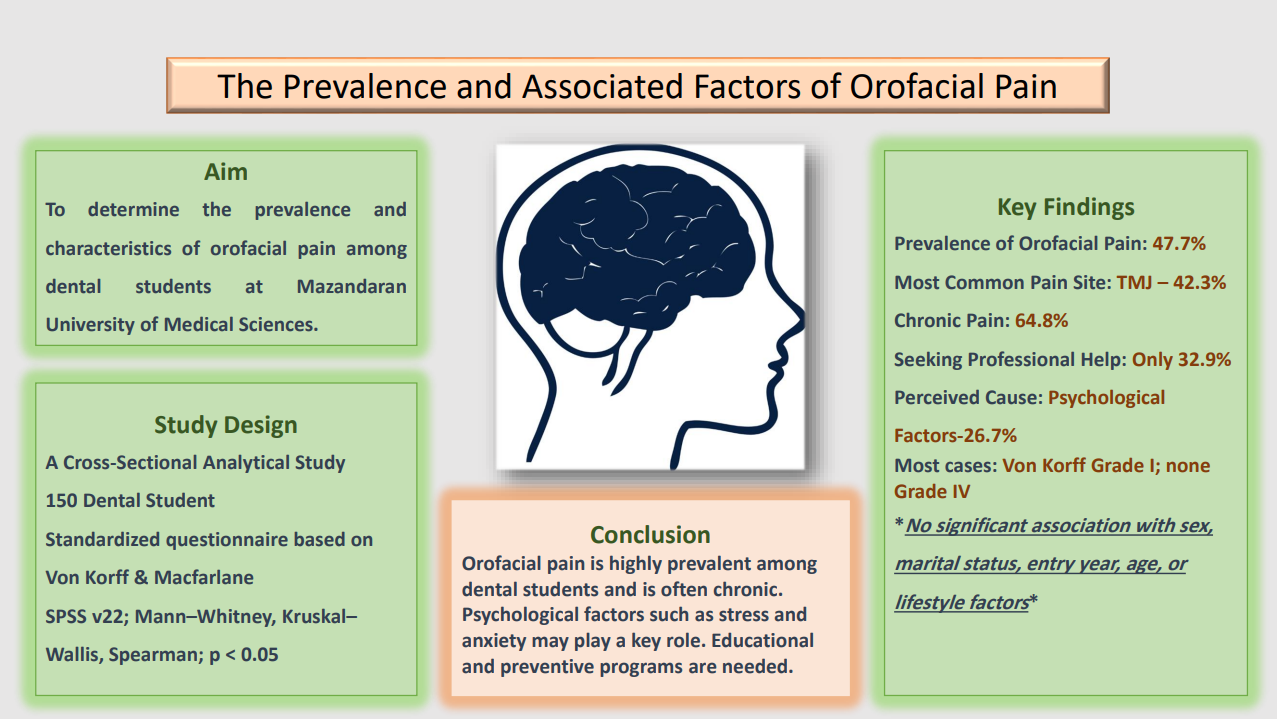
Background and purpose: Orofacial pain is a common problem among young people and may adversely affect academic performance and quality of life. This study aimed to determine the prevalence and characteristics of orofacial pain among dental students at Mazandaran University of Medical Sciences.
Materials and methods: This descriptive-analytical study was conducted in 2025 among 150 dental students who enrolled between 2019 and 2023. Data were collected using a standardised questionnaire based on the Von Korff and Macfarlane instruments. After written informed consent was obtained, the data were analysed using SPSS version 22. The Kruskal-Wallis and Mann-Whitney tests were used for statistical analysis, with P < 0.05 considered statistically significant. Spearman’s correlation coefficient was used to assess the association between age and pain and disability scores.
Results: Orofacial pain was reported by 47.7% of the students, and the temporomandibular joint was the most frequently reported site of pain (42.3%). In 64.8% of cases, the pain was chronic. The mean current pain intensity score was 2.16, while the mean score for the worst pain experienced in the preceding six months was 4.13. No statistically significant associations were found between pain intensity or pain-related disability and demographic or lifestyle variables.
Conclusion: The relatively high prevalence of orofacial pain among dental students highlights the importance of addressing this issue through educational programmes. Although no significant associations were found between the demographic or lifestyle variables examined and pain intensity or pain-related disability, psychological factors were the most frequently perceived cause of pain (26.7%). This finding suggests that stress, anxiety and other psychological factors may be relevant to the experience of orofacial pain; however, further investigation is needed to establish their role. Further studies using standardised assessment tools are warranted to investigate these
Keywords: cross-sectional studies, dental students, orofacial pain, prevalence, temporomandibular joint disorders
Type of Study: Brief Report |
Subject:
Dentistry
| Rights and permissions | |
 |
This work is licensed under a Creative Commons Attribution-NonCommercial 4.0 International License. |

Articles Copyright © The Author(s). Owned by Mazandaran University of Medical Sciences.
Contact Us
Address: Journal Office, Building No. 2, Mazandaran University of Medical Sciences, Moallem Square, Sari.Tel: +98 (011)34484874 Postal code: 48175-866 E-Mail: jmums@mazums.ac.ir Telefax: +98 (011)33262679
