

Volume 36, Issue 259 (8-2026)
J Mazandaran Univ Med Sci 2026, 36(259): 165-171 |
Back to browse issues page



Download citation:
BibTeX | RIS | EndNote | Medlars | ProCite | Reference Manager | RefWorks
Send citation to:


BibTeX | RIS | EndNote | Medlars | ProCite | Reference Manager | RefWorks
Send citation to:
Mojtahedzadeh K, Shirzad A, Sayyadi F, Yazdanfar F, Sorkhi H, Seyedmajidi S. Oral Health Status Among Children with Chronic Kidney Disease: A Cross-Sectional Study at Amirkola Children's Hospital, Babol, Iran. J Mazandaran Univ Med Sci 2026; 36 (259) :165-171
URL: http://jmums.mazums.ac.ir/article-1-22739-en.html
URL: http://jmums.mazums.ac.ir/article-1-22739-en.html
Kowsar Mojtahedzadeh 
 , Atena Shirzad , Fatemeh Sayyadi , Fatemeh Yazdanfar , Hadi Sorkhi , Seyedali Seyedmajidi
, Atena Shirzad , Fatemeh Sayyadi , Fatemeh Yazdanfar , Hadi Sorkhi , Seyedali Seyedmajidi
Abstract: (26 Views)
Background and purpose: Chronic kidney disease (CKD) induces metabolic disturbances and changes in salivary composition that predispose patients to a wide range of oral manifestations. In children, these complications are particularly important due to the vulnerability of growth and developmental processes. Given the limited and sometimes inconsistent evidence from previous studies, this study aimed to comprehensively evaluate the oral health status of children with CKD.
Materials and methods: This descriptive-analytical cross-sectional study was conducted between 2024 and 2025 among 71 children aged 4-17 years with CKD who were referred to the nephrology department of Amirkola Children’s Hospital, Babol, Iran. Demographic characteristics, disease stage, and oral examination findings were recorded. Oral health parameters included xerostomia, taste alteration, halitosis, gingival inflammation index, plaque index, developmental defects of enamel, and dental caries indices (DMF/dmft indices). Data were analysed using SPSS version 26.
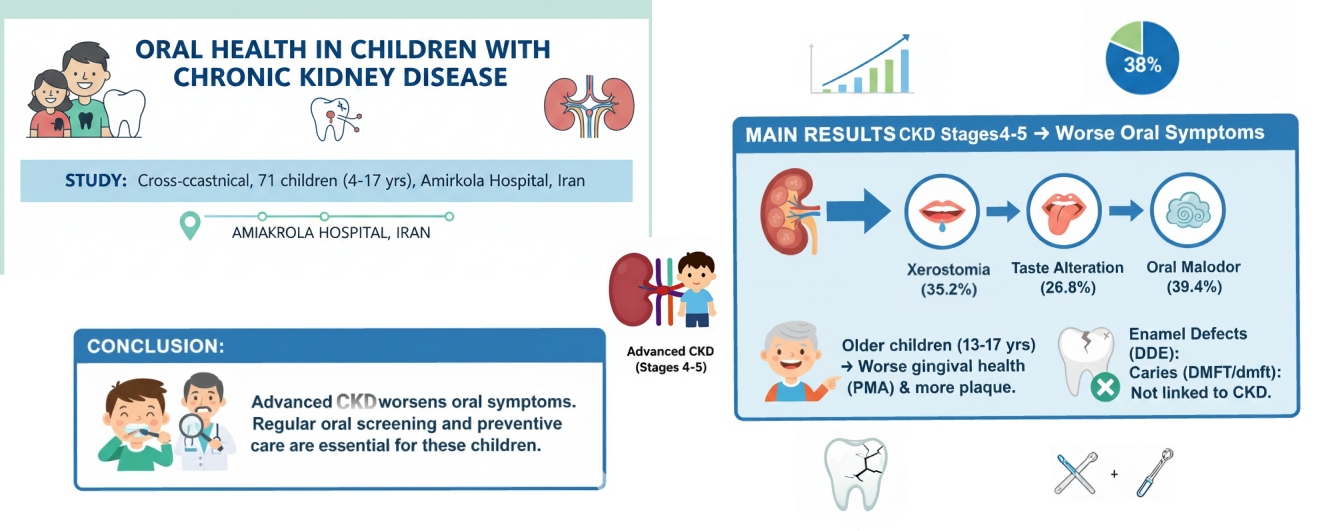
Results: The mean age of participants was 11.90 ± 3.35 years, with 64.8% boys and 35.2% girls. The prevalence of xerostomia, taste alteration, and halitosis was 35.2%, 26.8%, and 39.4%, respectively, and all were significantly higher in patients with advanced CKD stages (stages 4-5) (P< 0.001, P = 0.013, and P< 0.001, respectively). Developmental defects of enamel were observed in 38% of children, with no significant associations with age, sex, or disease stage. The PMA index was significantly higher in the 13-17-year age group (P= 0.016), but showed no significant association with sex or disease stage (P> 0.05). Plaque index scores were significantly higher among boys (P= 0.028) and adolescents aged 13-17 years (P= 0.003). The mean combined caries index was 3.45 ± 5.01, with no significant correlation with age, sex, or CKD stage.
Conclusion: CKD progression was associated with an increased prevalence of functional oral manifestations, including xerostomia, taste alteration, and halitosis, whereas structural dental indices showed no significant association with disease severity. These findings highlight the importance of regular oral health assessments and preventive dental care in children with CKD.
Materials and methods: This descriptive-analytical cross-sectional study was conducted between 2024 and 2025 among 71 children aged 4-17 years with CKD who were referred to the nephrology department of Amirkola Children’s Hospital, Babol, Iran. Demographic characteristics, disease stage, and oral examination findings were recorded. Oral health parameters included xerostomia, taste alteration, halitosis, gingival inflammation index, plaque index, developmental defects of enamel, and dental caries indices (DMF/dmft indices). Data were analysed using SPSS version 26.
Results: The mean age of participants was 11.90 ± 3.35 years, with 64.8% boys and 35.2% girls. The prevalence of xerostomia, taste alteration, and halitosis was 35.2%, 26.8%, and 39.4%, respectively, and all were significantly higher in patients with advanced CKD stages (stages 4-5) (P< 0.001, P = 0.013, and P< 0.001, respectively). Developmental defects of enamel were observed in 38% of children, with no significant associations with age, sex, or disease stage. The PMA index was significantly higher in the 13-17-year age group (P= 0.016), but showed no significant association with sex or disease stage (P> 0.05). Plaque index scores were significantly higher among boys (P= 0.028) and adolescents aged 13-17 years (P= 0.003). The mean combined caries index was 3.45 ± 5.01, with no significant correlation with age, sex, or CKD stage.
Conclusion: CKD progression was associated with an increased prevalence of functional oral manifestations, including xerostomia, taste alteration, and halitosis, whereas structural dental indices showed no significant association with disease severity. These findings highlight the importance of regular oral health assessments and preventive dental care in children with CKD.
Keywords: chronic kidney disease, oral health, xerostomia, DMF index, developmental defects of enamel
Type of Study: Brief Report |
Subject:
Dentistry
Send email to the article author
| Rights and permissions | |
 |
This work is licensed under a Creative Commons Attribution-NonCommercial 4.0 International License. |

Articles Copyright © The Author(s). Owned by Mazandaran University of Medical Sciences.
Contact Us
Address: Journal Office, Building No. 2, Mazandaran University of Medical Sciences, Moallem Square, Sari.Tel: +98 (011)34484874 Postal code: 48175-866 E-Mail: jmums@mazums.ac.ir Telefax: +98 (011)33262679
