

Volume 36, Issue 258 (7-2026)
J Mazandaran Univ Med Sci 2026, 36(258): 159-170 |
Back to browse issues page



Download citation:
BibTeX | RIS | EndNote | Medlars | ProCite | Reference Manager | RefWorks
Send citation to:


BibTeX | RIS | EndNote | Medlars | ProCite | Reference Manager | RefWorks
Send citation to:
Aghaei Amirkhizi N, Asnaashari S, Soltanmohammadi F, Javadzadeh Y. Role of Exosomes in Multiple Sclerosis. J Mazandaran Univ Med Sci 2026; 36 (258) :159-170
URL: http://jmums.mazums.ac.ir/article-1-22822-en.html
URL: http://jmums.mazums.ac.ir/article-1-22822-en.html


Abstract: (21 Views)
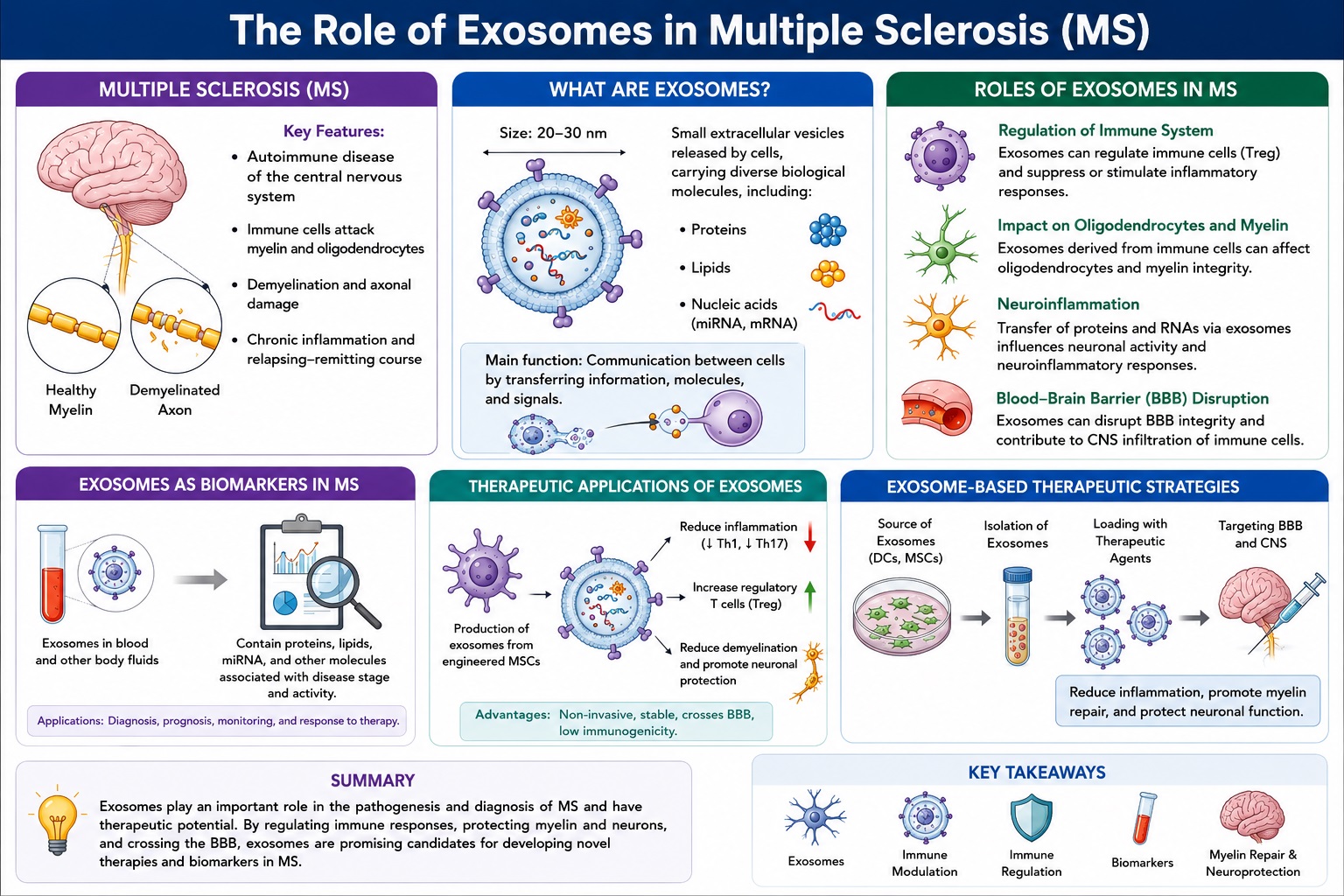
Multiple sclerosis (MS) is an autoimmune disease of the central nervous system (CNS) in which autoreactive immune cells recognize myelin antigens, leading to demyelination and axonal damage. Pro-inflammatory CD4+ T cells reactive to myelin peptides primarily target myelin and oligodendrocytes. Under normal physiological conditions, regulatory CD4+ T (Treg) cells maintain immune homeostasis by suppressing the detrimental effects of inflammatory T cells. However, the number and/or function of Treg cells are reduced in patients with MS, although the underlying mechanisms remain unclear. Many aspects of MS pathogenesis, particularly the mechanisms responsible for the initiation of immune dysregulation, are still poorly understood. For instance, the mechanisms by which the peripheral immune system develops autoreactivity against CNS components remain unknown. This review highlights the emerging role of circulating exosomes in MS, with particular emphasis on their potential involvement in impairing Treg-cell differentiation and function. According to recent findings, exosomes are endosome-derived extracellular vesicles measuring 30-200 nm in diameter that carry specific proteins, lipids, and RNA molecules. They are secreted by a wide variety of cell types and mediate intercellular communication by transferring their molecular cargo to recipient cells. Their ability to interact with nearby and distant cells suggests that they play an important role in signalling between cells within the CNS and the peripheral immune system. In addition to forming myelin sheaths around axons, oligodendrocytes preserve axonal integrity through trophic support mechanisms that are not yet fully understood. Oligodendrocyte-derived exosomes have been shown to promote the differentiation of oligodendrocyte precursor cells into myelin-producing cells, thereby enhancing remyelination following injury. Furthermore, because exosomes are biocompatible and capable of crossing the blood-brain barrier, they represent promising therapeutic vehicles. A better understanding of exosome-dependent pathways in MS may provide new insights into disease pathophysiology and facilitate the development of novel diagnostic and therapeutic strategies. Moreover, exosomes and their molecular cargo have considerable potential as biomarkers for MS.
Type of Study: Review |
Subject:
Nano technology
Send email to the article author
| Rights and permissions | |
 |
This work is licensed under a Creative Commons Attribution-NonCommercial 4.0 International License. |

Articles Copyright © The Author(s). Owned by Mazandaran University of Medical Sciences.
Contact Us
Address: Journal Office, Building No. 2, Mazandaran University of Medical Sciences, Moallem Square, Sari.Tel: +98 (011)34484874 Postal code: 48175-866 E-Mail: jmums@mazums.ac.ir Telefax: +98 (011)33262679
